
Image Credit: www.instagram.com/vibhawarid
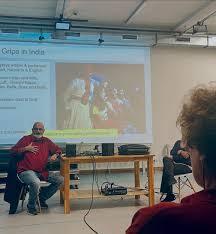
GRIPS Theatre India has completed 40 years of work in children’s theatre, reinforcing a philosophy that places curiosity, questioning and social awareness at the centre of storytelling for young audiences. Founded in Pune by veteran actor Mohan Agashe, the company emerged under the influence of the socially engaged children’s theatre movement pioneered in Berlin by German playwright Volker Ludwig.
Ludwig, who recently visited Pune to interact with theatre practitioners, has played a key role in shaping the ideological foundation of the GRIPS movement, which sees theatre as a tool for civic awareness rather than passive entertainment.
Roots in Berlin, Growth in India
GRIPS Theatre was founded in Berlin in 1969, at a time when children’s theatre was largely dominated by fairy tales and festive spectacles. The German movement consciously departed from that tradition, choosing instead to reflect the lived realities of children through direct, socially grounded narratives.
This approach found resonance in India when Agashe adapted the philosophy to local conditions, positioning theatre as a means of nurturing awareness, empathy and independent thinking among children. Over the years, GRIPS Theatre India developed its own identity while remaining anchored in the movement’s core principles.
Challenging Norms Through Children’s Theatre
From its early years, the GRIPS approach attracted debate, particularly in Germany, where its encouragement of questioning authority was seen as controversial. Over time, however, the movement gained wider acceptance, driven by sustained engagement rather than a dilution of its ideas.
GRIPS productions treat everyday experiences—family conflict, loneliness, school life and social pressure—as legitimate subjects for children’s theatre. The underlying belief is that these themes are inseparable from broader social and political realities and must be addressed openly with young audiences.
Engaging Contemporary Social Issues
Over the decades, GRIPS Theatre India has addressed issues such as bullying, migration, fractured families and identity, reflecting the changing social landscape faced by children. Productions are informed by research and psychological insights, particularly as young people increasingly navigate emotional stress and isolation in a digitally connected world.
A significant section of the audience comes from migrant and diverse social backgrounds, ensuring that the narratives remain grounded in everyday realities rather than abstract ideas.
Building Multi-Generational Audiences
One of the most enduring outcomes of the GRIPS philosophy has been the creation of multi-generational audiences. The theatre now caters to children from early childhood through adolescence, with its influence extending across decades. Many early viewers have continued their association with GRIPS by introducing the plays to subsequent generations within their families.
A New Phase for GRIPS Theatre India
As it enters its fifth decade, GRIPS Theatre India is moving beyond adaptations of German texts. Under the leadership of Shrirang Godbole, the focus is shifting towards original writing, production and design rooted firmly in Indian socio-political realities, while continuing to draw inspiration from the GRIPS ideology.
This evolution reflects the maturity of the movement in India, where it now functions not as an extension of a German institution but as an independent cultural force shaped by local contexts.
A Living India–Germany Cultural Partnership
Four decades on, GRIPS Theatre India stands as a rare example of sustained India–Germany people-to-people engagement in the arts. What began as a cross-cultural influence has grown into a movement in its own right—committed to nurturing young citizens who are encouraged to think critically, question confidently and engage actively with society.