Photo Credit: MEA India
Negotiations for a long-awaited free trade agreement between India and the European Union are entering a decisive phase, European Commission President Ursula von der Leyen said on Tuesday, signalling that both sides are close to clinching what could become one of the largest trade deals ever concluded.
Addressing global leaders at the World Economic Forum (WEF) in Davos, von der Leyen said the EU and India are “on the cusp of a historic trade agreement” that could fundamentally reshape global trade flows and supply chains.
“There is still work to do. But we are on the cusp of a historic trade agreement. Some call it the mother of all deals. One that would create a market of two billion people, accounting for almost a quarter of global GDP,” she said during her speech.
A Deal of Unprecedented Scale
Von der Leyen described the prospective agreement as a cornerstone of Europe’s broader push to strengthen global partnerships and reduce economic vulnerabilities.
Framing the negotiations within the EU’s evolving trade philosophy, she said Europe was committed to “fair trade over tariffs, partnership over isolation, sustainability over exploitation,” and to diversifying supply chains by deepening engagement with major growth economies.
“And right after Davos, the next weekend, I will travel to India. There is still work to do, but we are on the cusp of a historic trade agreement,” she added.
According to the Commission President, the agreement would give European companies early-mover advantages in one of the world’s fastest-growing markets while anchoring India more firmly into global production networks.
India at the Centre of Europe’s Growth Strategy
Von der Leyen placed India and the wider Indo-Pacific region at the heart of Europe’s future economic vision, calling the region one of the “economic powerhouses of this century.”
“Europe wants to do business with the growth centres of today and the economic powerhouses of this century, from Latin America to the Indo-Pacific and far beyond,” she said.
She added: “Europe will always choose the world, and the world is ready to choose Europe.”
The remarks represent the strongest public indication yet that Brussels and New Delhi are aiming to conclude talks that have stretched over nearly two decades.
Why the Agreement Matters
If finalised, the India–EU trade pact would rank among the most ambitious global trade agreements, covering not only tariffs but also services, investment, digital trade, sustainability standards and regulatory cooperation.
For the EU, India is increasingly central to its strategy of reducing reliance on limited supplier bases and building resilient supply chains, particularly in clean technology, digital infrastructure, pharmaceuticals and critical raw materials.
For India, deeper access to the 27-nation bloc—its second-largest trading partner—would strengthen export competitiveness, attract technology inflows and support its ambition to move up the manufacturing value chain.
Goods trade between India and the EU stood at around €124 billion in 2023, while services trade is estimated at nearly €60 billion, driven largely by IT and digital services.
Long Road to the Current Momentum
Negotiations for the free trade agreement began in 2007 but stalled for nearly a decade before being revived in 2022 amid shifting geopolitical and economic realities.
Since then, talks have progressed alongside the India–EU Trade and Technology Council, which was set up to coordinate cooperation in critical technologies, digital governance and supply-chain resilience. Officials say this parallel track has helped narrow regulatory differences and modernise the scope of discussions beyond traditional tariff reductions.
Sticking Points Still Remain
Despite the optimism in Davos, negotiators on both sides acknowledge that difficult issues remain unresolved.
The EU continues to push for steeper tariff reductions on automobiles, wines and spirits—sectors India has traditionally protected. India, meanwhile, is seeking improved mobility provisions for skilled professionals, a politically sensitive issue within the EU due to varying visa regimes among member states.
Disagreements also persist over sustainability standards, access to public procurement markets and regulatory alignment.
Von der Leyen herself cautioned that negotiations are not yet complete, reiterating that “there is still work to do.”
Germany Steps Up Political Engagement
Germany, the European Union’s largest economy and one of India’s most significant trading partners, has also intensified political engagement in recent weeks, adding momentum to the broader negotiations.
Chancellor Friedrich Merz paid an official visit to India earlier this month, during which both sides reviewed progress in economic cooperation, supply-chain partnerships, clean energy collaboration, advanced manufacturing and emerging technologies.
Officials said the German Chancellor is expected to be part of the high-level European delegation accompanying President von der Leyen for the upcoming summit in New Delhi, underlining Berlin’s strong interest in the outcome of the trade talks and the strategic importance Germany attaches to a comprehensive India–EU agreement.
High-Profile Visit to Provide Political Push
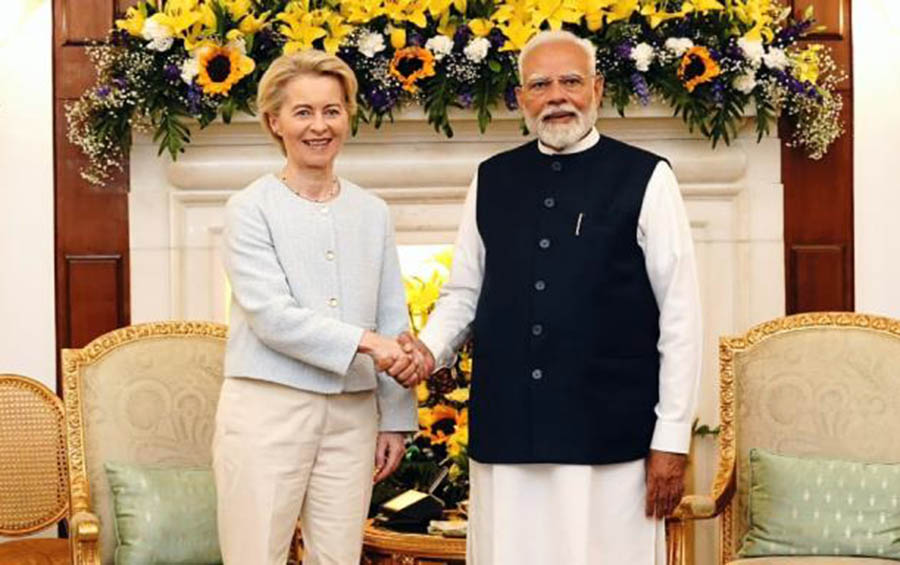
Von der Leyen’s comments come just days ahead of her visit to India, which diplomats see as a crucial opportunity to resolve the most contentious issues at the political level.
According to India’s Ministry of External Affairs (MEA), European Council President Antonio Luís Santos da Costa and Commission President von der Leyen will undertake a State Visit to India from January 25 to 27, 2026, at the invitation of Prime Minister Narendra Modi.
Both leaders will be the Chief Guests at India’s 77th Republic Day celebrations, underscoring the growing strategic weight of the partnership.
During the visit, they will co-chair the 16th India–EU Summit on January 27, meet President Droupadi Murmu, and hold restricted as well as delegation-level talks with Prime Minister Modi. An India–EU Business Forum is also scheduled on the sidelines of the summit.
Broader Agenda: Energy, Defence and Global Partnerships
Beyond trade, von der Leyen used her Davos address to outline Europe’s priorities in energy and defence.
She said the EU was working towards building an energy union capable of delivering “homegrown, reliable and affordable energy” and stressed the need for an “urgency mindset” to secure sustainable growth.
On defence, she said Europe had achieved more in the past year than in previous decades, with member states raising military investments to record levels. She noted that three leading European defence-technology startups had reached unicorn status, reflecting growing innovation in the sector.
Strategic Partnership Deepens
India and the EU have been strategic partners since 2004, but ties have deepened markedly in recent years.
The MEA said bilateral engagement has expanded across trade, technology, climate action, connectivity and people-to-people exchanges, especially after the EU College of Commissioners’ visit to India in February 2025, described by both sides as historic.
With the summit in New Delhi approaching, expectations are mounting that the two sides could soon move closer to sealing what Brussels is already calling a “historic” and potentially game-changing agreement.
If concluded, the pact would link two billion consumers under a single trade framework and represent nearly a quarter of global GDP—instantly placing it among the most influential economic agreements in the world.