Photos’ Credit: www.facebook.com/BJP4India
India and the European Union are seeking to deepen their strategic partnership beyond trade, with Prime Minister Narendra Modi and European Commission President Ursula von der Leyen underlining growing cooperation in defence, technology, resilient supply chains and economic security amid rising global uncertainty.
Addressing the European Round Table for Industry (ERT) in Gothenburg, Sweden, on May 17, 2026, Prime Minister Modi said the recently concluded India-European Union Free Trade Agreement (FTA) would open major opportunities for industries, investors and innovators on both sides.
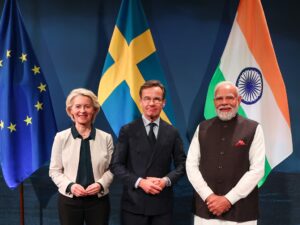 The India-EU FTA negotiations were formally concluded in January 2026 and are expected to eliminate tariffs on more than 90 per cent of traded goods. The agreement now awaits legal scrutiny and ratification, including approval by the European Parliament.
“Political, economic, and strategic convergence between India and Europe is important for peace and stability across the world….The Security and Defence Partnership and the Mobility Agreement have given new strength to our strategic and people-centric partnership,” PM Modi said.
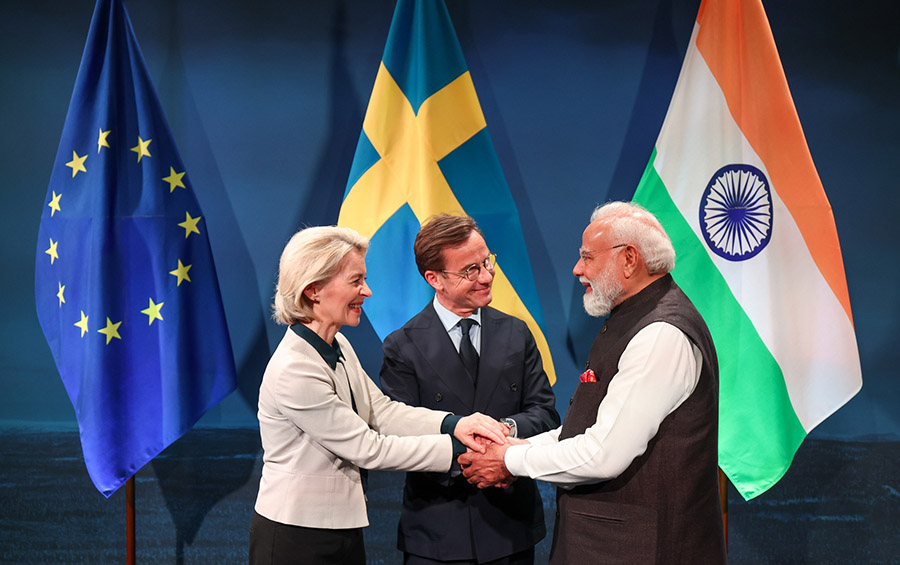
The roundtable, hosted by the Volvo Group during PM Modi’s visit to Sweden, was attended by European Commission President Ursula von der Leyen, Swedish Prime Minister Ulf Kristersson, senior European industry leaders and representatives from leading Indian and European companies.
Ursula von der Leyen Calls India-EU FTA the ‘Mother of All Deals’
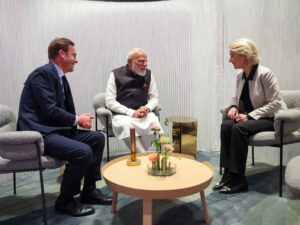 European Commission President Ursula von der Leyen described the India-EU trade pact as the “mother of all deals”, calling it a landmark agreement that could redefine economic ties between India and Europe.
“We succeeded indeed in concluding our landmark trade agreement. We call it the mother of all Deals,” President von der Leyen said during a joint press interaction.
Highlighting the scale of the agreement, she said, “A shared market of over 2 billion people. That is close to one quarter of global GDP. Over 9 per cent of tariff cuts. An enormous opportunity to grow trade and investment.”
The EU chief also hinted at a future investment agreement with India, describing it as “the missing piece of the puzzle in our reinforced economic cooperation.”
“One can say the trade agreement opened the door. An investment agreement walks us through this door,” she added.
Responding to President von der Leyen’s remarks, PM Modi said India and Europe were entering a new phase of cooperation.
“Our cooperation in the defense sector is growing. Ursula von der Leyen’s presence today adds significance to this event. During her visit to India in January, we made historic decisions to elevate India-EU relations. We are progressing on those outcomes, and the India-EU Free Trade Agreement (FTA) will create new opportunities for industries and investors. As Ursula said, this is the ‘Mother of All Deals,’” PM Modi remarked.
India-EU Cooperation Expands Into Security and Defence
Beyond economic ties, both sides highlighted growing India-EU cooperation in security and defence.
President Von der Leyen said the first EU-India security and defence dialogue held in New Delhi marked a significant step in expanding strategic engagement.
“In January, we not only signed the mother of all deals, but we also moved closer on security and defence, on which we signed our partnership,” she said.
“With the first EU-India security and defence dialogue in New Delhi, we continue to deepen the cooperation, particularly on maritime security, where we will hold joint EU-India naval exercises.”
She added that India and the EU would also cooperate on cybersecurity, protection of critical infrastructure and information sharing.
“We will also work together in encountering cyber threats, protecting our critical infrastructure, and generally increasing our information sharing. Our cooperation can help bring stability to an unstable world and provide security to our citizens,” the EU Commission President said.
Technology, Semiconductors and Supply Chains Emerge as Key Focus Areas
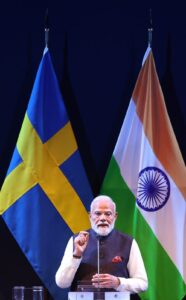 Technology and economic resilience featured prominently in discussions between India and the EU.
PM Modi said the India-EU Trade and Technology Council was already enabling cooperation in areas such as semiconductors, clean energy, digital technology, innovation and resilient supply chains.
According to an official statement, the Prime Minister invited European companies to increase investments in sectors including artificial intelligence, semiconductors, telecom, electronics, healthcare and deep-tech manufacturing.
He also stressed the need for trusted and diversified global supply chains amid geopolitical uncertainty.
Reiterating the government’s “Design for India, Make in India and Export from India” vision, PM Modi said India was emerging as one of the world’s most attractive destinations for investment, innovation and manufacturing.
President Von der Leyen said the Trade and Technology Council was helping align India-EU cooperation in emerging technologies and digital systems.
“Our EU-India Trade and Technology Council is already showing the way forward. Under its umbrella, we are aligning our AI governance, we’re working together on semiconductors, we’re strengthening the resilience of our supply chains, and we are ensuring interoperability between our digital systems,” she said.
She added that these issues would be discussed further at the next India-EU Trade and Technology Council meeting scheduled for July.
Sweden Visit Highlights Broader India-Europe Outreach
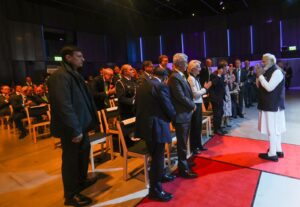 Prime Minister Modi’s visit to Sweden formed part of his broader Europe outreach aimed at strengthening India’s economic and strategic engagement with the region. During the visit, Modi held talks with Swedish Prime Minister Ulf Kristersson and interacted with European business leaders on cooperation in innovation, clean energy, mobility and advanced technologies.
The Prime Minister also highlighted growing India-Europe collaboration through connectivity initiatives such as the India-Middle East-Europe Economic Corridor (IMEC), which he said would strengthen economic integration and business partnerships between the two regions.
He further proposed that the India-Europe CEOs Roundtable be held annually and suggested setting up an India Desk at the European Round Table for Industry to institutionalise engagement between Indian and European businesses.
The discussions in Gothenburg reflected the growing momentum in India-EU relations as both sides seek closer alignment in trade, technology, defence and global economic cooperation amid an increasingly uncertain geopolitical landscape.