
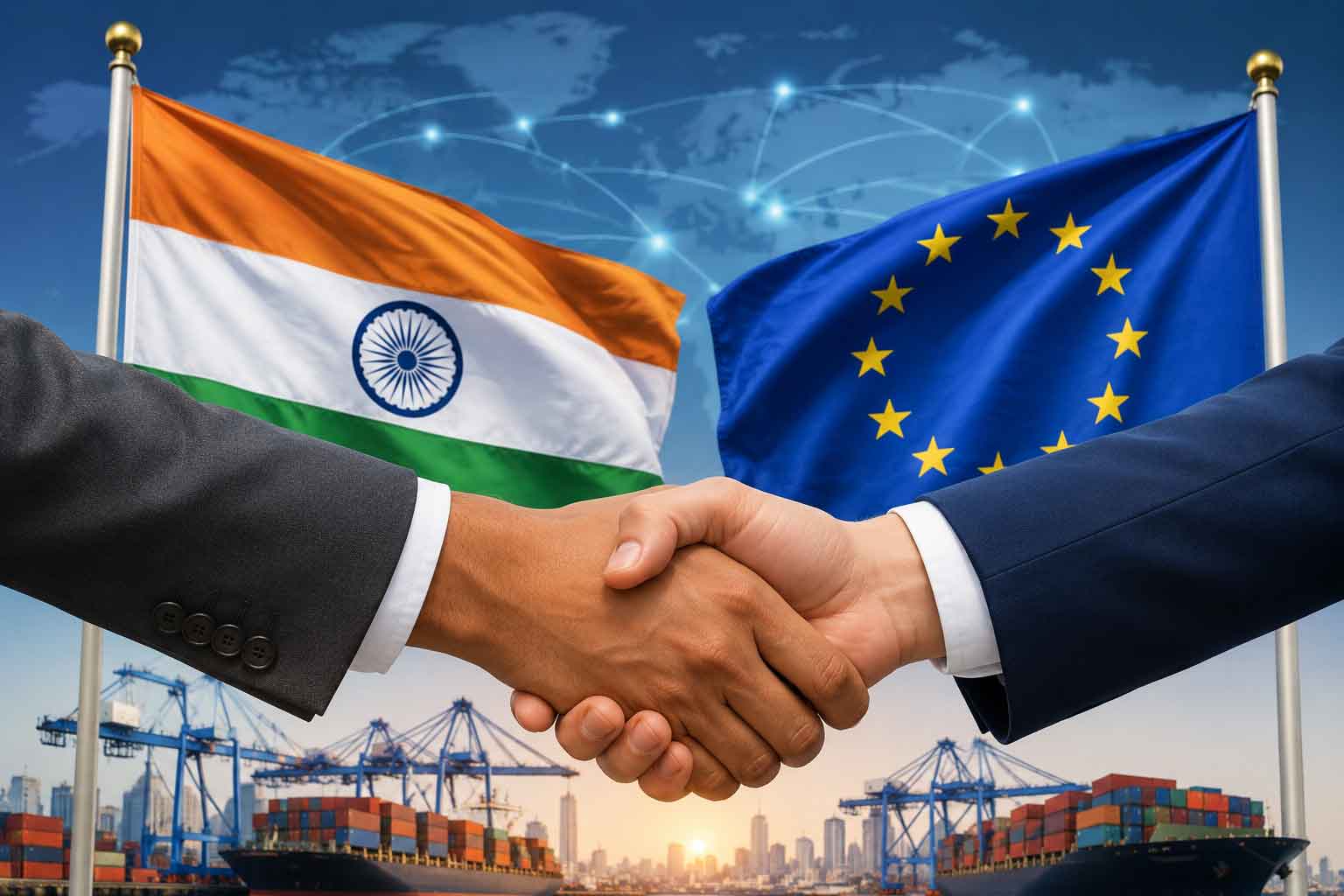
The proposed India-European Union Free Trade Agreement (FTA) is expected to significantly reshape economic ties between the two regions by expanding trade, investment, employment generation, manufacturing, digital trade and mobility, according to Darpan Jain, Additional Secretary, Department of Commerce and Industry.
Speaking at a conference on next-generation trade pacts organised by the Federation of Indian Chambers of Commerce & Industry in New Delhi on Tuesday, 18 June, Jain described the India-EU agreement as the “mother of all deals” and outlined 20 major pillars that form the foundation of the proposed pact.
“You all know that this has happened after years of dialogue, debate and determination. We have been able to conclude this agreement,” Jain said during his address.
Agreement Connects Two Major Global Economic Powers
Highlighting the strategic significance of the deal, Jain said the agreement brings together the world’s second and fourth largest economies and would impact nearly two billion people while covering close to one-third of global trade.
Calling the first pillar of the agreement “shared values, scale and complementarity,” Jain said India and the EU possess strong economic synergies that could create long-term growth opportunities for both sides.
“Total global trade in goods and services currently stand around 33 trillion. If you combine imports of EU and India, it is almost 11 trillion,” he said.
According to Jain, India’s strengths in labour-intensive manufacturing and knowledge-based services complement the EU’s capabilities in high-technology and capital-intensive sectors such as finance, telecommunications and maritime services.
India and EU FTA Networks Expected to Expand Supply Chain Opportunities
Jain said the agreement would also unlock new global supply chain opportunities by leveraging the extensive FTA networks of both India and the EU.
He noted that India has signed nine free trade agreements with 38 countries over the last five years, while the EU currently has more than 40 FTAs covering nearly 70 countries.
The proposed agreement, he added, is comprehensive in scope and includes 20 chapters spanning goods, services, intellectual property rights, sustainability and digital trade.
Under the proposed arrangement, 99.5 per cent of India’s exports are expected to receive preferential tariff access in the EU market, while India would extend preferential treatment to nearly 97 per cent of EU exports.
Major Gains Expected for Labour-Intensive Sectors
Jain highlighted that sectors such as textiles, apparel, gems and jewellery, leather, footwear, marine products and agriculture are likely to emerge as key beneficiaries of the agreement.
India currently exports nearly USD 33 billion worth of labour-intensive products to the EU, many of which face import duties ranging from 10 per cent to 26 per cent.
“All these duties will get eliminated,” he stated.
He further pointed out that India exports only USD 7.2 billion worth of textiles and apparel to the EU despite the bloc importing nearly USD 263 billion worth of such products annually, indicating significant room for expansion.
Similarly, the EU’s marine imports currently stand at USD 53 billion, while India’s exports to the region remain at only around USD 1 billion.
Sensitive Sectors Protected, Auto Sector Gets Quota-Based Access
The Commerce Ministry official clarified that sensitive agricultural sectors such as dairy, cereals and poultry have been kept outside the scope of tariff concessions to protect domestic interests.
On automobiles, Jain said the agreement adopts a calibrated approach through “limited quota-based, long-phased solutions” aimed at encouraging investments and integrating India more deeply into European value chains.
Services, Mobility and Digital Trade Form Core of Agreement
Jain said India’s rapidly growing services exports sector is expected to benefit significantly from the agreement, with the EU committing market access across 144 out of 155 services subsectors.
The agreement also contains provisions to facilitate mobility for professionals, including intra-corporate transferees, contractual service suppliers and independent professionals.
According to Jain, the pact further creates a supportive framework for Indian students in Europe while encouraging cooperation in digital payments and financial technologies, including systems such as UPI.
He also highlighted provisions relating to Global Capability Centres (GCCs), cybersecurity, e-commerce, paperless trading and personal data protection.
Mechanisms Included to Address Trade Disputes and Carbon Rules
On dispute resolution, Jain said the agreement incorporates rapid-response mechanisms, transparency obligations and systems to address non-tariff barriers more efficiently.
The FTA also establishes a dedicated framework to handle issues related to the European Union’s Carbon Border Adjustment Mechanism (CBAM), which has emerged as a major concern for exporting nations.
“This partnership is not a superficial agreement. It is a comprehensive partnership… everything connected to economic area is covered,” Jain said.