India and Germany are looking to deepen cooperation in green industrial transformation, clean technologies and resilient supply chains as both countries seek to accelerate industrial decarbonisation while maintaining economic competitiveness and energy security.
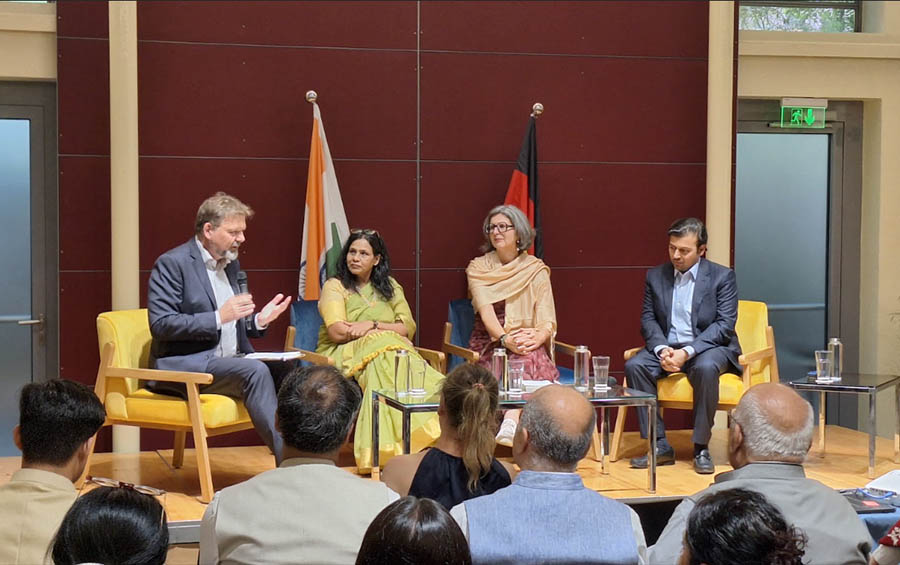
These issues took centre stage during the latest edition of the German Embassy’s Climate Talk series on “Partnering for Industrial Green Transition”, hosted by the Embassy of the Federal Republic of Germany in New Delhi on May 28, 2026.
The high-level discussion brought together senior policymakers, industry executives, sustainability experts and innovation stakeholders to deliberate on how India-Germany and broader India-European Union collaboration can support long-term green growth and low-carbon industrial development.
The event was held at the German Embassy in New Delhi at a time when countries across the world are increasingly focusing on balancing climate commitments with industrial resilience, future competitiveness and secure supply chains.
Ambassador Ackermann Highlights Strategic India-Germany Partnership
Opening and moderating the session, Philipp Ackermann, Ambassador of Germany to India and Bhutan, emphasised the growing strategic importance of Indo-German cooperation in building sustainable industrial ecosystems and future-ready supply chains.
 “India and Germany share a strong foundation of trust, innovation and industrial cooperation. As the global economy moves towards cleaner growth models, our partnership can help build resilient green industries and sustainable supply chains for the future,” Ambassador Ackermann said.
Highlighting India’s emerging position in the global clean technology landscape, he added, “India is uniquely positioned to become a major global partner in green manufacturing and clean technologies. Closer cooperation between India, Germany and the European Union can accelerate industrial decarbonization while also creating jobs, innovation and long-term economic resilience.”
Focus on Climate Policy, Green Manufacturing and Innovation
 The panel discussion featured Heike Henn, Director General for International Climate Action at Germany’s Federal Ministry for the Environment, Climate Action, Nature Conservation and Nuclear Safety (BMUKN); Anandi Iyer, Director of the Fraunhofer Representative Office India, and Co-Founder of TheDialog; and Nishant Arya, Vice Chairman and Managing Director of JBM Group and Chair of the CII Europe–India Council.
Speaking during the discussion, Henn stressed the importance of policy certainty and international collaboration in driving industrial transition towards low-carbon economies.
“The transition towards low-carbon industry will only succeed if it is environmentally sustainable, economically viable and socially beneficial at the same time. Governments must create stable and predictable policy frameworks that give businesses the confidence to invest in green technologies and industrial transformation,” she said.
Henn further noted that India and Germany can benefit from exchanging experiences in key sectors linked to industrial decarbonisation.
“India and Germany have valuable experiences to share in areas such as clean manufacturing, carbon markets and industrial decarbonization. Through stronger international cooperation and partnerships between governments, industry and research institutions, we can accelerate the transition towards resilient and competitive green economies,” she added.
India’s Growing Role in Global Green Manufacturing
 During the session, Anandi Iyer highlighted the importance of applied science, collaborative innovation and Indo-German research partnerships in developing scalable green industrial solutions.
Nishant Arya, meanwhile, focused on the industrial and mobility dimensions of the transition, underlining opportunities for India to emerge as a global hub for clean technologies and electric mobility manufacturing.
The discussion also examined how closer collaboration between governments, industry and applied research institutions could support the shift towards low-carbon industrial systems while simultaneously strengthening economic resilience and global competitiveness.
Participants particularly emphasised India’s expanding role as a major centre for green manufacturing and discussed the growing need for resilient and diversified supply chains amid evolving geopolitical and economic uncertainties.
India-EU Cooperation and FTA Discussions in Spotlight
The dialogue further highlighted the potential of stronger India-European Union engagement in areas such as sustainable industry, climate-resilient infrastructure and clean technology value chains.
Participants noted that the ongoing India-EU Free Trade Agreement (FTA) negotiations could play an important role in deepening cooperation across clean manufacturing, industrial sustainability and future green technology ecosystems.
The discussions reflected growing momentum in India-Germany climate and industrial cooperation as both countries seek to align economic growth with sustainability goals and long-term industrial transformation.