
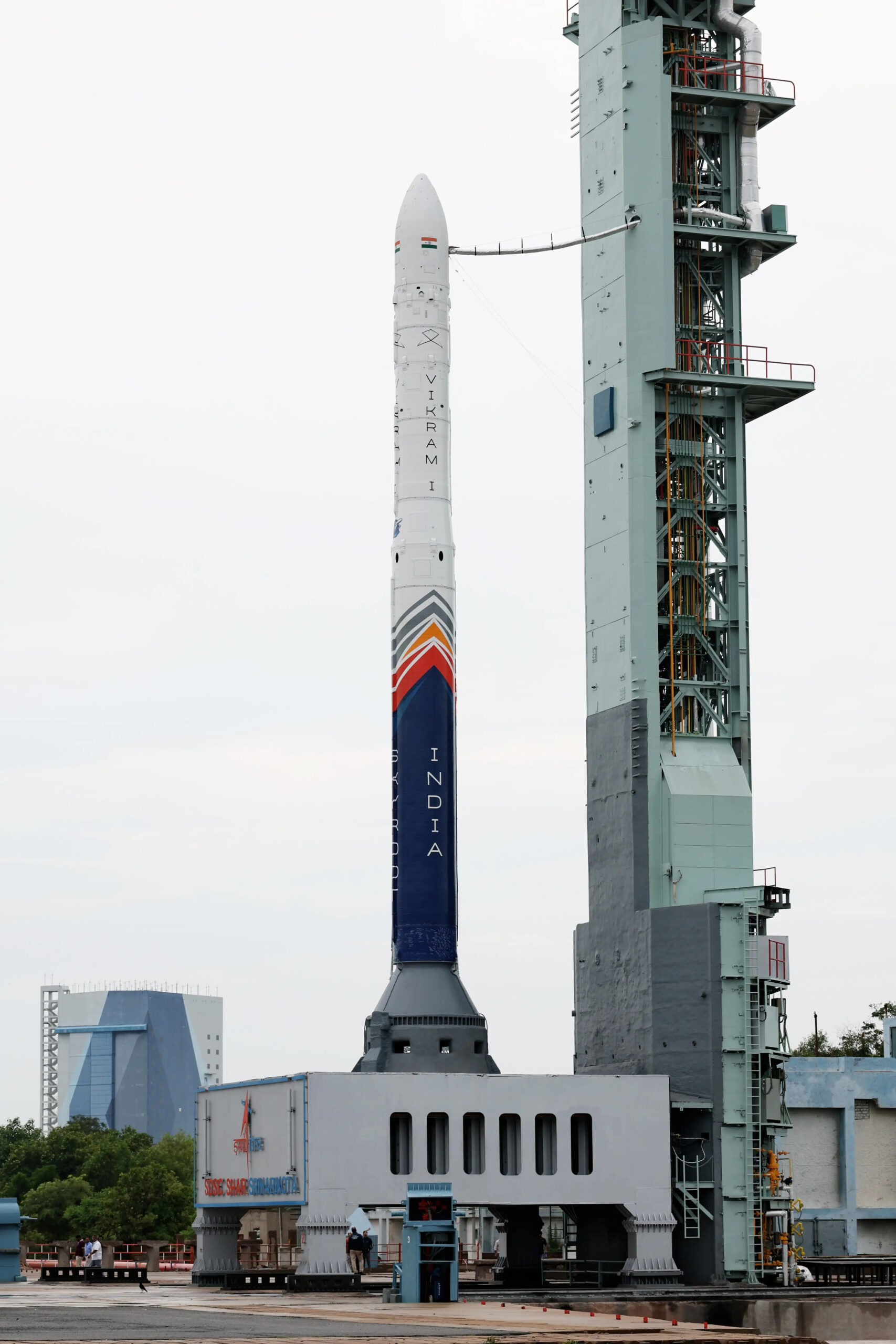
Photo Credit: www.isro.gov.in
India’s private space programme crossed a historic threshold on July 18, 2026, when Skyroot Aerospace’s indigenously developed Vikram-1 successfully reached orbit on its maiden flight from the Satish Dhawan Space Centre in Sriharikota.
The achievement made Hyderabad-based Skyroot the first private Indian company to send a domestically developed rocket into orbit from Indian soil. It was also the first orbital launch undertaken by a private company from an Indian spaceport.
According to the Indian Space Research Organisation (ISRO), Vikram-1 lifted off at 12:05:30 pm. Two satellites—SCOPE and Grahaa—were injected into low-Earth orbit, while the remaining payloads stayed aboard the rocket’s upper stage to undertake in-orbit experiments.
Named Mission Aagaman, the flight demonstrated India’s emerging ability to develop and operate commercial orbital rockets through a combination of private enterprise, indigenous engineering and support from the country’s established public space institutions.
India’s first privately developed orbital rocket
Named after Dr Vikram Sarabhai, widely regarded as the father of India’s space programme, Vikram-1 is India’s first privately developed orbital launch vehicle.
The four-stage rocket comprises three solid-propellant stages and a liquid-propellant upper stage. Built with an all-carbon-composite structure, it incorporates high-thrust solid motors and a three-dimensionally printed liquid engine.
Vikram-1 has been designed primarily to carry small satellites into low-Earth orbit. According to official information, the rocket can place payloads weighing up to 350 kilograms into orbit.
Mission Aagaman targeted an orbit at an altitude of approximately 450 kilometres. ISRO said Skyroot successfully reached orbit on its first attempt—an important technical accomplishment for a company undertaking its first orbital mission.
The flight tested the vehicle’s propulsion systems, composite structures, avionics, guidance and control systems, stage-separation mechanisms and upper-stage operations under actual launch conditions.
Indigenous technology powers Vikram-1
Vikram-1 brings together several technologies developed in India, including its composite airframe, solid-propulsion stages and Raman-1 liquid engine used in the upper stage.
A major development milestone was reached on August 8, 2025, when the Kalam-1200 first-stage motor underwent a successful static test at the Satish Dhawan Space Centre.
The motor is 11 metres long and 1.7 metres in diameter, with a propellant mass of 30 tonnes. ISRO described it as a monolithic composite motor and said its performance during the test was in line with predictions.
ISRO facilities were also used to validate Vikram-1’s second-stage motor. The Raman-1 upper-stage engine was tested at ISRO’s Liquid Propulsion Systems Centre.
The upper stage provides the precision required to place satellites into their intended orbits. The rocket’s carbon-composite construction helps reduce structural weight, while three-dimensional printing can simplify engine manufacturing by reducing the number of individual components.
Together, these technologies reflect the growing capabilities of Indian private industry in advanced materials, propulsion, precision manufacturing, avionics and launch-vehicle integration.
Multiple payloads carried into orbit
Vikram-1 carried a combination of satellites, technology demonstrations and symbolic payloads from Indian and international participants.
The mission included Skyroot’s SCOPE technology-demonstration satellite and Grahaa Space’s SOLARAS S3 satellite. ISRO confirmed that the two satellites were successfully injected into low-Earth orbit.
The rocket also carried Embrace, a robotic arm developed by Indian company Cosmoserve Space to demonstrate technologies associated with capturing orbital debris.
An in-orbit technology experiment from Dcubed, a German space-engineering company based near Munich, was also aboard the rocket. Dcubed develops compact mechanisms used to secure satellite equipment during launch and release it after reaching space.
Mission Aagaman additionally carried “Cosmic Bloom”, a floral-shaped artwork, and an 18-karat gold miniature rocket featuring microscopic sculptures of Indian scientists C.V. Raman, Vikram Sarabhai and A.P.J. Abdul Kalam.
From Vikram-S to an orbital mission
Vikram-1’s success builds on Skyroot’s first launch, Mission Prarambh, conducted on November 18, 2022.
That mission used Vikram-S, a single-stage suborbital rocket developed to validate technologies and operational processes required for the company’s future launch vehicles. Vikram-S reached an altitude of 81.5 kilometres during a flight lasting approximately five minutes.
Although Vikram-S did not enter orbit, its flight made Skyroot the first private Indian company to launch a privately developed rocket into space from India.
Less than four years later, the company has advanced from a suborbital technology demonstration to the deployment of satellites in low-Earth orbit. The transition demonstrates how India’s private space companies are moving beyond individual technology tests towards complete orbital missions.
ISRO and IN-SPACe support private launch
Although Vikram-1 was privately developed, the mission also demonstrated the role of India’s public institutions in building a broader national space ecosystem.
ISRO provided Skyroot with access to its solid-motor casting and static-testing infrastructure at Sriharikota. Its facilities supported the testing of the rocket’s first and second stages, while the upper-stage engine was tested at the Liquid Propulsion Systems Centre.
During launch preparations, ISRO assisted with vehicle-stage preparation, material handling, transportation, trajectory analysis and integration at Sriharikota’s First Launch Pad. ISRO’s safety team also monitored operations at the space centre.
The Indian National Space Promotion and Authorisation Centre, or IN-SPACe, facilitated Skyroot’s access to ISRO infrastructure, provided technical consultation, conducted mission-readiness reviews and issued the required launch clearances.
The launch followed the space-sector reforms announced by the Union government in 2020, which expanded private participation in launch services, satellite development and space-based applications.
The Indian Space Policy 2023 subsequently defined the respective responsibilities of ISRO, IN-SPACe, NewSpace India Limited and private companies within the restructured ecosystem.
Opening India’s commercial launch market
India has possessed indigenous orbital launch capabilities through ISRO for decades. Vikram-1’s significance lies in extending that capability to an Indian private company for the first time.
Small-satellite launch services have become an important commercial segment as governments, companies and research institutions deploy satellites for Earth observation, communications, navigation, climate monitoring and scientific research.
Vikram-1 gives Indian satellite operators the prospect of procuring launches from a domestic private provider rather than depending entirely on government missions or overseas companies.
The mission also indicates that Indian private launch providers could compete for international customers seeking dedicated launches and opportunities to test technology in orbit.
“This launch has paved the way for similar ventures and opens up the gates to global commercial opportunities,” ISRO said following the mission.
India’s private space ecosystem expands
Official government figures show that India’s space start-up ecosystem grew from one start-up in 2014 to more than 400 in 2026.
Indian companies are now working across launch vehicles, propulsion, satellites, Earth observation, communications, geospatial services, space-based applications and space-situational-awareness technologies.
India’s space economy is currently estimated at approximately $8.4 billion. The government expects it to expand to between $40 billion and $45 billion by 2030, with a longer-term target of $100 billion by 2040.
The successful Vikram-1 mission gives this expanding ecosystem an important technical proof point: a private Indian company has demonstrated the ability to develop, integrate and launch an orbital-class rocket from India.
PM Modi calls launch a ‘defining moment’
Prime Minister Narendra Modi congratulated the Skyroot Aerospace team following the mission and described the achievement as a major development in India’s space journey.
“This is a defining moment in India’s space journey. The growing participation of our private sector is opening new frontiers and accelerating innovation,” Prime Minister Modi said.
“This achievement will encourage countless youngsters to dream bigger and innovate fearlessly,” he added.
Union Minister of State for Space Dr Jitendra Singh, who witnessed the mission at Sriharikota, said the launch demonstrated the strength of collaboration between the Department of Space, ISRO, IN-SPACe and India’s start-up ecosystem.
A focused India–Germany connection
By carrying Dcubed’s in-orbit experiment, Vikram-1 also demonstrated the potential for Indian private launch providers to serve international customers. The mission could open further opportunities for German NewSpace companies to test and deploy their technologies through India’s expanding commercial launch ecosystem.
Vikram-1’s maiden success does not replace ISRO’s central role in India’s space programme. Instead, it expands the country’s capabilities by adding an indigenous private launch provider to an ecosystem built on decades of Indian scientific and engineering expertise.
By reaching orbit on its first flight, Vikram-1 has demonstrated how domestic technology, entrepreneurship and national space infrastructure can combine to advance India’s ambitions in the global space economy.