Photo Credit: MEDHA
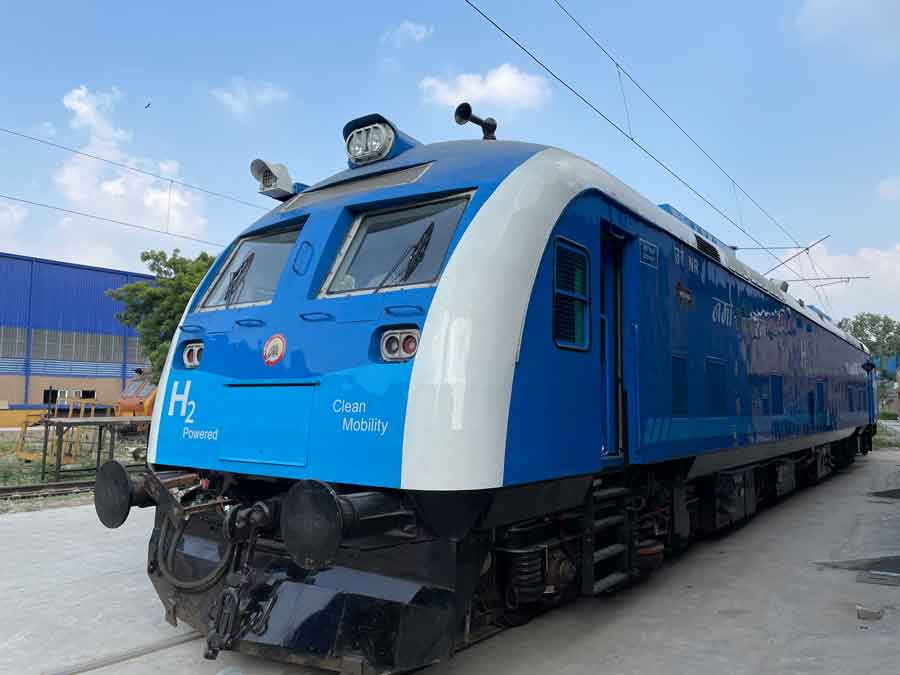
India has launched its first hydrogen-powered passenger train, marking a significant step in the country’s transition towards cleaner rail transport and demonstrating its growing capabilities in indigenous railway engineering.
Prime Minister Narendra Modi flagged off the train at Jind railway station in Haryana on July 17, 2026. The train will operate on Northern Railway’s approximately 89-kilometre Jind–Sonipat section, connecting Jind Junction, Gohana Junction and Sonipat.
Designed, engineered and integrated in India, the train was developed from the design stage through prototype manufacturing under technical specifications prepared by the Research Designs and Standards Organisation, or RDSO.
Its introduction places India among a small group of countries—including Germany, China and the United States—that have deployed or tested hydrogen-powered passenger trains.
Ten-coach train showcases Indian engineering capabilities
India’s hydrogen train has a ten-coach configuration and can accommodate approximately 2,600 passengers. It is powered by a 1,200-kilowatt hydrogen fuel-cell system and has an overall propulsion capacity of about 3,200 horsepower.
The train has been approved to operate at a maximum speed of 75 kilometres per hour, while its design speed is 110 kilometres per hour.
Prime Minister Modi described it as one of the longest and most powerful hydrogen-powered passenger trains developed globally. Hydrogen trains deployed in several other countries generally operate with shorter three- or four-coach configurations.
“The hydrogen train running between Jind and Sonipat is the most powerful hydrogen train in the world,” the Prime Minister said during his address in Jind.
The Prime Minister said the train had been designed by Indian engineers and built domestically, describing it as an example of the country’s capabilities under the Make in India and Atmanirbhar Bharat initiatives.
Indian Railways developed the train by converting a Diesel Electric Multiple Unit, or DEMU, platform to hydrogen fuel-cell propulsion. According to Indian Railways’ annual report for 2023–24, integration of the prototype was undertaken at the Integral Coach Factory in Chennai.
Indian engineering company Medha integrated the fuel-cell-based propulsion system into the DEMU platform. It also conducted static and dynamic testing, oscillation trials and performance trials, according to information published on the TÜV SÜD website.
The project required the integration of fuel cells, onboard hydrogen-storage equipment, traction batteries, control systems and specialised safety mechanisms within a passenger train designed for Indian operating conditions.
How the hydrogen-powered train works
The train uses a Proton Exchange Membrane Fuel Cell, or PEMFC, system as its primary energy source.
Inside the fuel cells, hydrogen reacts electrochemically with oxygen to generate the electricity required to power the train’s traction motors. A battery bank functions as a secondary energy source, helping meet peak power requirements and storing energy generated or recovered during operation.
Water vapour and heat are the principal by-products of the fuel-cell reaction. The train therefore emits no carbon dioxide, smoke or conventional air pollutants from its propulsion system while operating.
Hydrogen-powered trains can offer an alternative to diesel services on routes where continuous overhead electrification is technically difficult or disproportionately expensive. Unlike conventional electric trains, they generate electricity onboard and do not require uninterrupted overhead electric lines.
They can also operate more quietly than diesel trains and reduce local air pollution along railway corridors.
The overall environmental benefit, however, depends on how the hydrogen is produced. Green hydrogen generated through electrolysis using renewable electricity can deliver substantially lower lifecycle emissions than hydrogen derived from fossil fuels.
Government figures place the specific energy of hydrogen at approximately 120 megajoules per kilogram, compared with around 43 megajoules per kilogram for diesel. Its low density, however, requires specialised compression, storage, refuelling and safety infrastructure.
Dedicated hydrogen facility established at Jind
Indian Railways has established a hydrogen production, storage and refuelling ecosystem at Jind to support the train’s operations.
The facility can store nearly 3,000 kilograms of hydrogen at a time, making it the country’s largest railway hydrogen storage and refuelling installation. It has received the required licence from the Petroleum and Explosives Safety Organisation for storing and dispensing compressed hydrogen gas.
The installation includes the equipment needed to produce or receive hydrogen, compress the gas, store it safely and dispense it into the train’s onboard tanks.
The train consequently represents a wider technology project rather than only a new passenger vehicle. Its operation depends on the coordinated functioning of the trainset, hydrogen supply, storage tanks, compression equipment, dispensing systems, safety controls and maintenance infrastructure.
“This hydrogen train is completely different from other trains. It requires a separate system, separate infrastructure,” Prime Minister Modi said.
The Prime Minister added that additional hydrogen-related facilities could be developed at Jind if Indian Railways expands the technology to other routes.
German company provides independent safety assessment
The project also contains a focused India–Germany dimension. According to information published on the TÜV SÜD website on July 17, 2026, the Munich-headquartered testing, inspection and certification company conducted independent safety assessments of the train’s hydrogen and traction-battery systems. It also assessed the associated hydrogen production and refuelling facility at Jind.
TÜV SÜD said it worked with Medha and Indian Railways on the project between 2024 and 2026. Its role was limited to independent safety assessment and technical assurance; the train itself was designed, developed and integrated in India.
Following the project, TÜV SÜD and Medha signed a memorandum of understanding to expand their cooperation on hydrogen-powered rail vehicles and independent safety assessments for the Indian railway sector.
Service to cover Jind–Sonipat corridor
The new train will operate between Jind and Sonipat, covering approximately 89 kilometres. Prime Minister Modi referred to the route as a roughly 90-kilometre journey.
In addition to Jind Junction, Gohana Junction and Sonipat, the proposed halts include Jind City, Pandu Pindara Junction, Lalit Khera Halt, Bhambhewa, Isapur Kheri Halt, Butana Halt, Khandrai Halt, Rabrah Halt, Lath Halt, Mohana, Barwasni Halt and Sonipat New.
The train has initially been developed as a pilot project. Its operation will allow Indian Railways to evaluate fuel consumption, performance, reliability, maintenance requirements, refuelling procedures and passenger-service suitability under Indian conditions.
“For now, this journey is 90 kilometres long, but in the future, there are immense possibilities for expansion,” Prime Minister Modi said.
The Prime Minister added that Indian Railways would continue examining ways to reduce costs and improve efficiency before extending hydrogen propulsion to other parts of the network.
From pilot proposal to operational train
Indian Railways announced the Jind–Sonipat pilot several years before the train’s eventual launch. The project involved retrofitting an existing DEMU train with hydrogen fuel-cell propulsion and constructing the associated ground infrastructure.
In a written reply to the Rajya Sabha in February 2023, Union Minister for Railways Ashwini Vaishnaw said the pilot project had been awarded at a cost of ₹111.83 crore.
At the time, the Ministry of Railways said the running cost of hydrogen trains had not yet been established under Indian operating conditions. It expected the initial cost to be higher than that of established railway technologies but said costs could fall as more trains were introduced and the supporting hydrogen ecosystem expanded.
The launch in July 2026 followed a multi-year process encompassing technical design, prototype manufacturing, system integration, performance trials, independent safety assessment, regulatory approval and the construction of specialised hydrogen infrastructure.
Germany pioneered hydrogen passenger rail
Germany provides an important international reference point for India’s entry into hydrogen-powered passenger transport.
The country became the first to place a hydrogen fuel-cell passenger train into commercial service when the Alstom Coradia iLint began trial operations in Lower Saxony in September 2018. A fleet of 14 trains was subsequently introduced on a regional network in August 2022 to replace diesel units on non-electrified routes.
On September 15, 2022, a Coradia iLint train travelled 1,175 kilometres without refuelling, demonstrating the potential range of hydrogen fuel-cell propulsion.
India’s ten-coach train is larger than the shorter regional trainsets deployed in Germany and has been developed for the country’s high-volume passenger railway system. While Germany pioneered hydrogen passenger rail, India has demonstrated its ability to develop and adapt the technology domestically.
Wider plans under ‘Hydrogen for Heritage’
Indian Railways previously proposed introducing 35 hydrogen trains under its “Hydrogen for Heritage” programme, principally for heritage and hill routes.
When the programme was announced in 2023, the Ministry estimated a cost of around ₹80 crore for each train and approximately ₹70 crore for ground infrastructure on each route.
Hydrogen trains could be particularly useful on shorter, lower-density or geographically difficult routes where installing overhead electric infrastructure is technically challenging or uneconomical.
They are not expected to replace direct electrification on heavily used mainline corridors. Trains supplied directly through overhead electric lines are generally more energy-efficient because electricity does not first need to be converted into hydrogen and subsequently converted back into electricity onboard.
The Jind–Sonipat service will therefore test whether hydrogen propulsion can provide Indian Railways with a reliable and commercially sustainable alternative to diesel on selected routes.
Its significance extends beyond the introduction of a single passenger service. By developing the train, its propulsion system and the necessary supporting infrastructure within the country, India has demonstrated its ability to participate in an emerging field of clean railway technology that has so far been developed by only a limited number of countries.
The project also expands the scope of the Make in India programme beyond conventional railway manufacturing to include hydrogen fuel cells, energy storage, high-pressure fuel systems, advanced safety engineering and clean-mobility infrastructure. The involvement of Germany-headquartered TÜV SÜD in independently assessing the train’s hydrogen and traction-battery systems adds a focused India–Germany dimension to this largely indigenous technological achievement.