
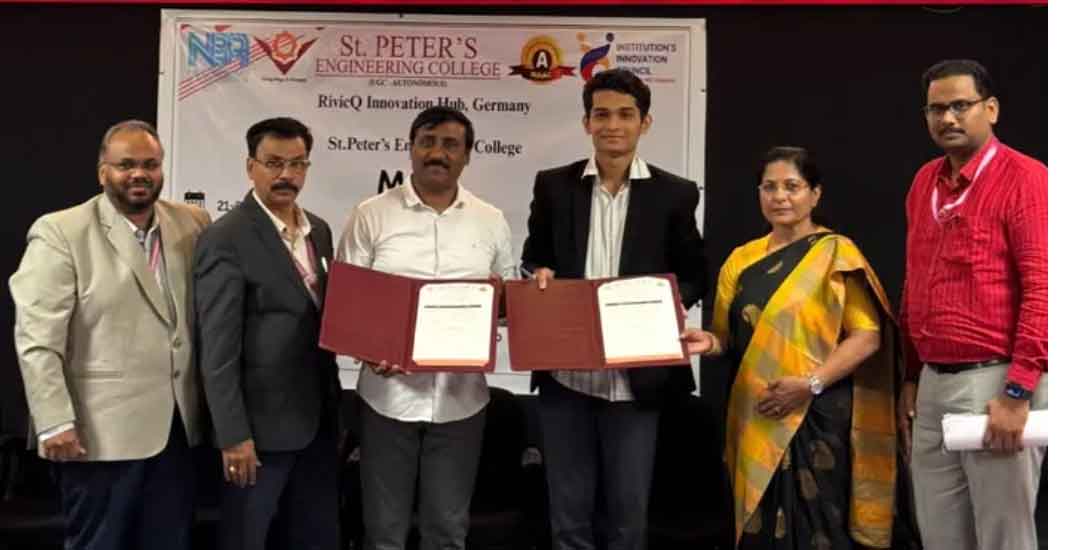
Picture Credit: St. Peter’s Engineering College
St. Peter’s Engineering College in Hyderabad has signed a Memorandum of Understanding (MoU) with Germany-based RivicQ Innovation Hub to develop academic and innovation links in emerging technologies, including quantum computing, artificial intelligence, cybersecurity and deep-tech research.
The agreement, announced in Hyderabad on July 21, 2026, is expected to support joint research, international academic engagement, internships, faculty exchanges and entrepreneurship programmes for students and faculty members at the autonomous engineering institution.
The partnership also seeks to build cooperation between India and Germany in skill development and technology-focused startup incubation, giving participating students greater exposure to international research and innovation networks.
Agreement covers emerging technology sectors
Under the MoU, St. Peter’s Engineering College and RivicQ Innovation Hub plan to collaborate across several interconnected fields: quantum technologies, artificial intelligence, cybersecurity, deep-tech research, entrepreneurship, innovation and technical training.
The proposed activities include joint research initiatives, workshops, innovation programmes, faculty exchanges, internships and international academic collaborations. Startup incubation will also form part of the partnership, with the two sides seeking to help students and researchers develop technology concepts into potential ventures.
The agreement could enable students and faculty members to work on projects at the intersection of quantum computing, AI and digital security—areas that are becoming increasingly important as organisations prepare for new technological and cybersecurity challenges.
According to publicly available information, RivicQ is a Berlin-based cybersecurity startup working on protecting digital identities and data against conventional and emerging quantum-era threats. The company describes its focus as the development of quantum-resilient and identity-centric security systems.
MoU exchanged at Hyderabad college
The MoU exchange ceremony was held at Rojamma Hall at St. Peter’s Engineering College in Hyderabad.
Those present included St. Peter’s Engineering College Secretary T. V. Reddy; Directors T. Saroja Reddy and T. Anuraag Reddy; Principal Dr K. Venkata Rao; Dean of Innovation and Incubation Dr M. Gowtham; and RivicQ Innovation Hub’s Indo-Germany representative Ande Hemanth.
The agreement is intended to provide a formal framework through which the two organisations can design and undertake collaborative academic and innovation activities.
Specific projects, timelines, funding arrangements and the number of students or faculty members expected to participate were not disclosed in the reports announcing the agreement.
Focus on research, internships and startup incubation
For students, the proposed cooperation is expected to create opportunities for internships, workshops, skill-development programmes and international exposure. Faculty members could benefit from exchange programmes and participation in collaborative research.
The inclusion of startup incubation also broadens the agreement beyond classroom teaching and conventional academic exchanges. It could allow students and researchers to receive support for developing early-stage ideas in quantum technology, AI, cybersecurity and related deep-tech fields.
The partnership aims to promote entrepreneurship alongside research, potentially connecting academic projects in Hyderabad with technology expertise and innovation networks in Germany.
An addition to India-Germany academic cooperation
The MoU adds a private institutional dimension to the expanding education and technology relationship between India and Germany. Although limited details about its implementation have been released, its subject areas reflect the growing emphasis on advanced digital technologies, cybersecurity skills and research-led innovation within bilateral academic engagement.
Its longer-term impact will depend on how the two organisations translate the agreement into research projects, faculty and student exchanges, internships, workshops and viable startup programmes.
No direct quotations from representatives of St. Peter’s Engineering College or RivicQ Innovation Hub were included in the reports announcing the MoU.