Photo Credit: Fraunhofer ISE
India and Germany are widening their renewable-energy research cooperation through a new agreement focused on solar technologies that can reduce pressure on land resources.
Germany’s Fraunhofer Institute for Solar Energy Systems ISE has signed a Memorandum of Understanding with Himachal Pradesh University in Shimla to undertake joint renewable-energy research, the institute announced on July 30, 2026.
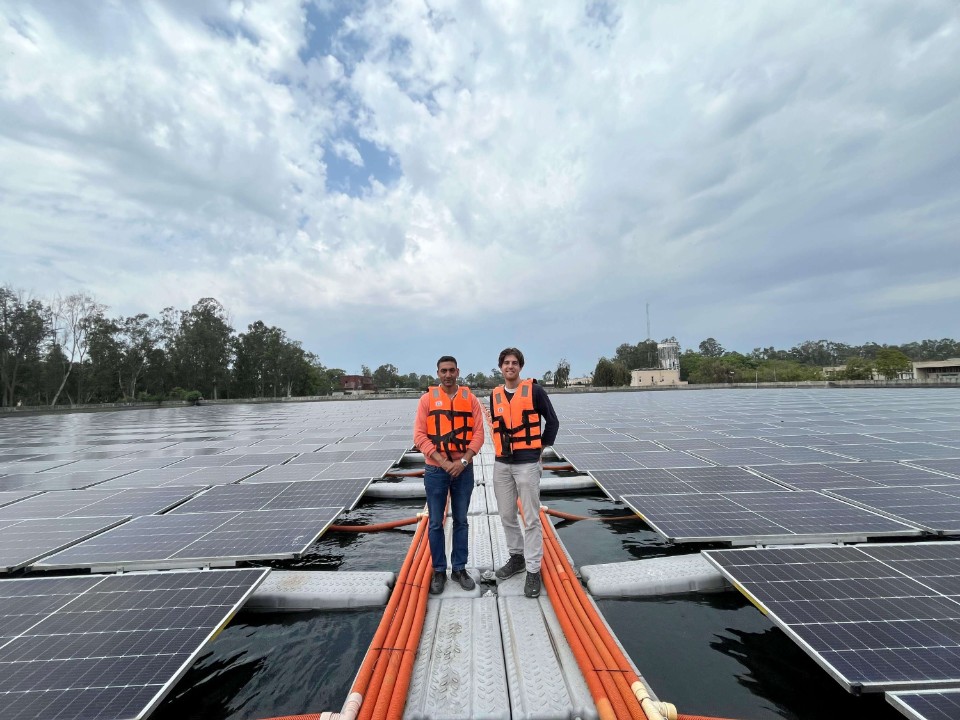
Floating photovoltaic systems and agrivoltaics will be central to the partnership. Floating PV plants place solar modules on water bodies, while agrivoltaic systems combine electricity generation with agricultural activity on the same land.
The agreement will also support exchange programmes and the joint supervision of master’s and doctoral students, linking institutional research with academic training and the development of specialised expertise.
India’s floating-solar potential draws research interest
Fraunhofer ISE sees considerable scope for floating solar installations in India as the country works towards ambitious renewable-energy expansion targets.
Dr. Karolina Baltins, Group Leader for PV Power Plants at Fraunhofer ISE, said India’s potential makes it an important location for further research. However, she noted that India and Europe face several common challenges, including uncertain approval procedures, public concerns and unanswered questions surrounding project economics.
Researchers also need to better understand the long-term reliability of floating solar systems and their effects on aquatic environments, she said. Cooperation between Indian and German institutions could allow both countries to exchange evidence and develop solutions based on their respective experience.
Unlike conventional ground-mounted solar parks, floating PV systems can use reservoirs, mining lakes and other suitable water surfaces for power generation. This can limit competition for land, although projects require careful assessment of anchoring systems, water conditions, durability, ecological effects and local regulations.
Agrivoltaics addresses a related land-use challenge by allowing crops and solar installations to share the same site. Research in this field examines how the arrangement affects agricultural productivity, water use, microclimates and electricity generation under different environmental conditions.
Fellowship laid the groundwork
The institutional partnership grew out of an Early Career Research Fellowship involving Alexander Graef and Dr. Manish Kumar under the Indo-German Science and Technology Centre.
During 2025, Dr. Kumar spent several weeks visiting research institutions in Germany. The exchange was followed in spring 2026 by a five-week research visit to India by Graef, who worked with Indian organisations and spent a substantial part of the visit at Himachal Pradesh University.
The fellowship provided an initial platform for cooperation between the researchers before the relationship was expanded into a formal agreement between Fraunhofer ISE and the university.
Building a longer-term research and training network
The MoU moves the collaboration beyond individual researcher exchanges by creating a framework for joint projects, student mobility and academic supervision.
For Himachal Pradesh University, the partnership offers access to Fraunhofer ISE’s expertise in photovoltaic power plants and integrated solar applications. Fraunhofer ISE, meanwhile, will gain opportunities to study the deployment of floating PV and agrivoltaic systems under Indian climatic, regulatory and market conditions.
The initiative adds a specialised research dimension to India–Germany clean-energy cooperation. Its eventual impact will depend on the projects developed under the agreement, but the focus on system reliability, environmental assessment and project viability could help generate evidence needed for the responsible expansion of floating solar and dual-use photovoltaic systems.