India and the European Union have drawn up a dedicated work plan under their proposed Free Trade Agreement to address concerns arising from the EU’s Carbon Border Adjustment Mechanism, with particular attention to the compliance challenges facing Indian small and medium enterprises.
Speaking at the Indo-German Chamber of Commerce Industry Dialogue 2026 on July 30, 2026, Darpan Jain, Additional Secretary in the Department of Commerce and India’s chief negotiator for the FTA, said the proposed trade agreement contains a separate annexure dealing with CBAM-related issues.
The framework covers emissions verification, calculation of embedded carbon, recognition of verifiers by EU authorities and the possible treatment of carbon costs paid by Indian companies in India.
“CBAM compliances are a concern among SMEs in terms of verification, determining the value of embedded carbon and ensuring that verifiers are recognised by EU authorities. There are separate provisions under the agreement to address these issues. We also have a provision to engage with EU authorities on taking into account the carbon price paid in India,” Jain said.
India’s domestic carbon price part of discussions
Jain said India and the EU had prepared a comprehensive framework to help Indian industry comply with the bloc’s carbon-related import rules while safeguarding commercial interests.
He also said India’s emerging carbon-pricing mechanism was part of the bilateral discussions.
“As you know, India is also developing its own carbon pricing mechanism. So, how to offset what is paid in India from what is paid in Europe is also part of the discussions,” Jain said.
Under the EU mechanism, an eligible carbon price already paid in the country where goods are produced can be deducted from the corresponding CBAM obligation, subject to the applicable European rules and documentation.
Jain said the annexure includes provisions covering verification processes, calculation of embedded emissions and engagement with EU authorities to ease compliance for smaller exporters.
“I am very hopeful that SMEs will not face any problems,” he said.
The proposed framework does not exempt Indian exporters from CBAM. It creates a mechanism for India and the EU to address technical and compliance matters associated with its implementation.
India and the EU concluded negotiations on their FTA in January 2026. The agreement must complete the required signing, approval and ratification procedures before entering into force.
Sandbag study examines India’s varied CBAM exposure
The significance of plant-level verification and embedded-carbon calculations is also reflected in a study released by Brussels-based climate think tank Sandbag on August 4, 2026.
The report examines India’s CBAM exposure by considering differences within its steel industry, rather than relying only on the country’s average emissions intensity.
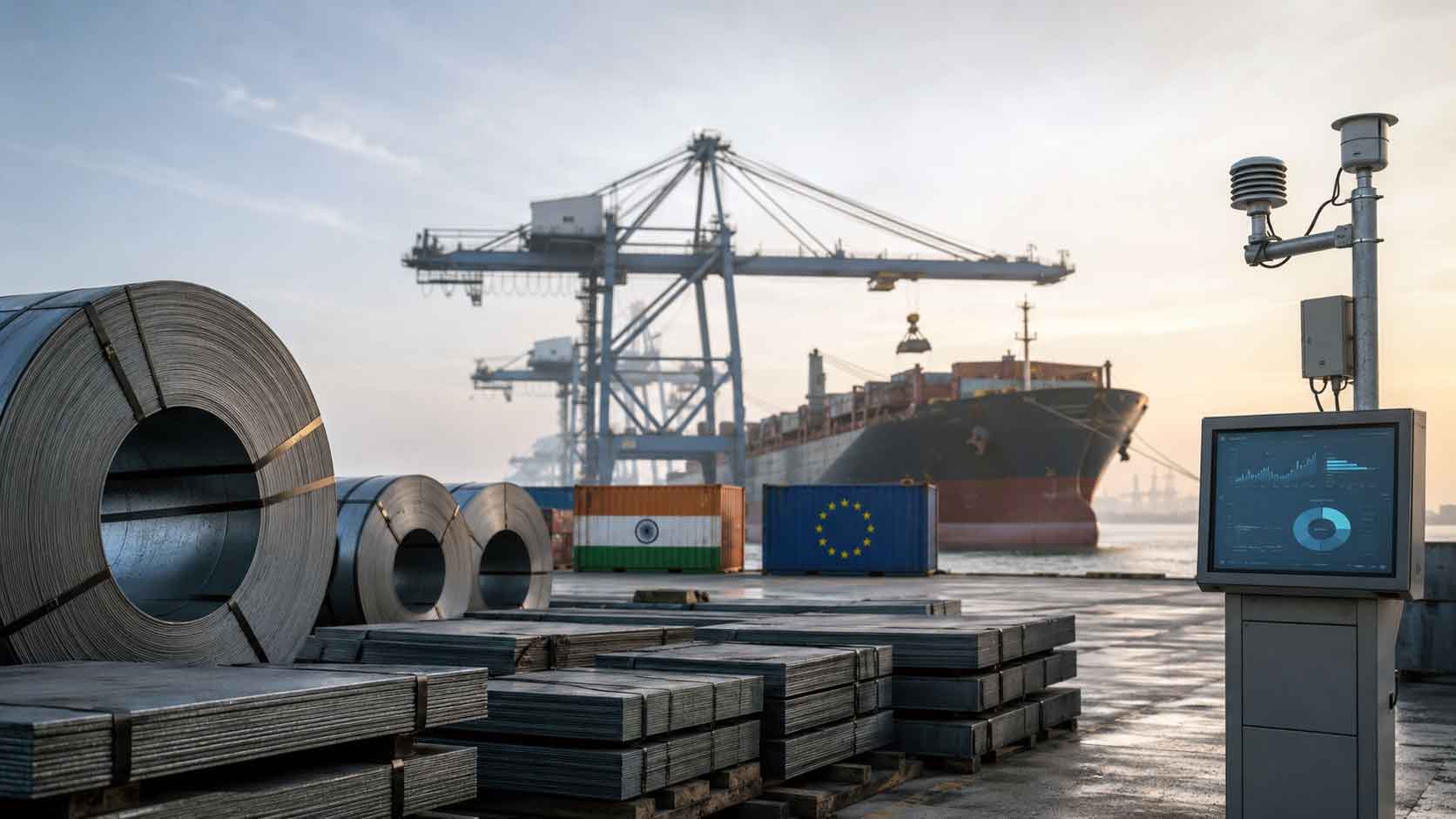
Sandbag estimates that CBAM fees on Indian exports could reach €762 million annually by 2034 under a business-as-usual calculation based on national-average emissions. It argues that this approach does not fully capture the variety of production routes used by Indian steelmakers.
Indian plants use technologies with different emissions levels. According to the report, CBAM costs could therefore vary depending on the type of steel exported, the plant where it is produced, the production process used, the facility’s location and its ability to meet EU monitoring, reporting and verification requirements.
These are also among the issues covered by the India–EU work plan outlined by Jain.
Gross fees estimated at €407 million
After considering lower-emission steel capacity, plant locations, product categories, EU reporting requirements and likely adjustments by exporters, Sandbag estimates gross CBAM fees of approximately €407 million under its “expected” scenario.
The study places the net economic cost at €79 million after including possible additional export earnings arising from higher steel prices in the EU market. The €79-million figure is therefore not the projected CBAM charge, but a modelled net impact after expected price effects.
Sandbag said India exported 4 million tonnes of CBAM-covered steel products in 2025. These comprised 2.59 million tonnes of flat products, 830,000 tonnes of long products and 570,000 tonnes of other goods, including ferro-alloys and pig iron.
The study found that India has sufficient natural gas-based direct reduced iron capacity to match its current flat-steel exports to the EU. It identified ArcelorMittal Nippon Steel’s Hazira plant in Gujarat as one facility with comparatively lower-emission capacity and access to export infrastructure.
For long steel, the report presents a less favourable assessment because Indian exports compete with European steel made largely through lower-emission, scrap-based production.
Verification could influence final liability
Sandbag’s findings indicate that India’s CBAM exposure may differ considerably across companies, plants and products. Access to lower-emission capacity alone would not be sufficient; exporters would also have to document embedded emissions and secure verification recognised under EU rules.
The study’s lower estimates remain modelled scenarios rather than forecasts. They depend on which Indian facilities supply the European market, whether their emissions data meet EU requirements and how carbon costs affect prices within Europe.
The EU’s definitive CBAM regime took effect on January 1, 2026. It covers imports in carbon-intensive sectors including iron and steel, aluminium, cement, fertilisers, electricity and hydrogen.
The India–EU work plan addresses the regulatory and compliance side of the mechanism, while the Sandbag study provides a more detailed assessment of how India’s varied steel capacity, product mix and verified plant-level emissions could determine the financial impact on its exports.
Click here to read the Sandbag study.