
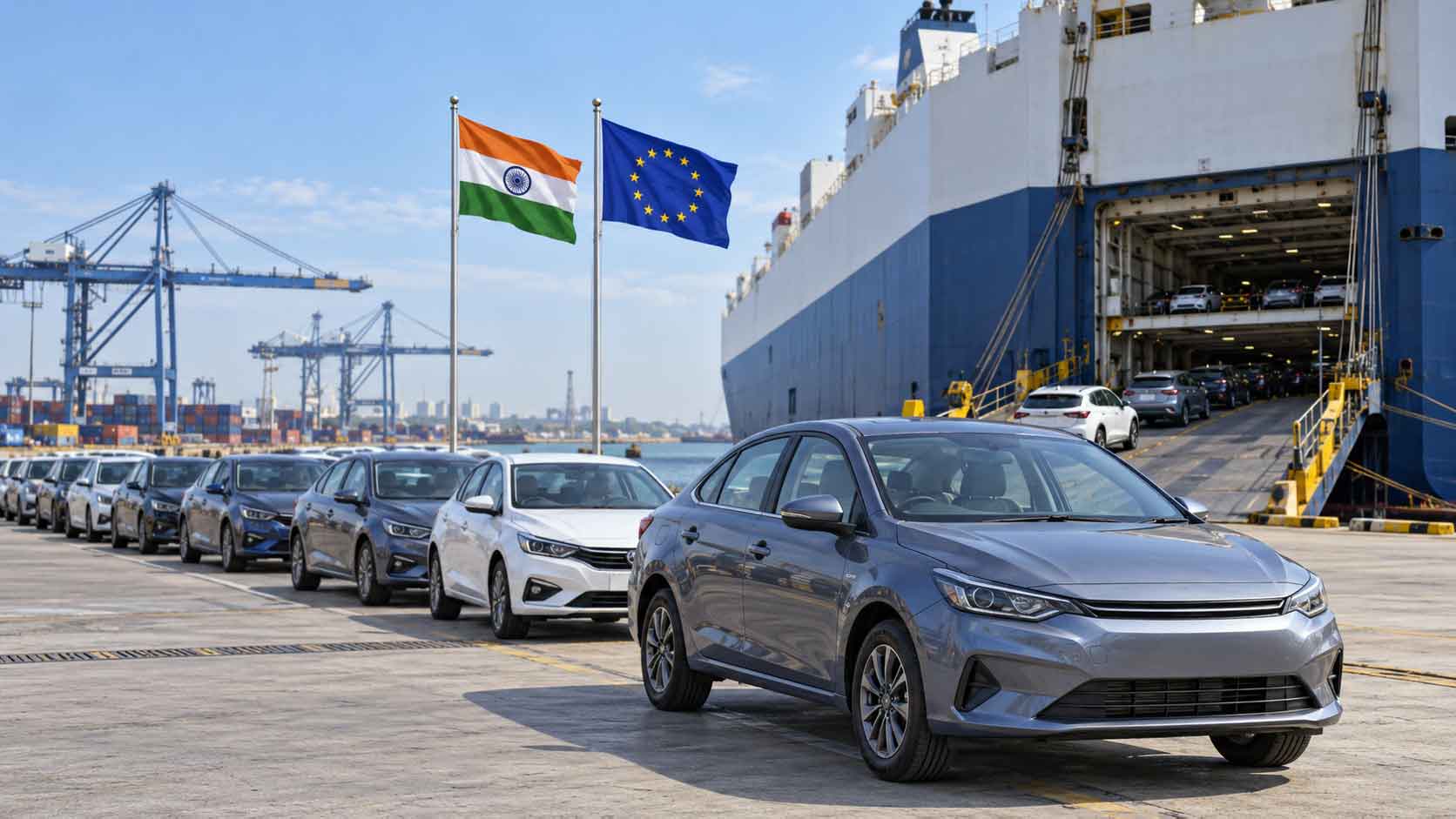
Indian automobile manufacturers are set to gain significantly wider access to the European Union under the India–EU Free Trade Agreement, with an annual concessional-duty quota of 2.5 lakh passenger vehicles proposed from the first year of implementation.
Under the tariff schedule made public after the agreement’s legal review, eligible Indian-origin cars entering the EU within the quota will initially face an import duty of 8%, compared with the current rate of 10%. The preferential duty will be progressively reduced to zero by the fifth year.
The annual quota will also expand gradually, reaching four lakh vehicles by the tenth year of the agreement.
Access for Indian Manufacturers
The concession is expected to create a larger export opportunity for Indian automobile manufacturers seeking to expand their presence in the European market. Preferential access will apply to eligible Indian-origin vehicles priced up to €50,000, subject to the agreement’s rules of origin and other regulatory requirements.
The arrangement could particularly benefit manufacturers using India as a production and export base. However, tariff reductions alone will not guarantee higher shipments, as Indian vehicles will still need to meet the EU’s safety, environmental and technical standards.
India Offers Calibrated Access to European Cars
The automotive provisions are reciprocal but structured differently. India will allow up to one lakh internal-combustion and hybrid passenger vehicles from the EU at reduced duties in the first year, with the quota increasing to 1.6 lakh by the tenth year.
European cars priced below €15,000 will remain outside the preferential arrangement, protecting the mass-market segment that accounts for much of India’s domestic passenger-vehicle sales. Tariffs on eligible European vehicles will begin at 30–35%, depending on their value, before declining to 10% from the fifth year.
A separate arrangement has been proposed for electric vehicles, with concessions delayed to provide additional time for India’s domestic EV industry to develop.
FTA Yet to Enter into Force
India and the EU concluded negotiations on the trade agreement on January 27, 2026. On September 11, the European Commission formally submitted proposals to the Council of the European Union seeking authorisation for its signature and conclusion.
The agreement will enter into force only after completing the required approval and ratification processes on both sides. The automobile quotas and reduced tariffs will therefore become operational from the agreement’s first year of implementation, rather than immediately.
For India’s automobile industry, the provisions open a substantially larger preferential route into the 27-member European market. Their eventual impact will depend on manufacturers’ ability to meet European standards, establish distribution networks and offer vehicles suited to local demand.