
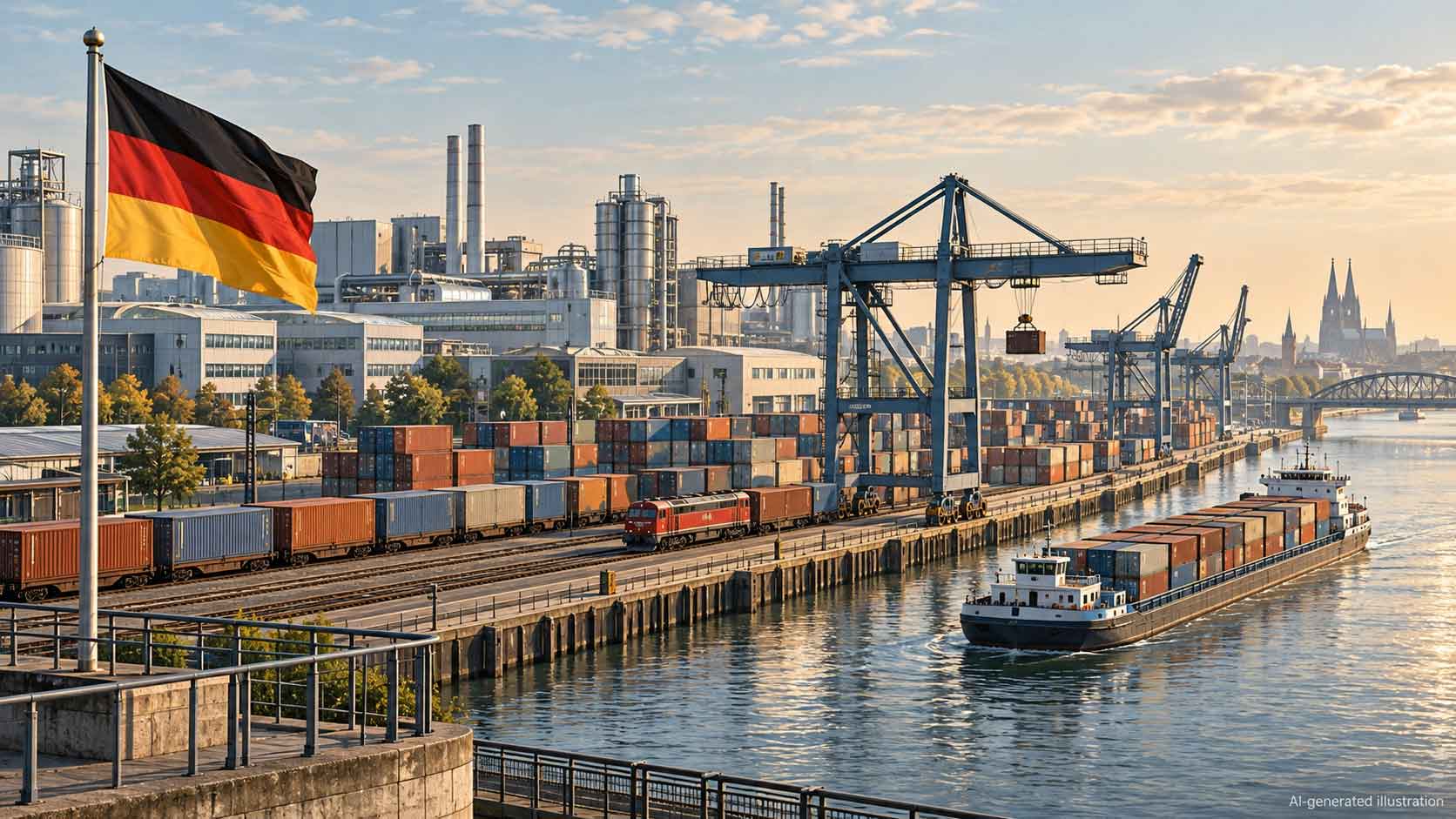
Germany has raised its economic growth forecast for 2026 to 1.3%, up from the 0.5% projected in the spring, as stronger exports and public spending support a recovery. The government also increased its forecast for 2027 to 1.1%, from 0.9%.
The autumn projections, presented by Federal Minister for Economic Affairs and Energy Katherina Reiche on October 8, point to an improved outlook for Europe’s largest economy. However, subdued household spending and constraints on private investment continue to limit the recovery.
Exports and Government Spending Drive Growth
Exports are expected to increase by 3.7% in 2026, followed by growth of 2.1% in 2027 and 1.1% in 2028. Government investment in infrastructure and defence is also supporting economic activity. Minister Reiche said the initial recovery needed to develop into sustained economic momentum, with further reforms necessary to support lasting growth.
Part of the improvement in trade during the second quarter reflected a temporary development: global shortages prompted buyers to replenish inventories of energy-intensive goods produced in Germany. This suggests that some of the recent export strength may not represent a lasting acceleration in demand.
Private Investment Remains Under Pressure
Private consumption is expected to remain restrained initially, as higher energy-related consumer prices weigh on household purchasing power despite continued gains in real wages.
Businesses also face low capacity utilisation, higher material and financing costs, and structural challenges. The government expects private investment to recover gradually during 2027, indicating that the stronger headline forecast has yet to translate into a broad improvement in business spending.
Inflation and Employment Temper the Outlook
The official projections put consumer-price inflation at 2.7% in 2026 and 3.0% in 2027, before easing to 2.2% in 2028.
The labour-market outlook remains subdued. Employment is projected to decline by 0.5% in 2026 and 0.4% in 2027, while the unemployment rate is expected to remain at 6.4% in both years. These forecasts indicate that improving economic output may coexist with continued pressure on employment.
A Stronger Forecast, With Limits
Germany’s economy grew by 0.2% in 2025. The projected expansion of 1.3% this year would mark an improvement, although growth is expected to moderate to 1.1% in 2027 and 0.6% in 2028.
The revised outlook offers a more encouraging picture of Germany’s economy. The durability of the recovery will depend on whether export gains and public spending are accompanied by stronger private investment and household demand.