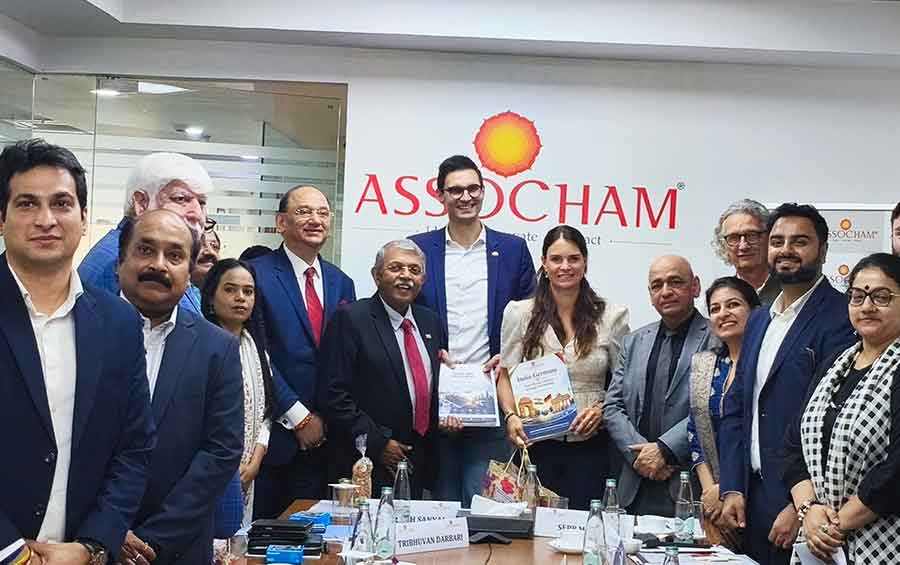
Picture Credit: ASSOCHAM
A German parliamentary and business delegation comprising Bundestag members Sepp Müller and Vanessa Zobel and Dermapharm Holding SE CEO Dr Hans-Georg Feldmeier met Indian industry representatives in New Delhi to discuss defence manufacturing, railways, logistics and technology cooperation, according to an ASSOCHAM statement issued on 29 October 2026.
Hosted by the Associated Chambers of Commerce and Industry of India (ASSOCHAM), the interaction examined opportunities for Indian and German companies to collaborate on product development, manufacturing and international supply chains. No signed agreements, investment commitments or contracts were announced in the statement.
Mr Müller participated as Deputy Chairman of the CDU/CSU Parliamentary Group in the German Bundestag, alongside Ms Zobel, a Bundestag member belonging to the same parliamentary group. Simran Dhingra, Head of International Cooperation at the Konrad-Adenauer-Stiftung’s India Office, also participated.
ASSOCHAM Secretary General Saurabh Sanyal and Tribhuvan Darbari, Chairman of the BIMSTEC Business Council Secretariat and Chairman of ASSOCHAM’s India–Eurasia Business Council, addressed the gathering.
Defence manufacturing and technology cooperation
Defence industrial cooperation was among the principal subjects raised during the meeting. Mr Sanyal highlighted opportunities for collaboration in technology development, manufacturing and industrial participation.
The discussions also covered possible cooperation in ports, shipbuilding and submarines. Mr Darbari pointed to the potential for combining German technology with Indian manufacturing capabilities and workforce skills to serve domestic and overseas markets.
These references concerned possible areas of industrial collaboration. The statement did not identify a specific defence agreement or report progress on an individual procurement programme.
Railways, freight corridors and logistics
Railway modernisation formed another substantial part of the discussions, with Mr Darbari identifying metro systems, freight corridors, logistics and advanced tunnelling technologies as potential areas for cooperation.
He proposed that German original equipment manufacturers work with Indian public- and private-sector companies through technology transfer, local manufacturing and joint participation in infrastructure projects. The possibilities outlined extended to projects in India and third-country markets.
The meeting also brought together representatives from transport, logistics, automotive and defence businesses, alongside economic research professionals. Participants included Sanjay Bajpai, Saandip Wadhwa, Vipin Vohra, Rajkiran Kanagala, Sushil Rajput and Dr Ambika Sharma.
Proposal to connect Indian MSMEs with German Mittelstand
A more specific proposal concerned partnerships between Indian micro, small and medium enterprises, startups and Germany’s Mittelstand businesses.
Mr Darbari proposed an ASSOCHAM-led initiative to help companies identify suitable technology partners and develop supplier relationships. The proposal focused on creating opportunities for smaller businesses to participate in industrial cooperation between the two countries.
The statement did not provide an implementation schedule or identify companies that would participate in the proposed initiative.
ASSOCHAM Chief Economist Dr S. P. Sharma also presented a framework developed by the chamber to examine factors affecting the ease of doing business in India. According to the statement, the framework brings together indicators to assess the country’s progress towards its development objectives.
Parliamentary participation in business engagement
The delegation’s composition brought German legislators and business representatives into discussions with Indian industry. The detailed sectoral proposals outlined in the statement were largely attributed to ASSOCHAM representatives, without corresponding German commitments being announced.
Mr Müller and Ms Zobel also attended the German Embassy’s Day of German Unity reception in New Delhi on 27 October, according to the Embassy.
At that event, German Ambassador to India and Bhutan Dr Jasper Wieck highlighted the role of parliamentarians in connecting bilateral relations with citizens, businesses and civil society.
The ASSOCHAM interaction reflected the industrial dimension of India–Germany relations, with discussions extending from large infrastructure and manufacturing projects to partnerships among smaller suppliers. Joint production, technology exchange and business matchmaking emerged as areas for further engagement.