Photo Credit: German Embassy, New Delhi
Germany’s participation at the IndiaAI Impact Summit underscored a pragmatic approach to artificial intelligence—one that prioritises usability and real-world outcomes over technological complexity, particularly in the agricultural sector.
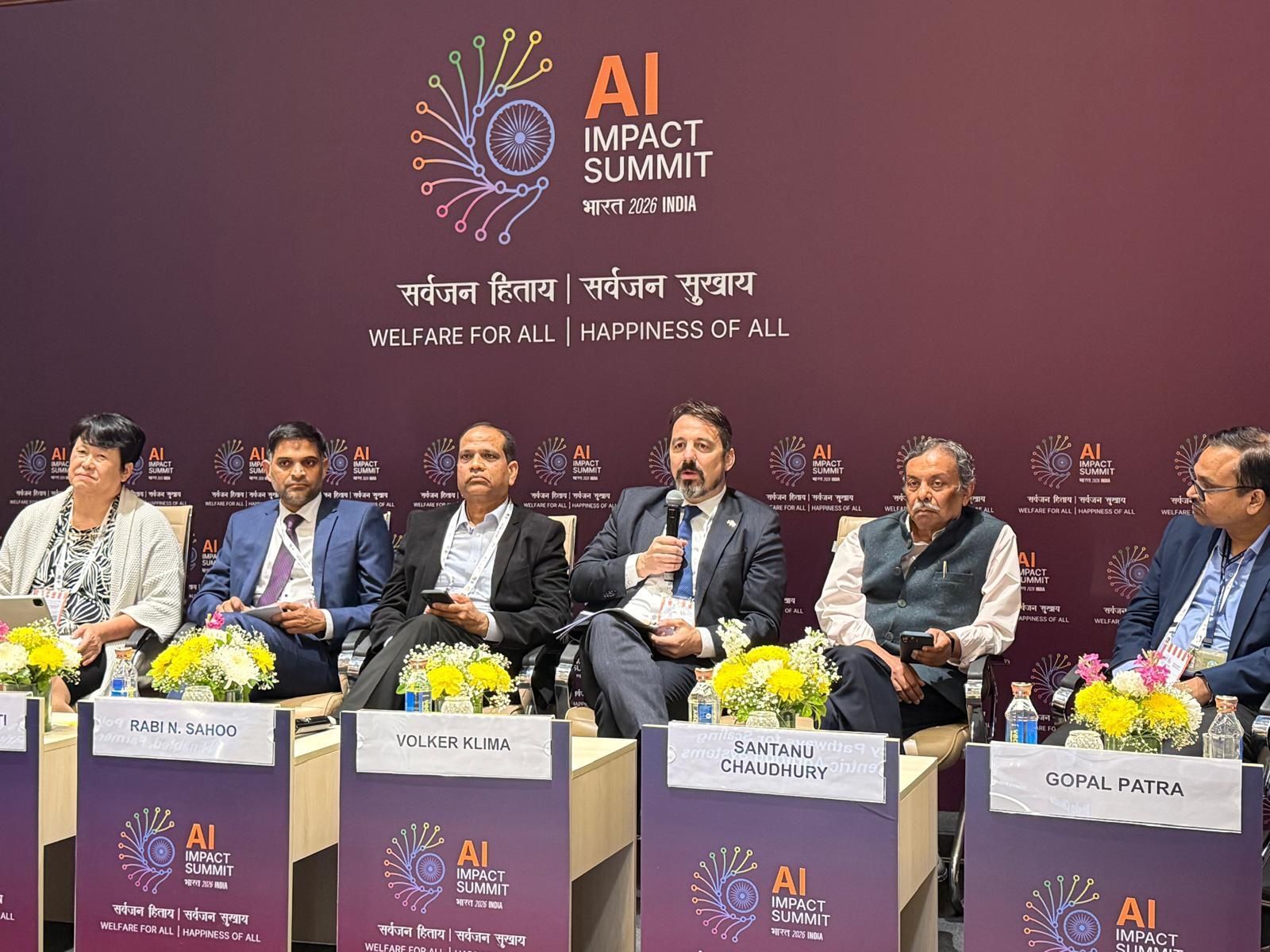
At a thematic panel focused on AI-enabled agriculture, Volker Klima, Head of Division for Agriculture and Food, highlighted the need for digital tools that directly assist farmers in managing climate risks, crop planning and decision-making—without requiring advanced technical knowledge. The discussion reinforced the view that artificial intelligence must simplify farming practices rather than complicate them.
The session was organised under the ACRAT (Accelerating Climate-Resilient Agriculture in Telangana) initiative, funded by Germany’s Federal Ministry of Agriculture, Food and Regional Identity. The project is implemented in close collaboration with Indian partners, including state-level agricultural institutions in Telangana, and focuses on strengthening climate resilience for small and marginal farmers.
According to official German documentation, ACRAT integrates satellite imagery, weather data, local agronomic inputs and AI-based analytics to generate practical, location-specific advisories. The objective is to translate complex climate and risk data into actionable guidance that farmers can use for crop selection, irrigation planning and risk mitigation. Importantly, the project follows a “human-in-the-loop” approach, ensuring that technology supports—rather than replaces—farmer judgement and extension services.
Germany’s intervention at the summit aligned with the broader goals of the IndiaAI Impact Summit, which, as outlined by the Government of India, is positioned as a global platform to advance responsible, inclusive and application-driven AI. Officially, the summit emphasises AI’s role in priority sectors such as agriculture, healthcare, education and governance, with a strong focus on ethical deployment, accessibility and public value.
Agriculture has been identified as a key area where artificial intelligence can deliver tangible impact—through improved climate forecasting, precision farming, early warning systems and data-driven advisory services. The ACRAT project was presented as an example of how international collaboration can support these objectives at the grassroots level.
Panel discussions at the summit reiterated that farmers do not require sophisticated digital systems or experimental technologies. What is needed are affordable, reliable and easy-to-use tools that can be deployed at scale. Germany’s approach, speakers noted, lies in piloting solutions in real farming environments, supporting innovation ecosystems and scaling models that demonstrate measurable benefits.
The session also echoed a wider message emerging from the summit: artificial intelligence in agriculture should enhance human capability, not displace it. As participants emphasised, without farmers there is no food system—regardless of how advanced technology becomes.
Germany’s engagement at the IndiaAI Impact Summit reflects a growing convergence with India on responsible AI deployment—where innovation is judged not by its sophistication, but by its ability to strengthen food security, rural resilience and sustainable development.