Photos: PMO India
India and Germany on Monday agreed on an expansive roadmap to strengthen cooperation in higher education, trade, defence manufacturing, clean energy, skills and strategic affairs as Prime Minister Narendra Modi and German Chancellor Friedrich Merz held wide-ranging talks during the latter’s first official visit to India and Asia.
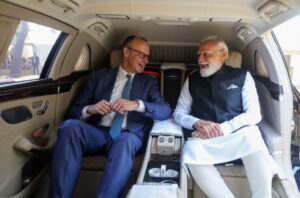 The two leaders also exchanged views on the Russia–Ukraine conflict, the situation in Gaza, regional security and reforms of global institutions, reaffirming their shared commitment to peaceful dispute resolution and coordinated action against terrorism.
Chancellor Merz arrived in Ahmedabad early Monday for a two-day official visit, his maiden trip to India since assuming office and his first visit to Asia as German Chancellor. The visit coincides with 75 years of India–Germany diplomatic relations and 25 years of the Strategic Partnership, marking a symbolic moment in bilateral ties.
Higher education roadmap, campus invitation and visa-free transit
At a joint press conference following delegation-level talks, PM Modi announced the finalisation of a comprehensive roadmap for higher education cooperation and formally invited German universities to establish campuses in India.
“The comprehensive roadmap on higher education that we have developed today will give a new direction to our partnership in the field of education. I invite German universities to open their campuses in India,” PM Modi said.
He also welcomed Chancellor Merz’s decision to allow visa-free airport transit for Indian citizens. “I express my gratitude to Chancellor Merz for announcing visa-free transit for Indian citizens,” PM Modi added, describing the step as a boost to people-to-people ties and academic mobility.
PM Modi said the leaders discussed major geopolitical developments. “India stands for the peaceful resolution of all problems and disputes and supports all efforts being made in this direction,” he said, adding that both countries were united against terrorism.
“We are unanimous that terrorism is the ultimate evil of humanity. India and Germany will come together and continue to fight it resolutely.”
He also reiterated the need for reform of international institutions. “India and Germany are jointly working through the G4 framework to reform the UN Security Council so that global institutions can reflect contemporary realities.”
CEOs Forum: trade crosses $50 billion, technology and renewables highlighted
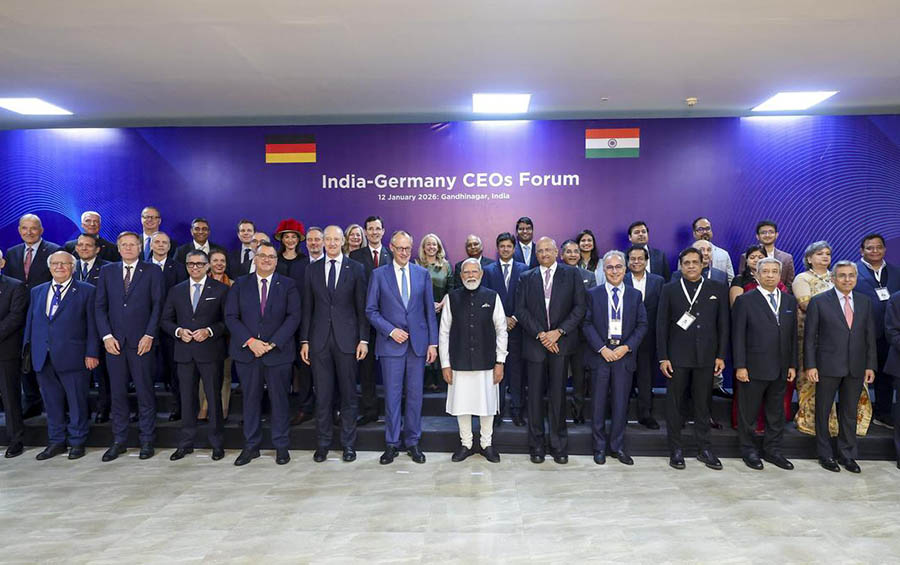
Earlier in the day, PM Modi and Chancellor Merz addressed business leaders at the India–Germany CEOs Forum in Ahmedabad, attended by top executives from manufacturing, automotive, energy, technology and financial services sectors.
PM Modi highlighted the sharp growth in economic ties. “Our bilateral trade has reached its highest level ever, surpassing the 50 billion dollar mark. More than 2,000 German companies have a long-standing presence in India. This reflects their unwavering confidence in India and the immense opportunities available here,” he said.
On technology cooperation, PM Modi added: “Technology cooperation between India and Germany has strengthened year after year, and its impact is clearly visible on the ground today.”
Emphasising energy collaboration, he announced a new institutional platform. “India and Germany share common priorities in the field of renewable energy. To further enhance this cooperation, we have decided to establish the India-Germany Centre of Excellence. This will serve as a shared platform for knowledge, technology and innovation.”
Several Memoranda of Understanding were signed covering renewable energy, industrial collaboration, skills development and research partnerships.
Defence, skills and strategic manufacturing cooperation
During delegation-level talks at Mahatma Mandir in Gandhinagar, the two sides reviewed cooperation in trade, investment, technology, education, skilling and mobility, and explored deeper collaboration in defence, security, science, innovation, research and sustainable development.
India and Germany signed a declaration to strengthen defence industrial cooperation, focusing on co-development and co-production of military platforms and systems. Both sides also agreed to expand joint naval and air force exercises.
PM Modi said: “India and Germany are not just economic partners, but two nations committed to global peace and stability.”
A new framework on skills and migration was also unveiled. “Special emphasis has been placed on development, migration, mobility and skill enhancement. India’s talented youth are making a significant contribution to the German economy,” PM Modi said.
Referring to the new agreement: “The Joint Declaration of Intent on the Global Skills Partnership issued today is a symbol of this trust. This will particularly facilitate the movement of healthcare professionals.”
The leaders also reiterated their commitment to concluding negotiations on the India–EU Free Trade Agreement to unlock further economic growth.
‘Cooperation vital for humanity,’ says PM Modi
Stressing the broader global relevance of bilateral ties, PM Modi said: “Close cooperation between the economies of countries like India and Germany is important for all of humanity. Growing trade and investment ties have infused new energy into our strategic partnership.”
Linking the visit to India’s intellectual heritage, he added: “It is a happy coincidence that Swami Vivekananda himself built the bridge of philosophy, knowledge and faith between India and Germany. Today, Chancellor Merz’s visit is giving new energy, new confidence and new dimensions to that very bridge.”
PM Modi highlighted the symbolic importance of the visit. “This is his first visit to India, and indeed to Asia, as Chancellor. It is strong evidence of the importance he attaches to relations with India. I express my sincere gratitude to him for his personal attention and commitment.”
He also noted: “Last year, we completed 25 years of our strategic partnership, and this year we are celebrating 75 years of our diplomatic relations. These milestones symbolise our shared ambitions, mutual trust and ever-strengthening cooperation.”
Chancellor Merz: FTA, defence and clean energy priorities
Addressing reporters, Chancellor Merz said Germany wanted to elevate relations to a new level. “We want to elevate the relations between India and Germany to an even higher level.”
On sustainability and urban development, he said: “We are jointly pursuing new projects in areas such as climate, energy, urban development and urban mobility. The new mega-project by companies from both countries in green hydrogen will prove to be a game-changer for future energy.”
On supply chains and defence: “India and Germany are working together to build secure, trusted and resilient supply chains. The MoUs signed today on all these subjects will give new momentum and strength to our cooperation. The growing cooperation in defence and security is a symbol of our mutual trust and shared vision.”
Calling for faster trade integration, he added: “To tap into the full potential of India-Germany economic relations, we need to conclude the negotiations on a free trade agreement between India and the European Union.”
Thanking PM Modi for hosting him in Gujarat, Chancellor Merz said: “You invited me to visit your home state of Gujarat. I express my heartfelt gratitude for this special gesture. It is a sign of very deep ties between our two countries, and also a testament of friendship towards me.”
Green ammonia agreement welcomed
German state-owned utility Uniper announced a long-term agreement with India’s AM Green to purchase up to 500,000 tonnes of green ammonia annually, starting in 2028.
Uniper CEO Michael Lewis said: “This agreement with AM Green is a key building block in our strategy to provide our customers with reliable access to renewable and low-carbon molecules at scale.”
PM Modi welcomed the agreement at the joint press briefing, calling it a strong signal of growing clean-energy cooperation.
Gandhi Ashram visit and kite festival diplomacy
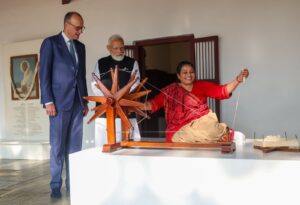 Earlier in the day, PM Modi welcomed Chancellor Merz at the Sabarmati Ashram, where both leaders paid floral tributes to Mahatma Gandhi, visited Hriday Kunj and observed traditional charkha spinning.
They later jointly inaugurated the International Kite Festival 2026 at the Sabarmati Riverfront, interacting with participants from India and abroad and flying kites together.
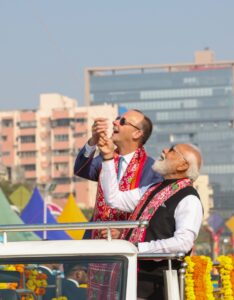 The festival features 135 international kite flyers from 50 countries, along with 65 participants from across India and 871 from Gujarat, and will run until January 14. Gujarat expects over five lakh visitors during the event.
What lies ahead
Chancellor Merz will visit Bosch and the Centre for Nano Science and Engineering (CeNSE) in Bengaluru on January 13 before departing for Germany.
The visit follows PM Modi and Chancellor Merz’s interaction at the G7 Summit in Canada and comes ahead of the India–EU Summit scheduled for January 27, which is expected to further shape New Delhi’s engagement with Europe.