Photo Credit: Dr. S Jaishankar
External Affairs Minister Dr. S Jaishankar concluded a high-intensity diplomatic engagement at the Munich Security Conference (MSC), using the platform to articulate India’s worldview amid a volatile global environment while foregrounding India–Germany and India–European Union cooperation.
Global context: a summit shaped by uncertainty
The 62nd Munich Security Conference, held from February 13 to 15, unfolded against the backdrop of continuing conflicts in Europe and West Asia, intensifying US–China strategic rivalry, supply-chain disruptions, and renewed debates on multilateral reform. Nearly 50 heads of state and government, senior ministers, military leaders, and policy thinkers participated, with a strong European presence and a large German delegation led by Chancellor Friedrich Merz.
Discussions across panels focused on global security architecture, de-risking and economic resilience, energy security, maritime stability, and the future of multilateral institutions—areas where India’s growing role featured prominently.
India, G7 and UN reform
On Saturday, February 15, Dr. Jaishankar met foreign ministers from the G7 countries, reiterating India’s support for the UN@80 agenda and long-standing calls for meaningful reform of the United Nations Security Council.
“Reiterated India’s support of the UN@80 agenda, particularly meaningful reform of the UN Security Council,” Jaishankar said in a post on X. He also underlined India’s contribution to global security through safeguarding sea lines of communication, first-responder roles, port security, and resilient submarine cable infrastructure.
The UN@80 initiative, launched in March 2025 by UN Secretary-General António Guterres, seeks to modernise the UN’s mandates and working methods ahead of its 80th anniversary.
Strong India–Germany focus at MSC
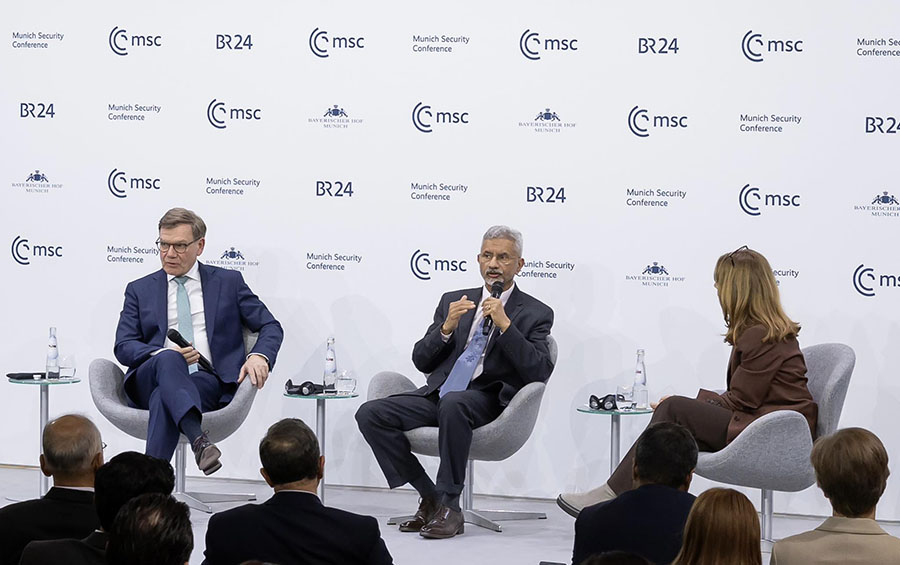
India–Germany relations formed a central thread of Dr. Jaishankar’s Munich engagements. He held talks with Foreign Minister Johann Wadephul and joined him on a panel titled “Navigating Uncertainty: India and Germany in a World in Disarray”. The discussion explored how closer India–Germany and India–EU cooperation can support global security, economic stability, and de-risking efforts.
Dr. Jaishankar also met Jens Spahn, leader of the Christian Democratic Union (CDU) in the Bundestag, appreciating bipartisan German support for deeper bilateral engagement.
The meetings followed January’s India–Germany summit in Gandhinagar, where Prime Minister Narendra Modi and Chancellor Merz oversaw the signing of 19 agreements spanning defence industrial cooperation, higher education, critical minerals, semiconductors, and a visa-free transit regime for Indian passengers through Germany.
India–EU FTA takes centre stage
Dr. Jaishankar’s interventions in Munich also came weeks after India and the European Union concluded negotiations for a landmark India–EU Free Trade Agreement on January 27. Covering nearly a quarter of global GDP, the pact is expected to eliminate tariffs on 99% of Indian exports to the EU and reduce duties on over 97% of EU exports to India.
At the roundtable “Delhi Decided: Mapping India’s Policy Calculus”, organised by the Ananta Aspen Centre, Jaishankar described the FTA as a strategic and economic inflection point for India–Europe relations.
In conversation with Indrani Bagchi, he stressed the importance of a nimble and dynamic foreign policy in a multipolar world, noting that India’s growth strategy is closely linked to diversified partnerships across Europe.
Strategic autonomy amid global pressures
Responding to questions on India’s interim trade agreement with the United States and energy ties with Russia, Jaishankar reiterated that strategic autonomy remains central to Indian foreign policy.
“We are very much wedded to strategic autonomy,” he said during his joint session with Wadephul, emphasising that independent decision-making is deeply embedded in India’s diplomatic history and political consensus.
Broader diplomatic outreach on the sidelines
Beyond the main sessions, Jaishankar met Romania’s Foreign Minister Oana-Silvia Țoiu to review bilateral ties, and held discussions with Keith Svendsen on maritime infrastructure cooperation.
He also exchanged views with Wolfgang Ischinger, noting that MSC 2026 offered a timely platform to present India’s perspectives and engage with global stakeholders.
India’s message from Munich
As the Munich Security Conference concluded on February 15, India’s message was consistent: New Delhi sees Europe—and Germany in particular—as a pivotal partner in shaping a stable, rules-based, and multipolar international order, even as it preserves strategic autonomy and expands its economic and security footprint across the EU.