Photo Credit: Ministry of Finance/India
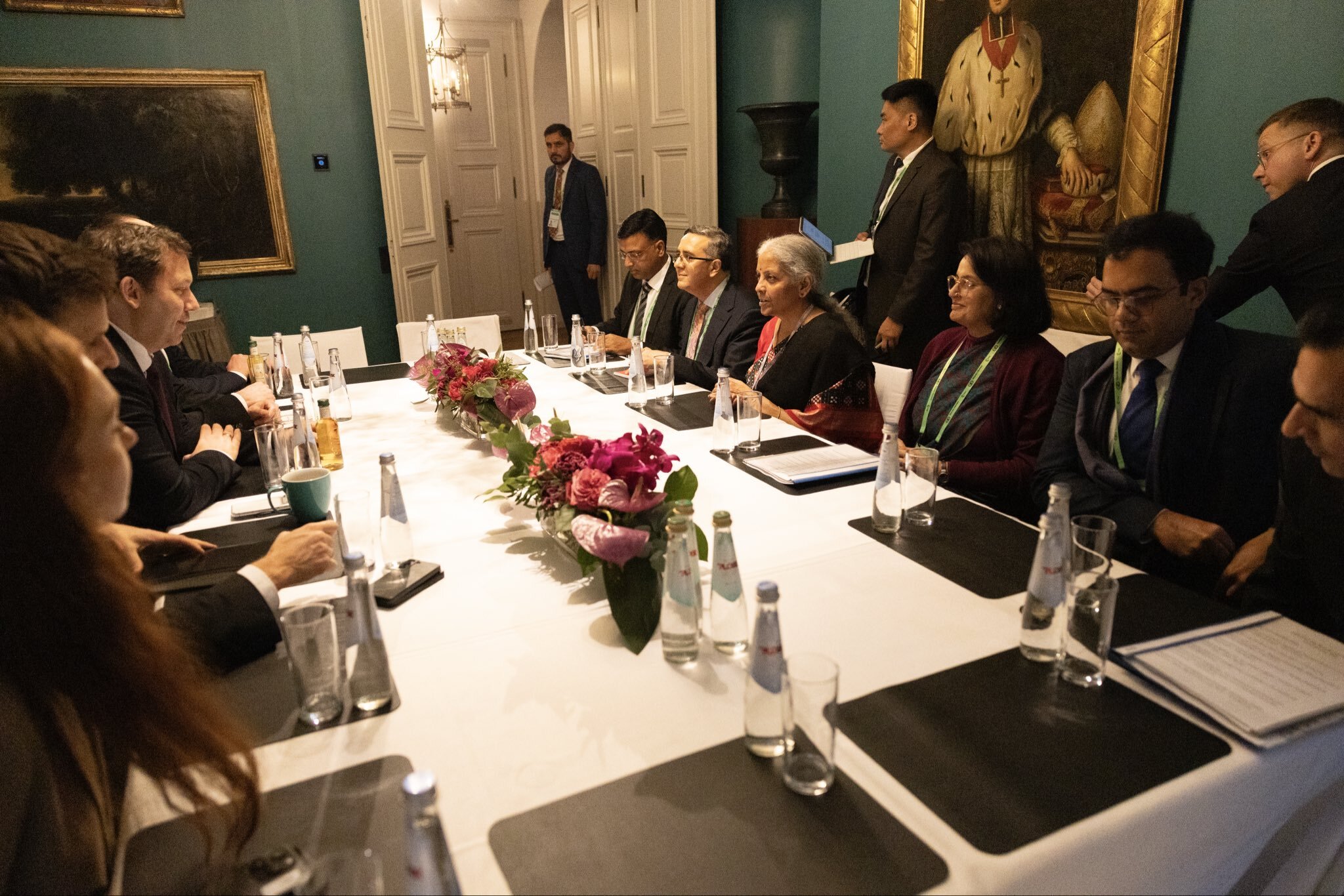
Union Minister for Finance and Corporate Affairs Nirmala Sitharaman held a series of high-level meetings in Munich during her visit to Germany from February 14–15, 2026, with discussions centred on the recently concluded India–European Union Free Trade Agreement (FTA), climate finance, manufacturing partnerships and investment flows.
The engagements took place on the sidelines of the Munich Security Conference 2026, where the Finance Minister participated in select roundtables and panel discussions while holding bilateral meetings with political leaders, industry heads and multilateral institutions.
Maritime investment and India–EU trade momentum
During her Munich visit, Sitharaman met Keith Svendsen, Chief Executive Officer of APM Terminals. According to the Ministry of Finance, discussions focused on the commercial and strategic advantages of the India–EU FTA finalised in January 2026.
Svendsen highlighted APM Terminals’ long-standing presence in India’s maritime ecosystem and outlined ongoing investments and partnerships across ports, logistics and container infrastructure. He also expressed the company’s intent to further expand its footprint in India. The CEO welcomed India’s reform trajectory, particularly deregulation measures and improvements in ease of doing business, and took note of Union Budget 2026–27 announcements, including those related to container manufacturing.
Bavaria talks underline climate finance, skills and recycling
The Finance Minister also met Eric Beisswenger, Bavarian Minister for European and International Affairs. Sitharaman noted that the discussions followed German Chancellor Friedrich Merz’s official visit to India on January 12–13, 2026, which had reinforced the depth of the bilateral partnership.
Both sides reviewed the implications of the India–EU FTA and explored cooperation avenues in climate finance, green and sustainable partnerships, and the exchange of best practices in recycling and circular economy industries. Minister Sitharaman also highlighted India’s renewed focus on skilling, drawing attention to Budget 2026–27 provisions, particularly in the healthcare sector.
ECB engagement focuses on trade facilitation
In a separate meeting, Minister Sitharaman met Christine Lagarde, President of the European Central Bank. Both leaders welcomed the finalisation of the India–EU FTA in January 2026 and discussed the role European financial institutions could play in facilitating trade flows under the agreement.
The Finance Minister underlined that India’s Union Budgets 2025–26 and 2026–27 provide for EU banks to open up to 15 branches in India over four years within the FTA framework, aimed at strengthening financial connectivity and trade financing.
Engagements with Liechtenstein and global finance leaders
Minister Sitharaman also met Brigitte Haas, Prime Minister of Liechtenstein, and Alois Philipp Maria. Discussions covered existing investments by Liechtenstein-based companies in India and prospects for scaling partnerships in manufacturing, environment-friendly technologies, agriculture-related equipment and climate solutions.
She outlined investment opportunities through the National Investment and Infrastructure Fund (NIIF) and the International Financial Services Centres Authority (IFSCA), positioning GIFT City as a financial gateway for global investors.
In another engagement, Minister Sitharaman met Vera Songwe, Chair and Founder of the Liquidity and Sustainability Facility, with talks focusing on global capital markets and fiscal constraints facing emerging economies amid evolving geopolitical conditions.
India–Germany finance dialogue and industrial outreach
The Finance Minister also held talks with Lars Klingbeil, Vice Chancellor and Federal Minister of Finance of Germany. Both leaders referred to the January 2026 meeting between Prime Minister Narendra Modi and Chancellor Merz, noting progress in defence, trade and technology cooperation.
Klingbeil described the India–EU FTA as a significant step for trade and investment, highlighting development cooperation and metro rail expansion projects in India. India’s Finance Minister, in turn, highlighted India’s digital public infrastructure and expressed readiness to share best practices related to India’s digital payments and technology stack.
Industry interaction with BMW
Minister Sitharaman also met Oliver Zipse, Chairman of the Board of Management of BMW AG. Discussions focused on India’s economic reforms, policy continuity and the long-term investment outlook. The Finance Minister outlined India’s Viksit Bharat 2047 vision, supported by reforms in GST, customs, manufacturing and Production-Linked Incentive (PLI) schemes, with particular emphasis on electric mobility, energy efficiency and battery infrastructure.
Broadening post-FTA engagement
According to the Ministry of Finance, Sitharaman’s Munich engagements reflect India’s broader post-FTA economic diplomacy, aimed at deepening partnerships across trade, finance, manufacturing, technology and climate action with Germany, the EU and key European stakeholders.