Photos’ Credit: x.com/DrSJaishankar
India’s External Affairs Minister Dr. S. Jaishankar concluded a high-level visit to Brussels with a strong push for deeper India–European Union engagement, underlining that “today’s geopolitical uncertainty makes a clear case for deeper partnerships.”
During the visit, Dr. Jaishankar participated in discussions with the EU Foreign Affairs Council and held meetings with top EU leadership, including European Commission President Ursula von der Leyen, European Council President António Costa, and EU High Representative for Foreign Affairs and Security Policy Kaja Kallas.
In a post-visit statement, Dr. Jaishankar described the engagements as “productive,” noting that he held “talks with EU HRVP Kaja Kallas” and “separate bilateral discussions with many” EU counterparts.
Focus on Germany and EU leadership engagements
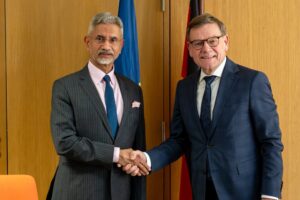 A key highlight of the visit was Dr. Jaishankar’s bilateral meeting with Germany’s Foreign Minister Johann Wadephul, where both sides held “a valuable exchange of notes on the conflict in West Asia.”
Dr. Jaishankar also said the two leaders “took stock of the progress of our bilateral relations following the State visit of Bundeskanzler Friedrich Merz to India in January 2026,” reflecting continued momentum in India–Germany ties within the broader EU framework.
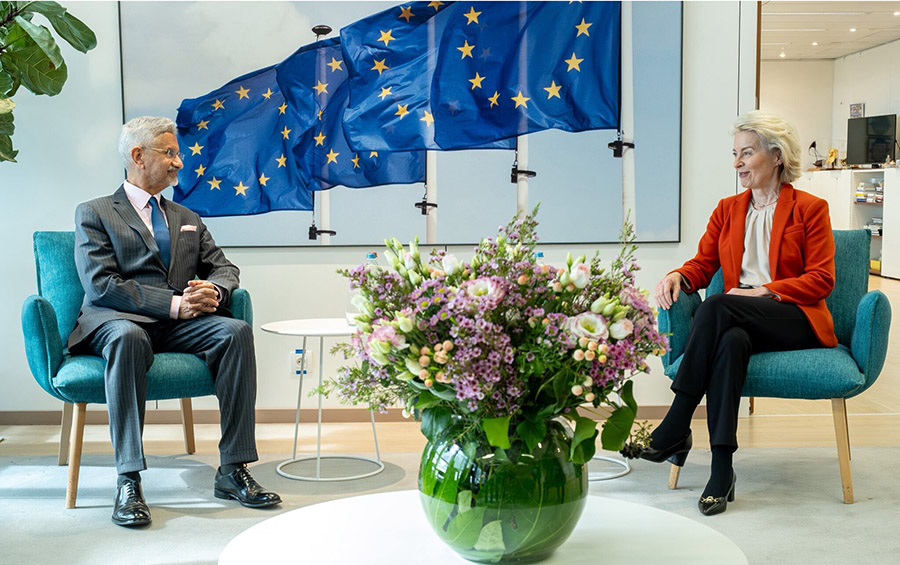
At the EU level, Dr. Jaishankar’s discussions with Ursula von der Leyen on Monday, March 16, 2026, focused on trade, including advancing the long-pending India–EU Free Trade Agreement (FTA), as well as global geopolitical developments such as the situation in West Asia. According to reports, both sides emphasized the importance of translating strategic intent into tangible economic outcomes.
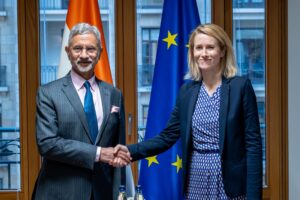 Similarly, his meeting with António Costa and Kaja Kallas covered a wide spectrum of bilateral and global issues, including security cooperation, Indo-Pacific coordination, and strengthening multilateral institutions.
Dr. Jaishankar noted: “Our conversations on various bilateral and global issues were enriching. Agreed to maintain close and continuing contact.”
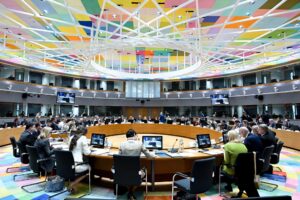
He also thanked Kaja Kallas for inviting him to the EU Foreign Affairs Council meeting, where maritime security and Indo-Pacific coordination were key discussion points.
Other meetings with EU foreign ministers were held on the sidelines, with Dr. Jaishankar noting that he “also met EU counterparts and held separate bilateral discussions with many.”
Strategic context: Security, Indo-Pacific and defence cooperation
 The visit comes shortly after the landmark India–EU Summit held in early 2026, with both sides now seeking to operationalise outcomes across trade, technology, and security.
Minister Jaishankar highlighted that “we are expanding our cooperation through our new Security and Defence Partnership,” signaling a growing convergence on strategic and defence issues.
Discussions at the Foreign Affairs Council also focused on maritime security and strengthening coordination in the Indo-Pacific, reflecting shared concerns over regional stability and supply chain resilience.
Minister Jaishankar’s 10-point roadmap for India–EU partnership
At the conclusion of his visit, Dr. Jaishankar outlined ten key messages that define the future trajectory of India–EU relations:
1. FTA as a turning point
“The finalization of the Free Trade Agreement (FTA) represents a turning point in India–EU ties,” he said, adding that it will “unlock its enormous economic potential” while reflecting the strategic depth of the partnership.
2. Translating FTA into action
Dr. Jaishankar stressed that both sides must “proactively assist each other in practical activities, including trade and investment promotion” to realise the gains of the agreement.
3. Upgrading the Trade and Technology Council
He called for the Trade and Technology Council (TTC) to be “upgraded and repurposed to facilitate collaboration in critical and cutting-edge technologies.”
4. Supply chain resilience
“De-risking supply chains and enhancing resilience are shared objectives,” Dr. Jaishankar noted, adding that the FTA will help deepen business linkages.
5. Talent mobility and GCCs
Highlighting workforce mobility, he said, “Mobility of skills and talent flows are very important,” and welcomed the establishment of the Legal Gateway Office in India. He added that both sides share “a common interest in promoting Global Capability Centers (GCCs) in India.”
6. Advancing defence cooperation
Dr. Jaishankar affirmed that “the Security and Defence Partnership will be taken forward,” with efforts to “conclude the Security of Information Agreement early.”
7. Connectivity and IMEC
Connectivity remains a priority, with both sides set to “work together to give practical shape to IMEC and other such initiatives.”
8. Strengthening multilateralism
“As multilateralism comes under stress, India and the EU will strive to strengthen its institutions and practices,” he said.
9. Institutionalising strategic dialogue
Dr. Jaishankar emphasized that the partnership will be driven by “close and regular consultations at the leadership level,” supported by domain-specific mechanisms.
10. Stability in a multipolar world
“In a multipolar and uncertain world, the India–EU partnership will act as a factor of stability and resilience,” he concluded.
A partnership entering a decisive phase
Dr. Jaishankar’s Brussels visit underscores a clear shift from intent to implementation in India–EU relations. With the FTA nearing finalisation, defence cooperation expanding, and technology and supply chains emerging as new pillars, the partnership is increasingly being framed as a stabilising force in a rapidly evolving global order.
As the Minister Jaishankar put it, the evolving India–EU engagement is not just economic, but deeply strategic—anchored in shared interests, mutual resilience, and a common vision for a multipolar world.