Photo Credit: German Embassy, New Delhi
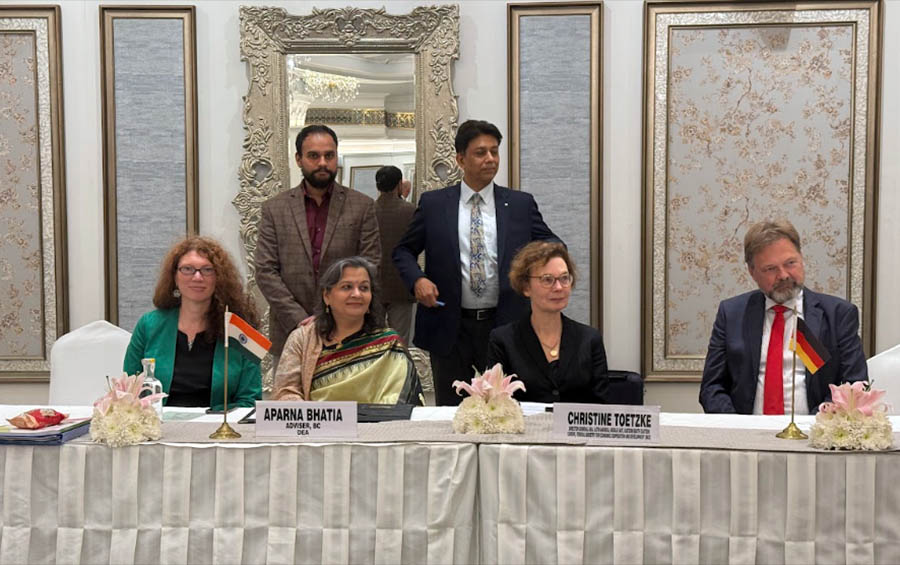
Germany and India on December 8 concluded the India–Germany Government Negotiations on Development Cooperation 2025, reinforcing their long-term strategic partnership under the Indo-German Partnership for Green and Sustainable Development (GSDP).
The negotiations resulted in fresh German commitments worth nearly €1.3 billion, largely in the form of concessional loans, focused on climate and energy, sustainable urban development, green urban mobility and the sustainable management of natural resources. Both sides also agreed to strengthen cooperation in skills development, particularly in renewable energy.
The agreements reaffirm Germany’s role as a key long-term partner in India’s climate transition, low-carbon growth agenda and inclusive development pathway.
A Broad and Ambitious Development Portfolio
At the close of the negotiations, India and Germany agreed on a comprehensive portfolio of new development cooperation projects across all priority pillars of the GSDP.
The €1.3 billion package is aimed at:
- advancing climate mitigation and adaptation,
- strengthening clean, reliable and secure energy systems,
- expanding sustainable and inclusive urban mobility, and
- enhancing the sustainable management of natural ecosystems.
The negotiated outcomes underscore the shared ambition of both countries to tackle climate change while supporting economic growth and social inclusion.
Germany Reaffirms India as a Strategic Partner
Addressing the outcomes, Christine Toetzke, Director General for Asia, Latin America, the Middle East and Eastern/South-Eastern Europe at Germany’s Federal Ministry for Economic Cooperation and Development (BMZ), underlined the continuity of Berlin’s engagement with New Delhi.
“India remains a major strategic partner country, also under the new German government. I am delighted to continue our trustful development cooperation under the umbrella of the GSDP, guiding our commitment to the bilateral cooperation,” Toetzke said.
She added, “With the projects committed today, Germany and India jointly follow the path to sustainable prosperity and overcome global challenges.”
GSDP ‘Truly Unique’, Says German Ambassador
German Ambassador to India and Bhutan Dr Philipp Ackermann highlighted the distinctive nature of the Indo-German Green and Sustainable Development Partnership.
“Our negotiations under the Green and Sustainable Development Partnership are serious in purpose but deeply rewarding, because they take place with partners we know well and value greatly,” Ackermann said.
Emphasising its scale and ambition, he noted, “Germany has no partnership quite like the GSDP with any other country (apart from India). Its scale, its ambition, and its spirit of equal collaboration make it truly unique. It is not traditional development cooperation; it is two mature nations working together to find solutions to the most pressing challenges of our time.”
Ackermann added that he was pleased with the efficient conclusion of the talks and “look forward to the important work we will take forward together in the coming year.”
Spotlight on Green Urban Mobility and Innovation
Ahead of the New Delhi negotiations, Toetzke travelled to Bengaluru to assess progress under the flagship Indo-German Green Urban Mobility Partnership for All, one of the most visible pillars of the GSDP.
Her programme in the city showcased India’s rapidly evolving mobility ecosystem—ranging from large-scale public transport infrastructure to digital, accessibility-focused innovations.
The partnership focuses on promoting low-carbon, people-centric, safe, accessible and affordable mobility solutions. Germany is supporting India’s ambitious green mobility targets, including vehicle electrification, last-mile connectivity, public transport modernisation, barrier-free infrastructure, digital innovation and social inclusion.
Metro Projects, Living Labs and Job Creation
A flagship example of Indo-German cooperation is the Yellow Line Metro segment in Bengaluru, recently inaugurated with the support of a €340 million loan from KfW, Germany’s development bank.
The project has strengthened sustainable urban transport, reduced emissions and generated an estimated 25,000 jobs, with German firms such as Siemens, Knorr-Bremse, Hübner and Voith contributing key technologies and services.
Further, the Living Lab in Bengaluru, supported through partnerships between government, academia, civil society and companies including Bosch and Nunam, highlights how Indo-German cooperation is fostering climate-smart innovation.
One standout initiative is India’s first rooftop solar-powered EV charging station using second-life batteries, developed by Nunam. Initially piloted in Bengaluru, the model has since been scaled to Surat to support the city’s electric bus fleet.
Inclusive Mobility at the Core
Inclusive urban development also featured prominently in the cooperation agenda. Indian non-profit and start-up innovations backed by Indo-German collaboration—such as OnBoard, developed at IIT Delhi to assist visually impaired commuters, and RampMyCity, which provides customised accessibility solutions—illustrate the shared commitment to building barrier-free and inclusive cities.
About the Indo-German GSDP
Launched in 2022, the Indo-German Partnership for Green and Sustainable Development (GSDP) serves as a strategic framework for climate-aligned and sustainable cooperation. It supports initiatives that advance the Sustainable Development Goals and the objectives of the Paris Agreement, positioning India and Germany as long-term partners in addressing global climate and development challenges.
With the conclusion of the 2025 negotiations, both countries signalled that their green partnership is set to deepen further in scale, scope and strategic relevance in the years ahead.