Photo: PMO India
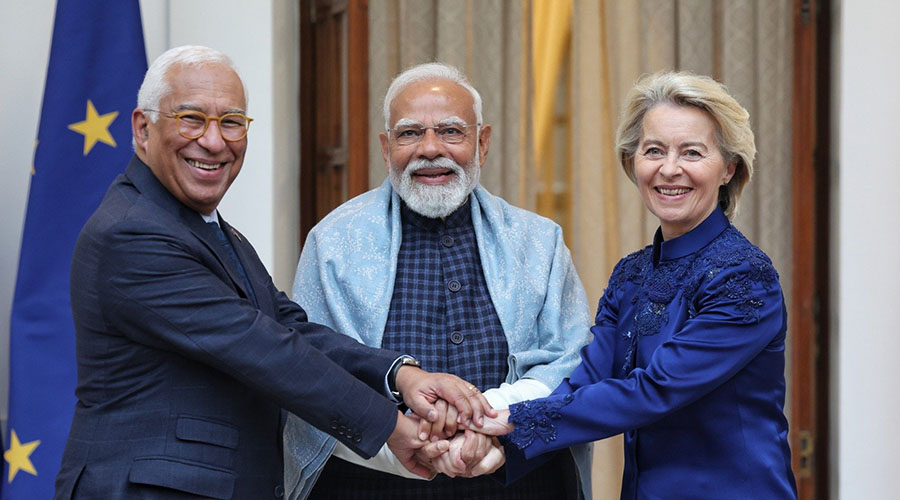
After nearly two decades of negotiations, India and the European Union on Tuesday signed what PM Narendra Modi and European leaders described as the largest and most consequential trade agreement in their history, creating a free-trade market of nearly two billion people and reshaping economic, strategic and technological ties between the two partners.
The agreement, formally concluding negotiations for the India-EU Free Trade Agreement (FTA), is expected to cut up to €4 billion in annual tariffs for European exporters and significantly expand market access for Indian goods and services. It also coincides with the launch of a first-ever India-EU security and defence partnership, a mobility framework, and expanded cooperation on innovation, space and advanced technologies.
Tariff cuts on 97% of EU goods, €4 billion annual savings
In a statement issued after the signing, the European Union said India has agreed to reduce or eliminate tariffs on nearly 97 per cent of goods imported from Europe, a move expected to save European companies around €4 billion every year in duties.
Commerce Secretary Rajesh Agrawal confirmed earlier that negotiations had been successfully concluded and that the agreement would now undergo legal vetting.
“Legal scrubbing of the text will take five to six months; formal signing will be done post that,” Agrawal said, adding that the deal is expected to take effect sometime next year after ratification by the European Parliament.
PM Modi: ‘Largest FTA in India’s history… a blueprint for shared prosperity’
Addressing the media alongside President Ursula von der Leyen and President António Costa, PM Modi framed the agreement as both an economic and strategic milestone.
“Today is another historic occasion, when the world’s two largest democratic powers are adding a decisive chapter to their relations. Today, India has concluded the largest Free Trade Agreement in its history so far,” PM Modi said.
Highlighting the symbolism of the date, he added: “Today is the 27th, and it’s a happy coincidence that on this very day, India is signing this FTA with the 27 countries of the European Union. This is not just a trade agreement. This is a new blueprint for shared prosperity.”
PM Modi also noted that the two sides had signed three major outcomes: “The two sides signed the conclusion of the FTA negotiations, a security and defence partnership and a mobility framework.”
Referring to EU leaders’ participation as chief guests at India’s Republic Day parade a day earlier, he said: “Yesterday was a historic moment when, for the first time, leaders of the European Union participated as chief guests in India’s Republic Day celebrations.”
Manufacturing, services and investor confidence to benefit: PM
Earlier in the day, while inaugurating India Energy Week virtually, PM Modi said the trade pact would significantly strengthen India’s manufacturing base and services economy while boosting global investor confidence.
“People around the world are discussing it as the ‘Mother of All Deals’. This agreement has brought massive opportunities for 1.4 billion Indians and millions of people in European countries,” he said.
“It has become a wonderful example of synergy between two of the world’s major economies. This agreement represents approximately 25 per cent of global GDP and about one-third of global trade.”
He added: “This trade deal will not only boost manufacturing in India but also further expand sectors related to services. This free trade agreement will further strengthen confidence in India for every business and investor in the world.”
According to PM Modi, labour-intensive sectors such as textiles, gems and jewellery, leather and jute are expected to be among the major beneficiaries.
Strategic signal amid global tensions
PM Modi linked the agreement to broader geopolitical shifts, underlining India and Europe’s shared commitment to rules-based global order.
“Respect for multilateralism and international norms is our shared priority,” he said. “We are in agreement that, to address today’s challenges, the reform of global institutions is essential.”
The remark was widely seen as a reference to recent unilateral trade measures by US President Donald Trump and growing strategic assertiveness by China under Chinese President Xi Jinping.
President Ursula von der Leyen: ‘A tale of two giants… cooperation is the answer’
President Ursula von der Leyen hailed the agreement as a turning point for global trade cooperation. “We did it. We delivered the mother of all deals,” she said.
“We are creating a market of 2 billion people, and this is the tale of two giants, the world’s second and fourth largest economies, two giants who choose partnership in a true win-win fashion – a strong message that cooperation is the best answer to global challenges.”
She said the deal would deeply integrate supply chains and manufacturing ecosystems: “This trade will further integrate our supply chain and strengthen our joint manufacturing power.”
On economic impact, she added: “It will cut up to 4 billion euros in annual tariffs for exporters of all sizes, and it will create good jobs for millions of workers here in India and in Europe.”
She also emphasised the strategic logic of diversification: “It brings together Indian skills, services and scale with Europe’s technology, capital and innovation. It will create levels of growth that neither side can achieve alone, and by combining these strengths, we reduce strategic dependencies at a time when trade is increasingly weaponised.”
First-ever India-EU security and defence partnership launched
Alongside the trade pact, the two sides unveiled their first dedicated security and defence partnership.
President Ursula von der Leyen, a former German defence minister, said: “We are not only making our economy stronger, we are also delivering security for our people in an increasingly insecure world.”
“Today, the world’s two largest economies and democracies launched their first-ever Security and Defence Partnership. This is a landmark departure and a trust-based platform for cooperation on the strategic issues that matter most.”
She outlined concrete areas of collaboration:
- Maritime security and joint naval exercises to tackle piracy
- Countering cyber and hybrid threats
- A dedicated dialogue on space security
- Cooperation on counterterrorism
- Negotiations on a Security of Information Agreement
“Europe and India have chosen to be reliable partners to one another, and this is how we demonstrate the trust we share,” she said.
Mobility pact, EU legal gateway office in India
The leaders also announced a mobility agreement aimed at easing the movement of talent between India and Europe.
“We both know our greatest wealth is our people,” President Ursula von der Leyen said. “We will facilitate the movement of students, researchers, seasonal and highly skilled workers.”
She also announced the launch of the first EU Legal Gateway Office in India: “It will be a one-stop hub to support Indian talent moving to Europe in full alignment with EU Member States’ needs and policies. This is good for our economies. This is good for the friendship between our people, and this openness benefits us all.”
PM Modi later said an estimated eight lakh Indians living in the EU would benefit from the framework.
Science, AI and €100-billion Horizon Europe programme
On research and technology cooperation, President Ursula von der Leyen said Europe and India would deepen collaboration in artificial intelligence and innovation ecosystems.
“We share core values. The freedom of research and science is paramount for us. Europe and India will always choose science. We will always choose progress as the way forward.”
She announced work towards India’s association with Horizon Europe, the EU’s flagship research programme worth €100 billion.
“Horizon is the world’s largest public research programme,” she said, adding that the two sides would also establish EU-India innovation hubs and launch a startup partnership to support co-creation and high-potential ventures.
President António Costa: ‘We are opening a new chapter’
President António Costa called the summit a defining moment in the partnership.
“Today is a historic moment. We are opening a new chapter in our relations, on trade, on security, on people-to-people ties,” he said.
“Our summit sends a clear message to the world at a time when the global order is being fundamentally reshaped, the European Union and India stand together as strategic and reliable partners.”
Calling India the world’s fastest-growing major economy, President Costa said the FTA would help shape a resilient global order based on peace, stability and sustainable development.
Holding an Overseas Citizen of India card, he said he was “proud” of his Indian roots and described the deal as reflecting the “shared vision of India and Europe”.
Two decades in the making
The agreement marks a breakthrough in talks that began in 2007, collapsed in 2013 over disputes including market access for automobiles, agriculture and dairy products, and were revived in 2022 amid pandemic-era supply chain disruptions and Russia’s war in Ukraine.
Officials said negotiations have concluded on 21 chapters after restructuring earlier drafts. The deal is expected to come into force in early 2027 after legal vetting and parliamentary approvals.
From cheaper cars to defence cooperation: what the deal covers
According to government officials and EU sources, the agreement includes:
- Gradual reduction of EU car tariffs in India from 110% to 40%, and eventually to 10%
- Easier access for EU firms in financial and legal services
- Greater market access for Indian textiles, marine products, footwear and sports goods
- Opening of India’s alcoholic beverages and automobile sectors
- Defence industry collaboration and strategic dialogue
Bilateral trade, currently valued at around US$213 billion, is projected to rise sharply over the next five years.
US reaction and geopolitical undertones
The agreement comes as India’s trade negotiations with the US continue. US Treasury Secretary Scott Bessent recently criticised Europe for purchasing refined Russian oil products from India, saying European countries were financing a war “against themselves”.
Against this backdrop, EU leaders stressed that India’s growth contributes to global stability. “When India succeeds, the world is more secure and we all benefit,” President Ursula von der Leyen said.
A structural reset in India-EU ties
With trade, security, mobility and innovation frameworks rolled out together, Tuesday’s agreement marks a comprehensive reset of India-EU relations — from a largely transactional economic partnership to a multi-layered strategic alliance.
As PM Modi summed it up: “The cooperation between India and the EU is a partnership for the global good.”