Photo Credit: x.com/DrSJaishankar
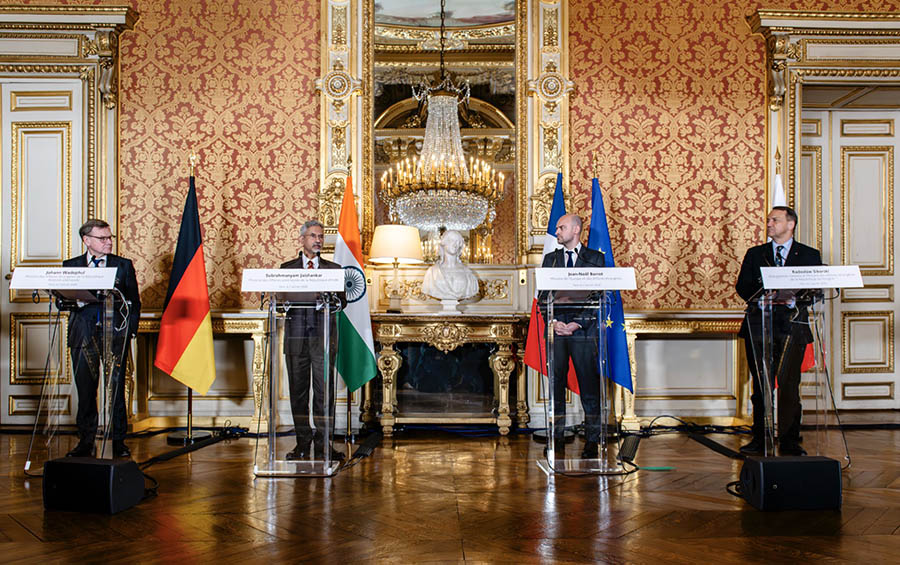
India on Wednesday, 7 January, stepped into the Weimar Triangle diplomatic format for the first time, with External Affairs Minister S Jaishankar holding wide-ranging discussions with France, Germany and Poland that placed India–Germany relations firmly within a broader push to elevate India–Europe cooperation.
The meeting brought together French Minister for Europe and Foreign Affairs Jean-Noël Barrot, Germany’s Minister of State for Europe and Climate Action Anna Lührmann (represented by German leaders including Johann Wadephul), and Polish Foreign Minister Radosław Sikorski.
India–Germany engagement within Europe’s core group
Speaking to the media after the talks, Dr. Jaishankar described the discussions as “short but deep and open,” centred on three broad themes: India–European Union relations, developments in the Indo-Pacific, and the conflict in Ukraine.
He underlined that India’s expanding engagement with Europe—both through Brussels and through key bilateral relationships such as Germany—naturally lends itself to smaller, focused groupings like the Weimar format to advance strategic cooperation.
Among India’s global partnerships, Minister Jaishankar said, ties with the European Union and its member states carry the greatest unrealised potential, with “many new areas waiting to be explored.” He added that France, Germany and Poland, as influential European partners, would play an active role in taking India–Europe relations “to the next level.”
Germany’s role amid global churn
Placing the talks in a wider geopolitical context, Jaishankar referred to a world undergoing profound change—from long-term shifts in the Indo-Pacific to Europe’s own strategic challenges and broader global realignments that could reshape the international order.
He stressed the importance of regular exchanges among countries located in different regions, noting that diverse perspectives become especially valuable in a volatile, uncertain and increasingly multi-polar global environment.
Such conditions, he argued, strengthen the case for deeper cooperation among like-minded partners that share converging interests and a common outlook—an assessment that aligns closely with India’s growing strategic convergence with Germany on issues ranging from economic diversification to security and resilience.
India–EU trade deal gains momentum
The India–Germany dimension of the engagement was further reinforced by strong European calls for the early conclusion of a long-pending India–EU free trade agreement.
France, Germany and Poland jointly urged the rapid signing of the pact, calling it a “decisive step” in relations between India and Europe. Minister Barrot said a major agreement was expected to be finalised in the coming weeks, with a dedicated summit scheduled for the end of January.
“This marks a decisive step in the strategic rapprochement between our two regions,” he said.
Poland’s Minister Sikorski said it was “very important that we quickly sign a free-trade agreement between the EU and India.”
Germany’s FM Johann Wadephul described the agreement as “an important step towards greater diversification,” adding that an India–EU security and defence partnership was “also on the right track.” He stressed the need to reduce dependencies “so as not to make ourselves vulnerable to blackmail.”
The two sides had earlier aimed to conclude the deal by the end of 2025, amid heightened global trade tensions.
The European Union is already India’s largest trading partner, with bilateral trade in goods valued at €124 billion in 2023—more than 12 per cent of India’s total trade. While the EU is seeking lower barriers for automobiles, wines and spirits, India is pushing for improved access for its textiles and pharmaceuticals. The proposed agreement is also expected to include elements of security cooperation.
“I believe we can bring greater stability to both the international economy and global politics,” Minister Jaishankar said, adding that it was “necessary that India strengthen its relationship” with Europe.
France talks and broader strategic alignment
Earlier in the day, Jaishankar held bilateral talks with Minister Barrot, reviewing the India–France strategic partnership—India’s earliest such partnership in Europe. The two sides discussed enhanced cooperation across sectors and global issues, and Minister Jaishankar conveyed India’s expectation of welcoming French President Emmanuel Macron in the near future.
Describing the day as productive even before the Weimar meeting, Minister Jaishankar thanked his counterparts for what he called a highly useful exchange, reflecting growing strategic alignment between India and key European powers, with Germany emerging as a central pillar of New Delhi’s Europe strategy.