
Photo: PMO India
German Federal Chancellor Friedrich Merz concluded his first official visit to India and his maiden trip to Asia on January 13, marking a major milestone in India–Germany relations with wide-ranging agreements spanning defence cooperation, clean energy, trade, critical technologies, skilling, education, and global governance.
The visit, undertaken at the invitation of Prime Minister Narendra Modi, coincided with the 25th anniversary of the India–Germany Strategic Partnership in 2025 and the upcoming 75 years of diplomatic relations in 2026, underscoring the growing political and economic weight of bilateral ties.
Chancellor Merz was accompanied by a high-level delegation, including 23 leading German CEOs and industry leaders.
Symbolic Start in Ahmedabad, CEOs Forum and Bengaluru Technology Focus
Prime Minister Modi welcomed Chancellor Merz in Ahmedabad, where the two leaders paid floral tributes at Mahatma Gandhi’s statue at Sabarmati Ashram and participated in the International Kite Festival. They also jointly addressed the India–Germany CEOs Forum, engaging business leaders from both countries.
Chancellor Merz is also visiting Bengaluru, with discussions centred on technology partnerships, innovation ecosystems and industrial collaboration.
The leaders held restricted and delegation-level talks on January 12, reaffirming their shared democratic values, commitment to a rules-based international order and mutual respect as the foundation of their strategic partnership.
Defence and Security: New Roadmap, Joint Exercises and Technology Cooperation
India and Germany agreed to significantly deepen defence and security cooperation, welcoming outcomes of the High Defence Committee meeting held in New Delhi in November 2025.
Key areas include:
- Institutionalised service-level staff talks and regular visits by service chiefs
- Expanded joint military exercises and training
- Continued reciprocal naval port calls
- Launch of a new Track 1.5 Foreign Policy and Security Dialogue
India welcomed Germany’s participation in major defence engagements in 2026, including:
- Naval Exercise MILAN
- 9th Indian Ocean Naval Symposium (IONS) Conclave of Chiefs
- Air combat exercise TARANG SHAKTI
- Deployment of a German liaison officer to the Information Fusion Centre – Indian Ocean Region (IFC-IOR)
The leaders noted ongoing cooperation between India’s DRDO and Europe’s OCCAR on the Eurodrone MALE UAV programme, enabling India to access advanced military technologies.
A Joint Declaration of Intent was signed to develop a Defence Industrial Cooperation Roadmap, focusing on:
- Technology partnerships
- Co-development and co-production of defence platforms
- Faster export clearances for defence equipment
- Regular defence industry exchanges
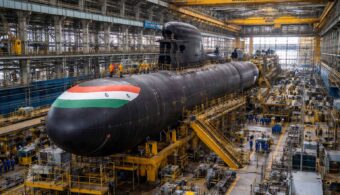
Both sides also highlighted continued collaboration in submarines, helicopter obstacle avoidance systems, and counter-drone technologies.
Progress was noted toward concluding agreements on:
- Peacekeeping training
- Reciprocal logistics support
- Knowledge exchange on emerging defence technologies between DRDO and Germany’s BAAINBw
Strong Joint Stand Against Terrorism
The two leaders “unequivocally and strongly condemned terrorism and violent extremism in all its forms,” including cross-border terrorism.
They condemned:
- The terrorist attack in Pahalgam, Jammu and Kashmir (22 April 2025)
- The terror incident in Delhi (10 November 2025)
Both sides committed to strengthening cooperation against terrorist entities, including those listed under the UN 1267 Sanctions Committee, and to eliminating terror safe havens, financing and infrastructure.
They welcomed the ratification of the Mutual Legal Assistance Treaty and progress under the Joint Working Group on Counter-Terrorism.
Trade and Economy: Bilateral Trade Crosses $50 Billion
India–Germany trade in goods and services surpassed USD 50 billion in 2024, accounting for over 25% of India’s total trade with the European Union, with growth continuing through 2025.
The leaders:
- Encouraged deeper SME, startup, AI and digital sector collaboration
- Invited greater German investment in India’s manufacturing and services sectors
- Highlighted Germany as an attractive destination for Indian investment
Both reiterated strong support for concluding the India–EU Free Trade Agreement at the upcoming EU–India Summit.
A Joint Declaration of Intent was signed to strengthen cooperation under the German-Indian CEO Forum, promoting industry partnerships in technology, automotives, defence manufacturing, shipbuilding, smart infrastructure, pharmaceuticals, chemicals, biotechnology, industrial engineering and energy.
Semiconductors, Critical Minerals and Digital Cooperation
The leaders welcomed new agreements on emerging technologies:
- A Joint Declaration of Intent on Semiconductor Ecosystem Partnership
- Cooperation on critical minerals, covering exploration, R&D, processing, recycling and overseas asset development
- Finalisation of the Indo-German Digital Dialogue Work Plan (2026–27)
- A new declaration on telecommunications cooperation
Prime Minister Modi welcomed the opening of German semiconductor firm Infineon’s Global Capability Centre in GIFT City in 2025.
Science, Space and Traditional Medicine
Both sides extended the mandate of the Indo-German Science and Technology Centre (IGSTC), which supports joint industry-academia research in advanced manufacturing, medical technologies, bioeconomy, waste-to-wealth, AI for sustainability and women-led research initiatives.
They also welcomed progress on:
- Indo-German Centres of Excellence in digital convergence, batteries, green transport and affordable healthcare
- Cooperation in bioeconomy, genomics, bioprinting and biomanufacturing
- India’s participation in major German research facilities such as FAIR, DESY and PETRA-III
In space cooperation, ISRO and Germany’s DLR agreed to expand collaboration and industry-level engagement.
The leaders also welcomed an MoU between the All India Institute of Ayurveda and Charité University of Germany on traditional medicine research.
Green and Sustainable Development Partnership: €5 Billion Already Deployed
Marking the halfway point of the €10 billion Green and Sustainable Development Partnership (GSDP), Germany confirmed that around €5 billion has already been deployed or earmarked since 2022.
Projects include:
- PM e-Bus Sewa
- Solar Rooftop Programme
- National Green Hydrogen Mission
- Metro rail projects in Ahmedabad, Surat and Bengaluru
- Climate-resilient infrastructure in Tamil Nadu
- Battery storage in West Bengal
- Agro-photovoltaics and renewable financing
New joint working groups have been launched on:
- Solar manufacturing
- Wind energy
- Battery energy storage
On hydrogen, both sides committed to aligning India’s National Green Hydrogen Mission with Germany’s Hydrogen Strategy, welcoming:
- A regulatory MoU between PNGRB and DVGW
- A major green ammonia offtake agreement between AM Green and Uniper Global Commodities
Indo-Pacific, IMEC and Global Governance
India and Germany announced a new bilateral Indo-Pacific consultation mechanism and reaffirmed support for:
- UNCLOS and international maritime law
- The India–Middle East–Europe Economic Corridor (IMEC)
They reiterated support for UN Security Council reform, including expansion of permanent and non-permanent membership.
On global conflicts, the leaders:
- Expressed concern over the war in Ukraine and supported a just, lasting peace
- Welcomed UNSC Resolution 2803 on Gaza
- Reaffirmed support for humanitarian aid and a negotiated two-state solution
They also called for accelerated global climate action ahead of COP30 in Belém and stronger climate finance and technology transfer for developing countries.
Education, Mobility and Skills: Visa-Free Transit and New Roadmap
A major people-to-people initiative announced was visa-free airport transit for Indian passport holders in Germany, welcomed by Prime Minister Modi.
Both sides also:
- Finalised an Indo-German Comprehensive Roadmap on Higher Education
- Encouraged German universities to establish campuses in India
- Supported joint IIT–German technical university partnerships
- Promoted job integration programmes for Indian graduates in Germany
They signed:
- A Joint Declaration on a Global Skills Partnership, focusing on ethical mobility of healthcare professionals
- An agreement to establish an Indo-German Centre of Excellence for Skilling in Renewable Energy
Both reaffirmed commitment to expanding German language teaching in India.
Culture, Sports and Maritime Heritage
New agreements include:
- Cooperation between Germany’s Maritime Museum and India’s National Maritime Heritage Complex at Lothal
- A Joint Declaration on Sports Cooperation covering training, governance, athlete rights and sports science
Next IGC in Germany Later in 2026
Chancellor Merz thanked Prime Minister Modi for the hospitality extended to him and his delegation. Both leaders agreed that the next round of India–Germany Inter-Governmental Consultations (IGC) will be held in Germany later in 2026.
They reaffirmed their shared commitment to deepening the strategic partnership across defence, economic development, technology, climate action and global governance.