
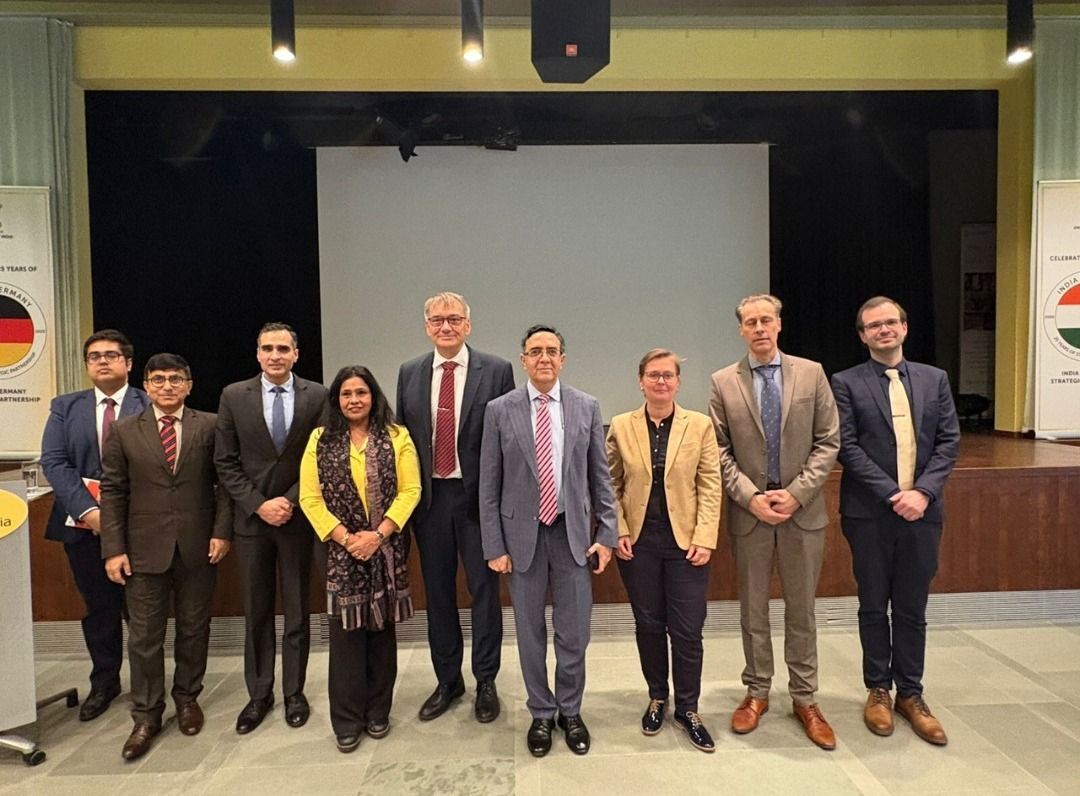
Picture Credit: Embassy of India, Berlin
India’s Ambassador to Germany Ajit Gupte on Monday released a detailed report examining the scope, challenges and opportunities for Indo-German collaboration in SME-led innovation and technology development, underlining the need to strengthen links between Indian SMEs, Germany’s Mittelstand and research institutions.
The report, titled Enhancing Indo-German SME Innovation & Technology Collaboration, has been prepared by DAAD India, the German Centre for Research and Innovation (DWIH) New Delhi, and Fraunhofer-Gesellschaft. The release event saw participation from over 30 representatives from academia, industry, research organisations and industry associations, reflecting growing interest in expanding applied research and technology cooperation between India and Germany.
Speaking at the event, Ambassador Gupte highlighted the importance of deepening innovation-driven partnerships between SMEs and research institutions in both countries to support long-term industrial competitiveness.
SMEs: Central to Both Economies
According to the report, SMEs form the backbone of both the Indian and German economies, though their structures differ significantly.
In Germany, SMEs account for 99.2% of all enterprises, employ 19.1 million people, and contribute 55.7% of net value added in the private sector. German SMEs are also strongly export-oriented, generating over EUR 220 billion in exports annually, equivalent to around 16% of total exports.
In India, the MSME sector comprises more than 40 million registered enterprises, contributes 30% of GDP, accounts for 40% of employment, and generates nearly 50% of India’s exports. However, the report notes that 97.7% of Indian MSMEs are micro-enterprises, which shapes their access to finance, technology, and research collaboration.
Contrasting Innovation Ecosystems
The report documents major differences in the innovation systems of the two countries.
Germany’s innovation ecosystem is characterised by high R&D intensity, with over 3.1% of GDP invested in research and development. Total R&D expenditure reached EUR 129.7 billion in 2023, with 67% of R&D spending driven by industrial research. Applied research institutions and structured collaboration between companies, universities and research organisations play a central role in supporting SME innovation.
India’s MSME ecosystem, by contrast, shows uneven levels of innovation activity. Manufacturing surveys cited in the report indicate that 24.97% of small firms and only 4.20% of micro firms engage in innovation activities. At the same time, the report highlights a significant acceleration in digital adoption among Indian MSMEs, particularly following the COVID-19 pandemic.
Limited International Technology Cooperation
Despite extensive national support schemes in both countries, the report finds that only a limited share of SMEs participates in international technology transfer or joint R&D projects.
Existing Indo-German cooperation mechanisms largely focus on trade promotion, market access and short-term exchanges, rather than sustained technology co-development or long-term research partnerships. As a result, structured SME-to-SME and SME-to-academia collaboration across borders remains limited.
The report also notes that while Germany is an active participant in international SME-focused innovation platforms such as Eureka, Eurostars, IraSME and CORNET, India’s engagement with these mechanisms remains limited, reducing opportunities for Indian SMEs to integrate into structured international R&D networks.
Key Barriers Identified
The report identifies several recurring challenges affecting Indo-German SME collaboration, including:
- Limited in-house R&D capacity within SMEs
- Low awareness of international research infrastructure
- Administrative and regulatory complexity
- Intellectual property management challenges
- Absence of long-term institutional platforms for follow-up and scale-up
These barriers, the report notes, disproportionately affect SMEs with limited financial and human resources.
Need for Structured, Long-Term Frameworks
Based on stakeholder consultations held in Berlin and New Delhi, the report calls for the development of sustained Indo-German frameworks dedicated specifically to SME-driven innovation and technology cooperation.
Key areas highlighted include the need for structured funding mechanisms, permanent matchmaking platforms, and improved access for SMEs to applied research infrastructure in both countries, with an emphasis on long-term engagement rather than project-based cooperation.
Read the full report here.