
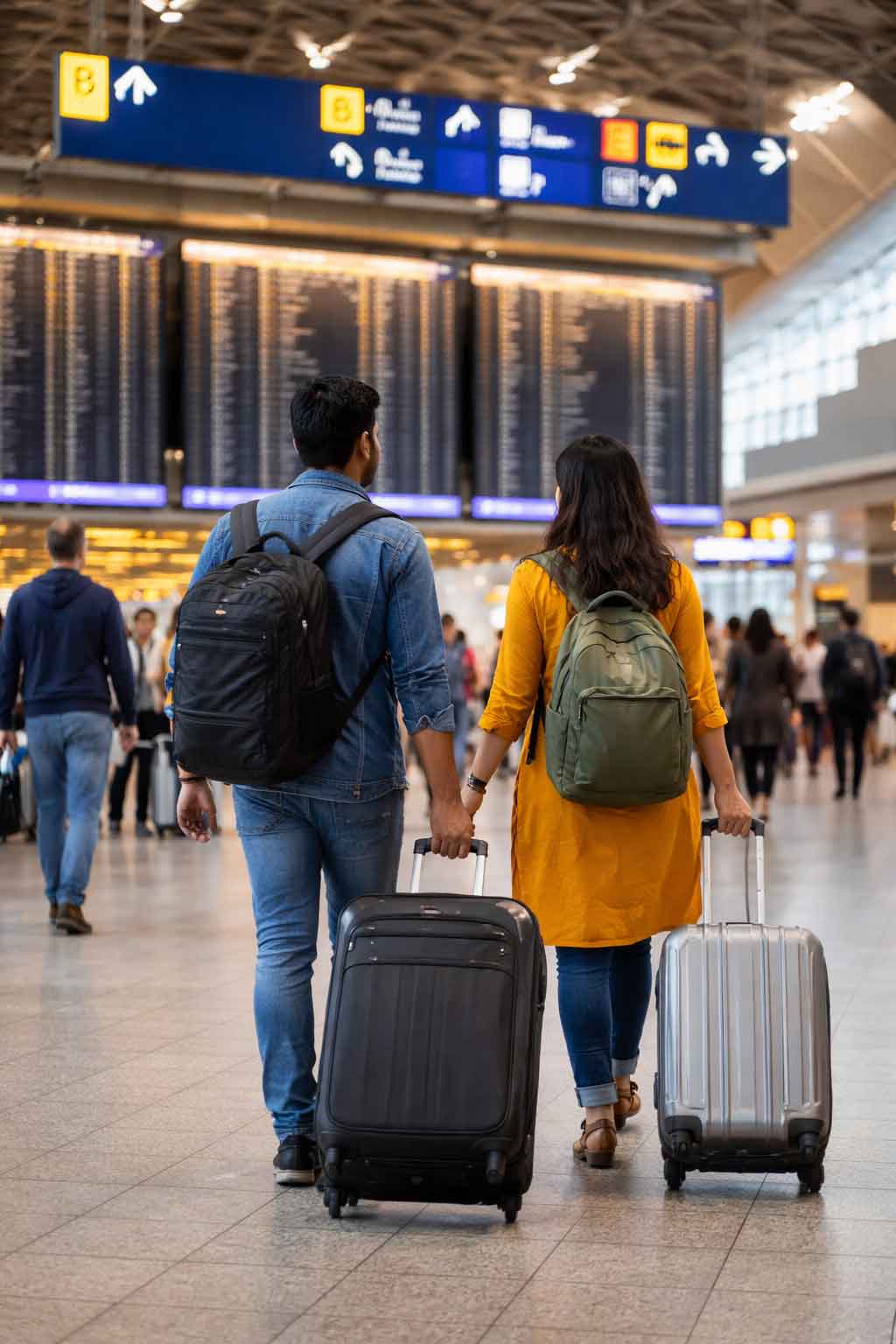
Indian passport holders flying through Germany will no longer need a Schengen airport transit visa during international layovers, a change that is expected to make long-haul travel smoother, quicker and less expensive for millions of travellers.
The decision was announced in the India–Germany joint statement released on Monday after German Chancellor Friedrich Merz’s official visit to India from January 12 to 13. It was Chancellor Merz’s first visit to India and his first trip to Asia since taking office as Federal Chancellor.
What changes at German airports
Until now, Indian nationals were required to apply for a Schengen transit visa even when they were only changing flights at German airports and not entering Germany or the wider Schengen area.
Under the new arrangement, Indian travellers transiting through airports such as Frankfurt, Munich and Berlin will be able to continue their onward journeys without securing this additional visa, as long as they remain within the international transit zone.
A transit visa is a short-term permit that allows passengers to pass through a country during a layover to reach a final destination. It requires proof of onward travel and documentation that the traveller does not intend to stay in the country.
With the requirement removed, passengers are expected to save both time and money, while airlines and travel agents will also face fewer administrative hurdles when booking routes via Germany.
What remains unchanged
Officials clarified that the waiver applies only to airport transit.
Indian citizens will still need to obtain the appropriate tourist, business, student or work visa to enter Germany or any other Schengen country. The decision does not alter existing immigration or entry rules for stays within Europe.
Leaders link move to people-to-people ties
Prime Minister Narendra Modi welcomed the announcement and thanked Chancellor Merz for the policy change.
According to the joint statement, the step “will not only facilitate and ease travel of Indian nationals, but will further intensify people-to-people links.”
Both leaders also reiterated that “strong people-to-people ties constitute a vital pillar of the Strategic Partnership.”
India and Germany said they welcomed the growing movement of students, researchers, skilled professionals, artists and tourists between the two countries and recognised the “valuable contribution of the Indian community to Germany’s economy, innovation and cultural life.”
They also underlined the need to expand cooperation in education, research, vocational training, culture and youth exchanges to strengthen mutual understanding.
Education and skills ties highlighted
Education cooperation featured prominently during the talks.
The two sides noted the rising number of Indian students in Germany, the expansion of joint and dual degree programmes, and closer partnerships between higher education institutions in both countries.
They welcomed initiatives aimed at helping Indian students and graduates integrate into the German job market, as well as growing institutional linkages between the Indian Institutes of Technology and German technical universities.
Both governments agreed to work towards an Indo-German Comprehensive Roadmap on Higher Education. Prime Minister Modi also invited leading German universities to establish campuses in India under the New Education Policy.
Part of broader strategic engagement
The visa-free transit decision was announced alongside a package of measures to deepen economic, technological and security cooperation between the two countries.
Referring to defence ties, PM Modi said during a joint press conference: “The growing cooperation in defence and security is a symbol of our mutual trust and shared vision. I express my heartfelt gratitude to Chancellor Merz for simplifying the processes related to defence trade,” noting that Germany’s easing of export procedures has benefited India in recent years.
Why it matters for Indian travellers
For frequent flyers, students and professionals, the policy removes one of the most time-consuming steps in planning travel through Europe.
Germany’s airports are among the busiest transit hubs globally, and the new rule is expected to make them more competitive with Middle Eastern hubs by offering Indian passengers quicker connections, fewer documents to manage, and lower overall travel costs.
Beyond aviation, the move is also being seen as a diplomatic signal of closer mobility cooperation as India and Germany expand their strategic partnership across education, industry, technology and defence.