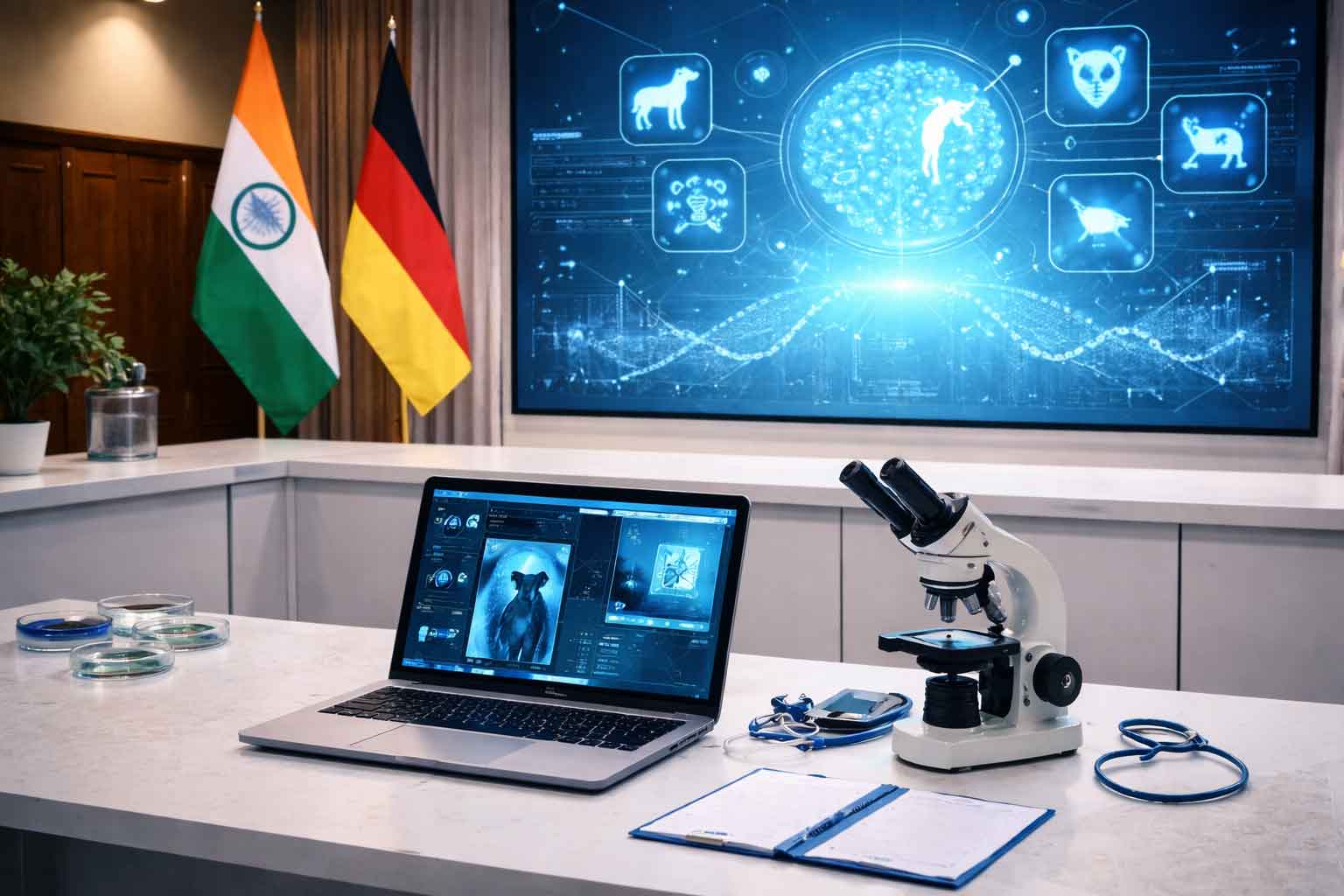
In a major boost to Indo-German scientific cooperation, researchers from India and Germany have announced plans to jointly develop artificial intelligence-based diagnostic systems aimed at delivering faster, more precise and highly accurate veterinary care.
The announcement was made at the InDeVet Summit 2026, held from February 23–25 at Guru Angad Dev Veterinary and Animal Sciences University (GADVASU) in Ludhiana. The summit, themed “Bridging Science, Policy and Education,” highlights deepening veterinary collaboration between India and Germany within the broader framework of India–European Union scientific engagement.
AI to Transform Veterinary Diagnostics
Ahmed Abdelwahad, Coordinator of the InDeVet Summit 2026, said the joint initiative represents a significant step forward for veterinary medicine. He underlined that AI-based diagnostic systems will help strengthen clinical accuracy and improve treatment timelines for animals.
The collaboration aims to harness advanced digital technologies to support early detection of diseases, improve diagnostic precision, and enhance overall animal healthcare delivery systems across both regions.
Student Exchange and Academic Mobility
Beyond technological cooperation, Dr Abdelwahad stressed that academic mobility forms a key pillar of the partnership. Under the proposed framework, Indian students will be able to pursue study and research opportunities in German institutions, while German scholars will engage with Indian universities and research centres.
This two-way exchange is expected to deepen institutional ties, promote knowledge transfer, and build long-term research capacity in veterinary sciences.
Roadmap for 2026–2030
A high-level panel discussion titled “The Future of Indo-German Veterinary Synergy” laid out a strategic roadmap for collaboration between 2026 and 2030. The session focused on identifying priority research areas, structured academic partnerships, and sustained policy engagement.
Deliberations also explored mechanisms for joint funding proposals, collaborative research projects, and curriculum development aligned with global veterinary standards.
Strengthening Institutional Partnerships
Additional sessions were dedicated to formalising long-term partnerships between leading universities in India and Germany.
GADVASU Vice-Chancellor Dr Jatinder Paul Singh Gill reaffirmed the university’s commitment to strengthening global alliances and expanding international research collaboration.
The summit drew participation from a distinguished panel of global experts, including:
- Dr Baljit Singh, University of Saskatchewan
- Dr Ramanuj Banerjee, Science Counsellor at the Embassy of India in Germany
- Dr Uwe Truyen, Leipzig University
- Dr Uwe Rösler, Freie University Berlin
- Prof. Klaus Osterrieder
Speakers emphasised the importance of sustained cooperation in research innovation and policy integration to address emerging animal health challenges.
Integrating One Health into Policy
A dedicated session titled “From Lab to Legislation” examined the integration of One Health solutions into public policy frameworks. Discussions focused on linking veterinary science with broader public health, environmental sustainability, and regulatory systems.
Dr R.S. Sethi, Dean of the College of Animal Biotechnology, concluded that the summit would “pave the way for transformative joint research and advancement in the veterinary discipline,” underlining the long-term impact expected from Indo-German collaboration.
The InDeVet Summit 2026 signals a growing convergence between India and Germany in veterinary innovation, academic exchange, and policy alignment — positioning both countries to shape the future of animal health through technology-driven and globally coordinated approaches.