Maharashtra and the German state of Hesse have signed a Memorandum of Understanding to expand cooperation across investment, industry, technology, employment and workforce mobility, establishing a new state-level channel within the broader India–Germany partnership.
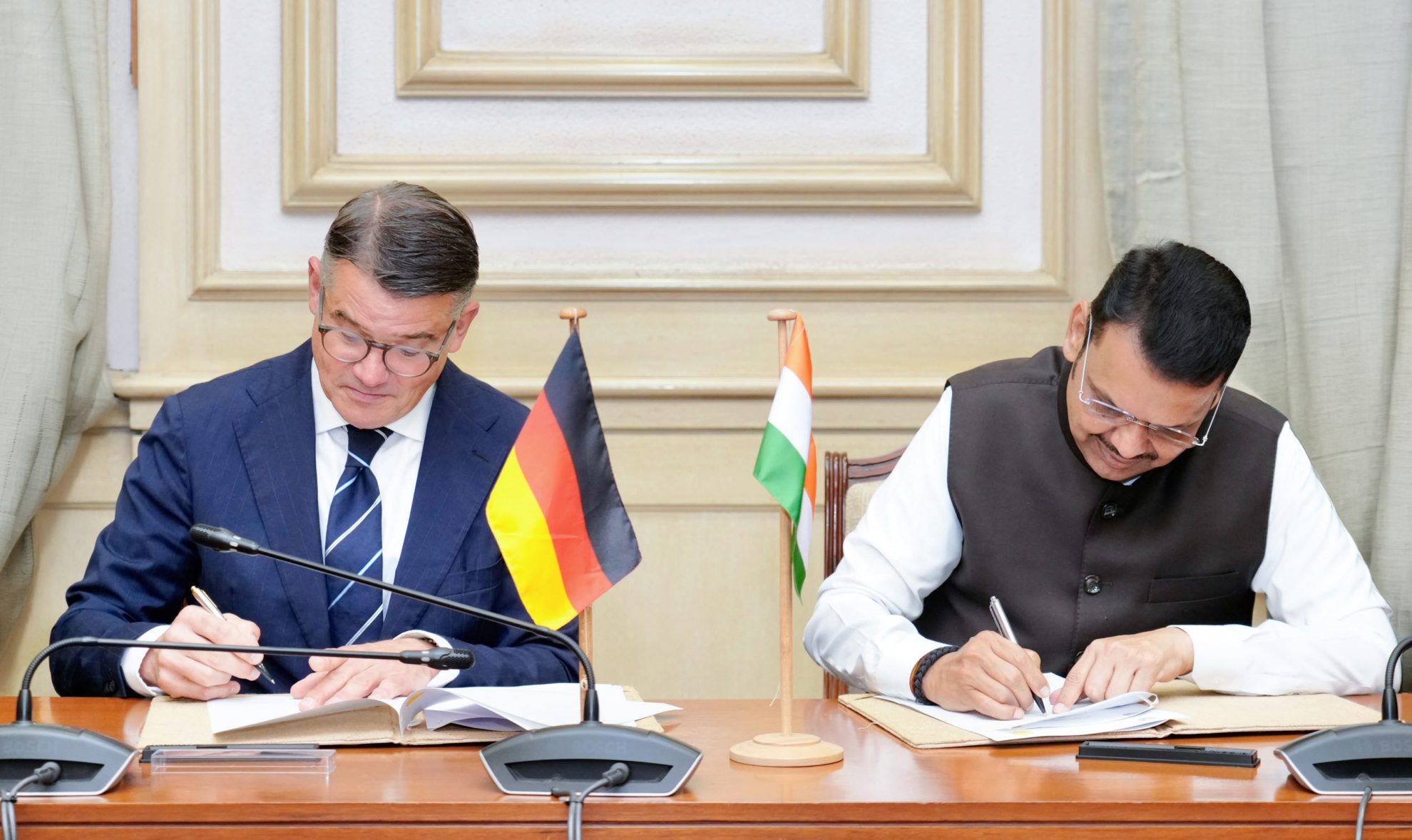
The agreement was signed by Maharashtra Chief Minister Devendra Fadnavis and Hesse Minister-President Boris Rhein at Sahyadri Guest House in Mumbai on August 21, 2026. It forms the basis for a longer-term partnership between two regions that host major financial and industrial centres—Mumbai in Maharashtra and Frankfurt in Hesse. Akashvani News and the Hesse State Chancellery confirmed the agreement.
MoU covers industry, technology and workforce mobility
The cooperation framework covers four principal areas: industry, services, information technology, and skilled manpower and cross-border mobility.
Potential sectors identified under the agreement include pharmaceuticals, healthcare, engineering, automobiles, financial services, logistics, the digital economy and artificial intelligence. The two governments also plan to encourage exchanges between companies, support investors and explore new commercial opportunities.
Chief Minister Fadnavis said Hesse could act as Maharashtra’s gateway to Germany and the wider European market, while Maharashtra could provide Hesse-based businesses with access to India and the Indo-Pacific region.
He invited German companies based in Hesse to consider investment opportunities in Maharashtra and encouraged Maharashtra-based businesses to use Hesse as an entry point into German and European markets.
However, the two governments did not announce any specific investment commitments, individual projects or employment targets alongside the MoU. The agreement currently provides an institutional framework through which such proposals may be developed.
Mumbai–Frankfurt financial connection in focus
The partnership draws partly on the economic similarities between the two regions. Mumbai is India’s principal financial centre, while Frankfurt is home to major German and European financial institutions.
Minister-President Rhein described the discussions in Mumbai as the beginning of a long-term partnership between two economically important regions. He said the agreement could connect Hesse-based companies with one of the world’s fastest-growing markets while allowing Maharashtra to draw on the technological expertise and international networks of the Rhine-Main region.
The Hesse government said the cooperation would also focus on strengthening supply chains, economic resilience, technological development and growth. Closer links between the financial sectors and research institutions of the two regions are expected to form part of the proposed engagement.
During his visit to Mumbai, Minister-President Rhein also visited the National Stock Exchange and discussed closer financial-market cooperation with Maharashtra Governor Jishnu Dev Varma and representatives of the exchange.
Skills, education and research identified as key areas
Skilled-worker mobility is another important component of the agreement, reflecting Germany’s demand for trained professionals in engineering, information technology, healthcare and other technical fields.
Chief Minister Fadnavis said cooperation in training and employment could help address Germany’s workforce requirements while creating international opportunities for young professionals from Maharashtra.
The Chief Minister also proposed greater engagement between universities and research institutions. He expressed the hope that universities from Hesse could establish a presence in the proposed Education City near Navi Mumbai.
Hesse’s Minister for Federal and European Affairs, International Affairs and Deregulation, Manfred Pentz, who accompanied the delegation, said the German state was seeking qualified professionals from India, particularly scientists, engineers and IT specialists.
According to the Hesse government, approximately 35,000 Indian nationals currently live in the state. It also says that more than half of the investment made by Indian companies in Germany is directed to Hesse, with information technology, digitalisation, pharmaceuticals, logistics and financial services among the prominent areas of activity.
Joint mechanism proposed for implementation
A joint working group is expected to be constituted to oversee the implementation of the MoU. The Maharashtra government has also proposed holding regular Maharashtra–Hesse Business Dialogues in Mumbai and Hesse to connect companies and institutions from both sides.
The implementation mechanism will be significant because the agreement is currently broad in scope. Its commercial impact will depend on whether the two governments translate the framework into identifiable investment projects, institutional partnerships, workforce programmes and business exchanges.
Agreement signed during Hesse delegation’s India visit
The MoU was concluded during Minister-President Rhein’s five-day visit to India from August 17 to 21, 2026, accompanied by a political and business delegation.
In New Delhi, the Minister-President held discussions with Union Minister of Commerce and Industry Piyush Goyal and Union Minister of State for Skill Development and Entrepreneurship Jayant Chaudhary. The meetings covered trade, investment and skilled-worker cooperation.
The delegation’s programme also included engagements with the National Stock Exchange and the Society for Innovation and Entrepreneurship at the Indian Institute of Technology Bombay.
The Maharashtra–Hesse framework adds a regional dimension to India–Germany economic relations by bringing together two major financial, industrial and technology centres. Its next phase will depend on the functioning of the proposed joint working group and the development of sector-specific projects under the MoU.