
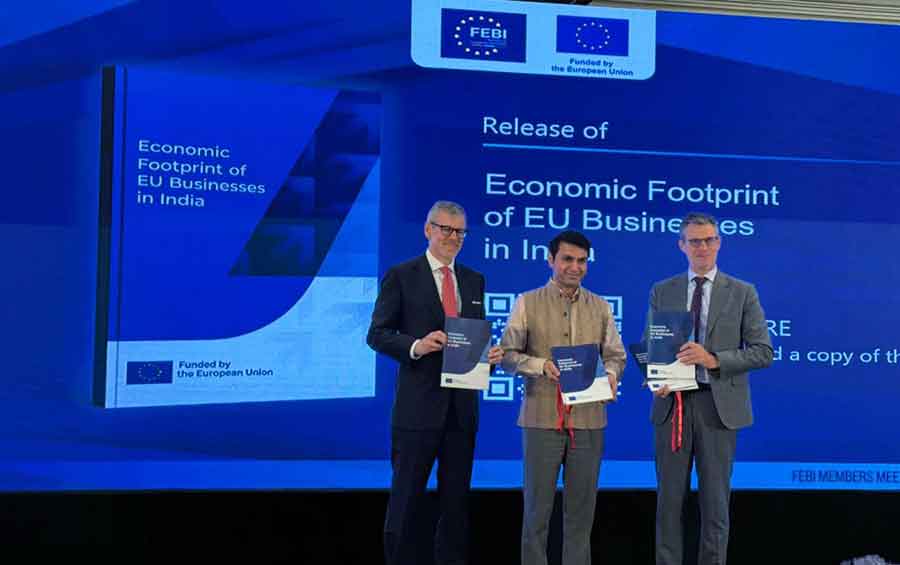
European Union companies operating in India generated an estimated €186 billion in turnover in 2024 — equivalent to around 5 per cent of India’s GDP — while supporting nearly 6 million jobs and contributing significantly to the country’s manufacturing and services ecosystem, according to a new economic footprint report released by the European Union in India on Thursday, 7 May.
The report, titled The Economic Footprint of EU Businesses in India, highlights the growing integration of European firms into India’s economy over the past decade, positioning the EU not merely as a trade partner but as a long-term economic stakeholder in the country.
Released in New Delhi, the study estimates that around 5,833 EU affiliate firms are currently operating across India, up sharply from 3,452 firms in 2014. The report notes that EU businesses today account for nearly 23 per cent of India’s manufacturing sector turnover, underlining their growing role in the country’s industrial landscape.
The findings come at a time when India and the European Union are seeking to deepen economic engagement following the adoption of the Joint EU–India Comprehensive Strategic Agenda in January 2026 and the conclusion of negotiations for a landmark Free Trade Agreement (FTA).
Manufacturing, ICT and Services Drive EU Presence
According to the report, manufacturing remains the backbone of the EU’s economic footprint in India, accounting for around 40 per cent of all EU firms operating in the country. Professional services contribute nearly 17 per cent, followed by information and communication technology (ICT) at 12 per cent, administrative support services at 9 per cent, and trade-related activities at 6 per cent.
The study reveals that EU firms are heavily concentrated in India’s major economic centres, with Maharashtra, Karnataka, Delhi, Tamil Nadu and Haryana hosting nearly 85 per cent of all European companies operating in the country.
Maharashtra emerged as the leading manufacturing and trade hub for EU firms, while Karnataka consolidated its position as a major ICT and technology centre. Delhi has become a key base for professional and administrative services, while Gujarat and Tamil Nadu are witnessing rapid growth in manufacturing activity. Telangana and Gujarat were identified as emerging destinations for new EU investments.
The report also points to Germany as the single largest European source country for businesses operating in India, with 1,445 firms linked to German parent companies. France, Italy, the Netherlands, Sweden and Spain also account for a substantial share of EU corporate presence in India.
€218 Billion Invested Over a Decade
European firms cumulatively invested approximately €218 billion in India between 2014 and 2024, including nearly €35.5 billion in 2023–24 alone, the report states.
Investment activity has been particularly strong in manufacturing, ICT, administrative support services and financial sectors. Manufacturing firms alone accounted for around €101 billion in cumulative investments over the decade.
The report further notes that Maharashtra and Karnataka together attracted nearly 60 per cent of all EU investments into India, while Gujarat, Delhi, Tamil Nadu, Haryana and Telangana have emerged as increasingly important destinations for European capital.
EU foreign direct investment inflows into India have also more than doubled over the last decade, rising from €3 billion in 2014 to around €7 billion in 2024. The cumulative EU investment stock in India is estimated at approximately €120 billion by 2025, representing nearly 17 per cent of India’s total FDI inflows.
The report identifies services, ICT, renewables, automotive manufacturing, pharmaceuticals, chemicals and infrastructure as key sectors attracting EU investments. Major European companies operating in India include German automotive manufacturers such as Volkswagen, BMW and Mercedes-Benz, along with European financial and insurance players including Deutsche Bank, Allianz and AXA.
Nearly 6 Million Jobs Supported
The study estimates that EU companies generated close to 6 million jobs in India in 2024, including around 3.7 million direct jobs and nearly 2 million indirect jobs through supply chains and related services.
ICT, manufacturing and administrative support services emerged as the largest direct employment generators among EU-linked sectors. Meanwhile, indirect employment was concentrated in manufacturing, wholesale and retail trade, logistics, transport and professional services.
Beyond employment, EU firms also contributed significantly to India’s public finances and social initiatives. The report estimates that European companies paid approximately €7 billion in corporate taxes in 2024 while spending around €271 million on corporate social responsibility (CSR) initiatives.
CSR spending by EU firms has increased sharply over the decade, rising from €42 million in 2014–15 to €271 million in 2023–24, with manufacturing and ICT companies accounting for the largest share of social spending.
EU Emerges as India’s Largest Goods Trading Partner
The report also underscores the rapidly expanding trade relationship between India and the EU. Bilateral trade in goods reached €120 billion in 2024, nearly doubling over the past decade.
According to the study, the EU has now emerged as India’s largest trading partner in goods during FY 2024–25. EU exports to India increased from €36 billion in 2014 to €49 billion in 2024, while imports from India rose even faster — from €34 billion to €71 billion during the same period.
Trade in services between the two sides also expanded significantly, reaching nearly €60 billion in 2023 compared to €24.6 billion in 2014. Business services and ICT account for more than 80 per cent of EU–India services trade.
The report notes that Karnataka, Tamil Nadu, Maharashtra and Telangana together account for nearly 83 per cent of India’s services exports to the EU.
“Playing the Long Game of Integration”: EU Ambassador
Commenting on the report, H.E. Ambassador Hervé Delphin, EU Ambassador to India said EU businesses were increasingly becoming embedded within India’s economic ecosystem.
“EU businesses presence in India goes far beyond the balance sheet — it’s about creating jobs at scale and driving real innovation and collaboration. It is also about playing the long game of integration of our economies,” he said.
Ambassador Delphin added that alongside the recently concluded FTA, both sides were now negotiating agreements on investment protection and geographical indications while jointly working on startup partnerships, trusted supply chains, innovation hubs and “Blue Valleys” for co-development and investment.
“All these initiatives provide an enabling environment for business ties to grow further,” he said.
The report’s foreword describes the EU–India FTA as “the mother of all deals”, arguing that it could bridge two economic blocs representing nearly a quarter of the global economy and population.
FEBI Calls FTA a “Signal of Intent”
Juergen Westermeier, President of the Federation of European Business in India (FEBI), said the study reflected a partnership that had evolved “not only in scale but in trust, ambition and shared purpose.”
“The FTA represents more than a trade deal, it is a signal of intent to deepen economic integration, strengthen value chains and create new avenues for businesses on both sides,” Westermeier said.
He added that EU businesses had become deeply embedded in India’s growth story through long-term investments, innovation partnerships and sustainable growth initiatives.
“As we look ahead, the EU–India partnership stands at an inflection point: one that holds the promise of deeper engagement, greater impact, and shared prosperity,” he said.
Read the full report here.