Photo Credit: www.linkedin.com/dr-mohan-yadav
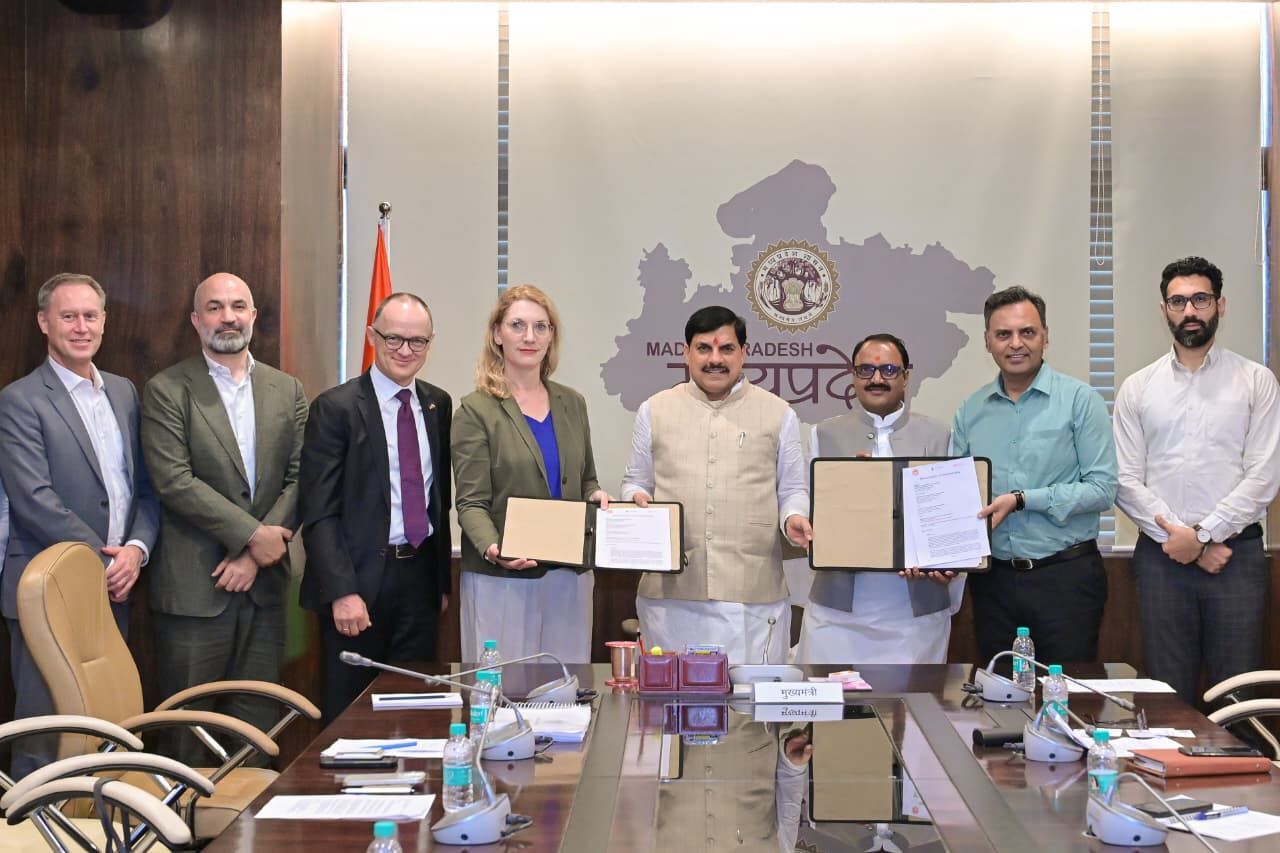
Madhya Pradesh has taken a significant step towards integrating agriculture and renewable energy with the signing of a Memorandum of Understanding (MoU) on 15 June, between the Department of New and Renewable Energy, Madhya Pradesh Urja Vikas Nigam Limited (MPUVNL), and the German government-supported Indo-German Agrivoltaics Collaboration Project (IGCA) .
The agreement, signed in Bhopal in the presence of Chief Minister Dr. Mohan Yadav and New and Renewable Energy Minister Rakesh Shukla, aims to accelerate the adoption of agrivoltaics across the state, enabling farmers to generate solar power while continuing agricultural activities on the same land.
The collaboration is expected to support Madhya Pradesh’s clean energy ambitions while creating new income opportunities for farmers, improving land-use efficiency, and promoting climate-resilient rural development.
Agrivoltaics to Combine Farming and Solar Power Generation
Agrivoltaics, also known as AgriPV, is an integrated land-use approach that allows agricultural production and solar energy generation to coexist on the same parcel of land. The model is designed to optimise land resources by enabling farmers to cultivate crops while installing solar panels that generate electricity.
Officials said the initiative seeks to reduce pressure on agricultural land, avoid land acquisition challenges often associated with renewable energy projects, and contribute to food security while expanding clean energy capacity.
Under the proposed Agro Solar PV initiative, farmers will retain ownership of their land and continue farming operations while simultaneously producing solar energy. By generating electricity from solar installations on their farms, they will be able to earn an additional source of income alongside agricultural earnings.
Framework to Align with PM-KUSUM 2.0
The partnership will support the development of a dedicated agrivoltaics framework for Madhya Pradesh, aligned with national renewable energy initiatives, including the PM-KUSUM 2.0 scheme.
The framework is expected to provide a roadmap for scaling agrivoltaic projects across the state, with a focus on increasing farmers’ incomes, strengthening energy security, and promoting sustainable rural development.
The non-binding MoU will remain in force until May 2030.
German Technical Expertise to Support Project Development
As part of the collaboration, German development agency GIZ, through the Indo-German Agrivoltaics Collaboration Project, will provide technical assistance to the state government.
The support will include identification of suitable agrivoltaic projects, technical and economic assessments, project design, financial viability studies, and implementation assistance. The partnership will also explore scalable agrivoltaic models tailored to Madhya Pradesh’s diverse agricultural conditions and cropping patterns.
Officials said the initiative would facilitate the adoption of clean energy technologies in rural areas while reducing dependence on conventional power sources and strengthening climate-resilient farming practices.
Capacity Building and Policy Support
Beyond project implementation, the collaboration will focus on capacity building and stakeholder engagement across the state.
Training and awareness programmes will be organised for farmers, Farmer Producer Organisations (FPOs), energy developers, distribution companies (DISCOMs), and other stakeholders to encourage wider adoption of agrivoltaic systems.
The German-supported project will also assist the state in developing an enabling policy and regulatory framework to support agrivoltaics while ensuring agricultural productivity and food security remain protected.
Strengthening India-Germany Cooperation in Renewable Energy
The MoU marks another milestone in India-Germany cooperation in the renewable energy sector, bringing together international expertise and state-level policy initiatives to advance sustainable development goals.
Officials said the agreement reflects Madhya Pradesh’s growing commitment to decentralised renewable energy generation and green growth. The collaboration is expected to create new opportunities for farmer-centric development while contributing to India’s broader objectives of enhancing energy security, accelerating the clean energy transition, and creating sustainable livelihoods in rural areas.
The signing of the agreement was facilitated by the Department of New and Renewable Energy, Government of Madhya Pradesh, with support from senior officials including Manu Srivastava, Additional Chief Secretary, New and Renewable Energy Department, and IAS officer Amanbir Singh Bains.
With the new partnership in place, Madhya Pradesh aims to position itself as a leading state in agrivoltaics, demonstrating how agriculture and renewable energy can be integrated to drive inclusive economic growth, environmental sustainability, and long-term rural prosperity.