
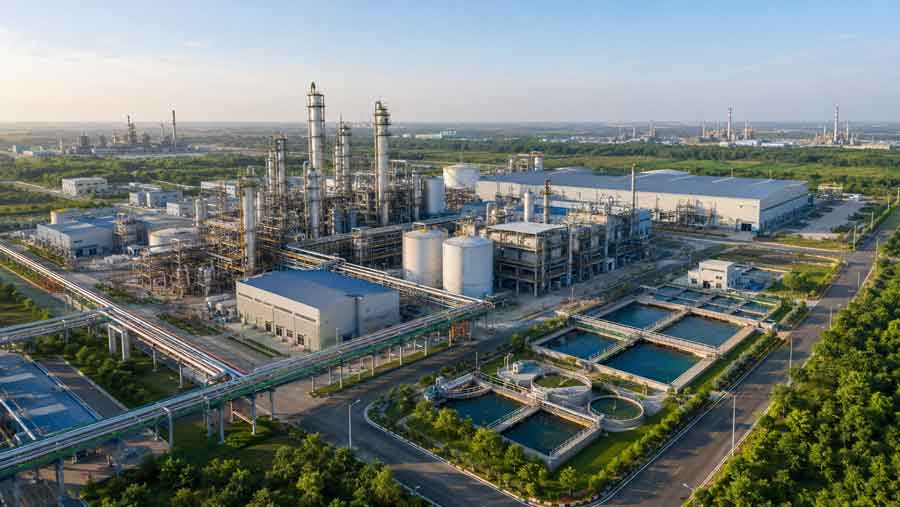
The BHAVYA Rasayan scheme will provide shared infrastructure for chemical manufacturers as India seeks to expand production, reduce import dependence and attract investment
The Union Cabinet, chaired by Prime Minister Narendra Modi, approved a ₹3,030-crore scheme on July 24, 2026, to establish three large chemical parks in India, marking a new effort to strengthen the country’s domestic manufacturing base and reduce its dependence on imported chemicals.
The Bharat Audyogik Vikas Yojana Rasayan, or BHAVYA Rasayan scheme, was initially announced in the Union Budget for the 2026–27 financial year. It will run for five years, from 2026–27 to 2030–31.
The government has allocated ₹3,000 crore to develop common infrastructure and basic utilities within the parks. The remaining ₹30 crore will cover administrative expenditure.
Centre and states to jointly develop parks
The Union government will offer a grant of up to ₹1,000 crore for each chemical park. The state government developing the park must contribute at least ₹500 crore.
States will compete for the three projects through a challenge-based selection process. The locations have not yet been announced and will be chosen after the government evaluates proposals from interested states.
Each park must be developed on at least eight square kilometres, equivalent to around 2,000 acres, of contiguous and encumbrance-free land.
The availability of clear land, state-level financial support and the ability to provide infrastructure are therefore likely to be important considerations in the selection process.
Plug-and-play infrastructure for Indian manufacturers
The parks will offer plug-and-play facilities designed specifically for the chemical industry. Instead of requiring every company to separately establish treatment plants, utility networks and logistics infrastructure, manufacturers will be able to use shared facilities within the industrial clusters.
The planned infrastructure includes:
- Common effluent treatment plants
- Treatment, storage and disposal facilities
- Hazardous-waste management systems
- Water-supply and distribution networks
- Solvent-recovery and distillation facilities
- Steam-generation and distribution systems
- Interconnected pipelines
- Warehousing and logistics facilities
The common-infrastructure model is expected to reduce the capital and operating costs of setting up chemical-manufacturing units in India. According to government estimates, shared facilities could lower operating expenses for manufacturers located within the parks by 20% to 30%.
Actual savings will depend on the locations selected, the industries operating within each park and the use and maintenance of the common facilities.
Government expects large private investment
Union Minister for Information and Broadcasting Ashwini Vaishnaw, while announcing the Cabinet decision on July 24, said the chemical industry was a foundational sector because it supplied essential raw materials to several parts of the Indian economy.
The Minister explained that the ₹3,030-crore government allocation would finance common infrastructure and was not the total investment expected under the initiative.
The government estimates that each park could attract private investment of between ₹20,000 crore and ₹50,000 crore. The three parks could consequently mobilise substantially more capital than the initial public allocation if the projects draw the anticipated industrial participation.
The scheme is intended to attract Indian as well as foreign companies, increase domestic production capacity and generate employment across chemical manufacturing and its ancillary industries.
Reducing India’s dependence on imported chemicals
Chemicals and petrochemicals are essential inputs for several major Indian industries, including agriculture, pharmaceuticals, nutraceuticals, textiles, construction, automobiles and electronics.
By creating clusters with ready infrastructure, the government aims to expand local chemical production, replace selected imports and make domestic manufacturers more competitive. Larger integrated clusters could also lower logistics costs by bringing raw-material suppliers, producers, processing units and downstream industries closer together.
The parks are also expected to help Indian chemical manufacturers become more closely integrated with global supply chains and expand exports.
However, the extent of import substitution will depend on which segments of the chemical industry invest in the parks and whether the new facilities address products for which India currently depends substantially on overseas suppliers.
Environmental infrastructure at the centre of the plan
The scheme places particular emphasis on common environmental facilities because chemical manufacturing involves effluents, solvents and hazardous waste that require specialised treatment and disposal.
Centralised effluent-treatment and hazardous-waste facilities could improve environmental compliance while lowering the cost faced by individual companies, particularly small and medium-sized manufacturers.
Their effectiveness will depend on capacity, regular maintenance, transparent monitoring and strict enforcement of India’s environmental and industrial-safety regulations. Shared facilities alone will not remove environmental risks unless they are operated and supervised effectively.
Next step: selection of states and locations
The challenge-based selection of three state proposals will be the next major stage in implementing the scheme. The government has not yet identified where the parks will be located or provided individual construction timelines.
The success of the BHAVYA Rasayan scheme will depend on how quickly states can provide clear land, mobilise their required contribution and attract manufacturers. Timely construction of common infrastructure, environmental oversight and sustained private investment will also determine whether the parks can strengthen India’s position in the global chemicals industry.