
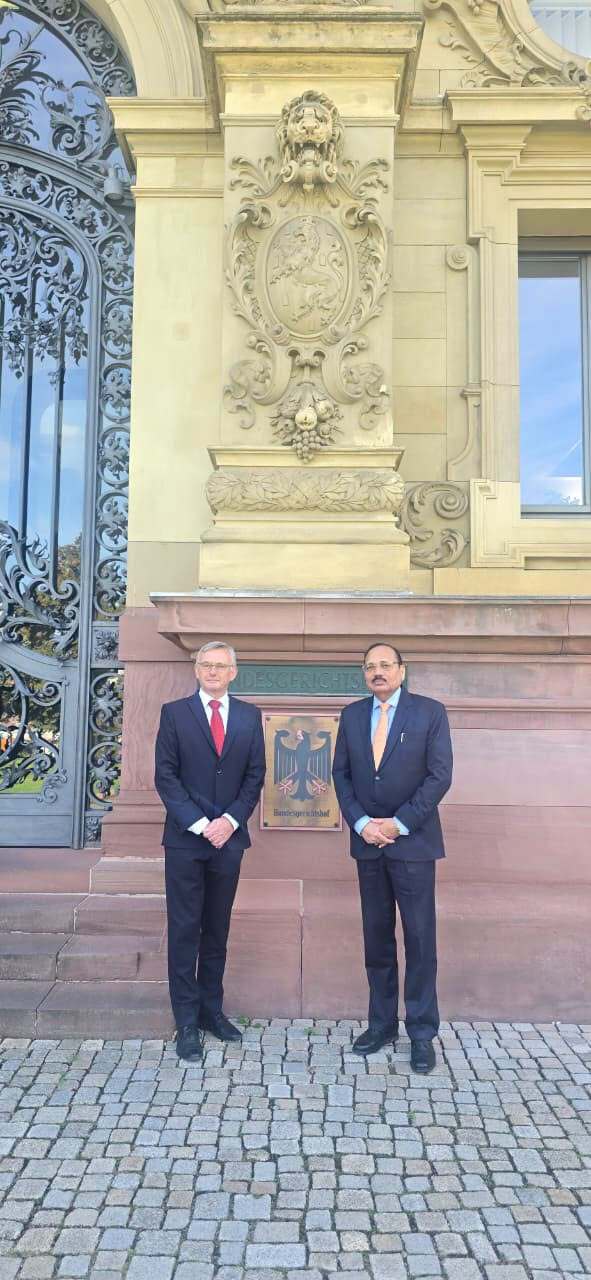
Photos’ Credit: India in Germany (Consulate General of India, Munich)
Chief Justice of India Surya Kant has called for closer institutional cooperation between the Indian and German judiciaries, identifying artificial intelligence, judicial digitalisation, cross-border mediation and legal education as potential areas for structured engagement.
Chief Justice Surya Kant made the remarks during a bilateral meeting with Dr Ulrich Herrmann, Presiding Judge of Germany’s Federal Court of Justice, and a German judicial delegation in Karlsruhe on August 26, 2026.
The discussions reflected the growing scope of India–Germany relations beyond diplomacy, trade and technology, extending cooperation to judicial administration and the changing demands placed on courts.
Different systems, common challenges
 India and Germany operate under different legal traditions. India follows a common-law system with an integrated judicial hierarchy, while Germany has a civil-law system divided into separate branches of federal jurisdiction.
Chief Justice Surya Kant said these differences provide a useful basis for institutional exchange, since both judiciaries face common questions relating to appellate workloads, consistency of case law, timely disposal of cases, access to justice and court administration.
He also congratulated the Federal Court of Justice on the establishment of its Seventh Criminal Senate in Leipzig, which became operational on July 1, 2026. The development was cited as an example of how judicial structures can be adapted in response to increasing caseloads.
The discussions focused on three broad areas: technology and AI in justice delivery, cross-border mediation and dispute resolution, and the possibility of formalising judicial cooperation through a Memorandum of Understanding or another institutional arrangement.
AI should assist, not decide
The use of artificial intelligence in courts formed a major part of the meeting. Chief Justice Surya Kant said technology could support legal research, administration and access to information, but should not determine judicial outcomes.
 “Artificial intelligence may augment judicial reasoning, but it cannot substitute judicial conscience,” he said.
Draft regulations prepared by the Supreme Court’s AI Committee reportedly envisage the use of AI for functions such as scheduling, transcription and translation. At the same time, the proposed safeguards would prevent such systems from assessing witness credibility, flight risk, the possibility of repeat offences or eligibility for bail.
A permanent apex body has also been proposed to oversee the adoption, regulation and accountability of AI within the Indian judicial system.
Chief Justice Surya Kant outlined India’s digitalisation efforts under Phase III of the eCourts Mission Mode Project, which has an approved outlay of ₹7,210 crore. The programme includes single sign-on facilities, electronic delivery of summons, integration between eCourts and ePrison systems and an updated eCourts Services mobile application.
AI-supported tools being used or developed within the Indian judicial system include SUPACE and LegRAA for legal research, SUVAS for translating judgments into 16 regional languages and SuSahay, a conversational interface providing citizens with information about cases and court procedures.
Germany’s electronic case files, E-Justice Council, Bund-Länder Commission and proposed Federal Justice Cloud were also discussed. Despite their different approaches to digitalisation, both sides agreed that judicial decisions must remain the responsibility of judges and legally authorised judicial officers.
Focus on cross-border commercial mediation
Cross-border mediation emerged as another potential area of Indo-German cooperation. Chief Justice Surya Kant pointed to India’s Mediation Act, 2023, which provides a statutory framework covering domestic, international and online mediation.
He said the two countries could exchange experience in commercial mediation, recognition and enforcement of mediated settlements and the joint training of professionals handling India–Germany business disputes.
The meeting also covered online dispute resolution and hybrid mechanisms such as “med-arb-med”, under which mediation and arbitration may be used at different stages of a commercial dispute.
Such cooperation could acquire greater relevance as commercial and investment links between India and Germany expand, creating a corresponding need for efficient mechanisms to resolve cross-border disputes.
Structured judicial exchanges proposed
Chief Justice Surya Kant welcomed a concept note prepared by the Hanseatic Higher Regional Court of Hamburg proposing reciprocal study visits, workshops and opportunities for judges to observe court proceedings in the two countries.
Possible areas for future exchanges include AI and technology in court administration, digital evidence, cybercrime, cross-border commercial law, mediation and the ethical use of emerging technologies.
He also proposed collaboration between India’s National Judicial Academy and German judicial institutions at the federal and state levels. Registries and technical teams could separately exchange experience in e-filing, electronic records, cybersecurity, listing practices, anonymisation and publication of judgments.
As an immediate step, Chief Justice Surya Kant suggested that India and Germany designate institutional points of contact to develop a practical cooperation programme. A formal MoU or another arrangement could subsequently be considered after the two sides determine its scope, participants and frequency.
The Karlsruhe meeting signals an effort to give India–Germany judicial engagement a more structured form. While the two systems remain institutionally distinct, their shared concerns over court efficiency, responsible use of AI, commercial dispute resolution and public confidence provide considerable ground for sustained cooperation.