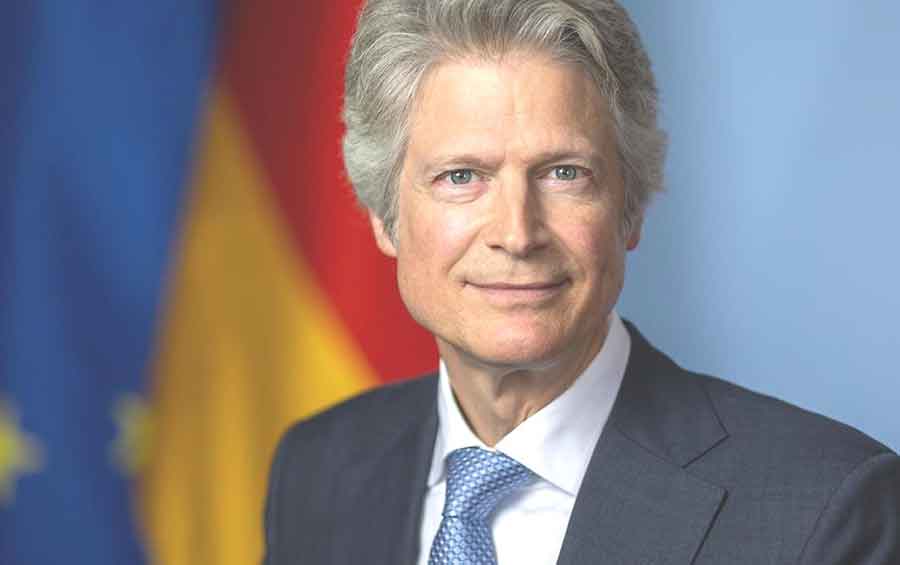
Germany is ready to sign the proposed agreement to build six conventional submarines in India once New Delhi completes its internal approvals, German Ambassador to India Dr Jasper Wieck said on Wednesday, 23 September. At his press briefing, the Ambassador identified defence cooperation, trade, skilled labour mobility and student exchange as priorities for India–Germany relations.
Submarine project awaits India’s approval
Under Project 75(I), India’s Mazagon Dock Shipbuilders Limited (MDL) and Germany’s TKMS are negotiating a project to build six next-generation submarines in India. Amb. Dr Wieck said the documents had been finalised on the German side and that Germany was ready to sign. India’s internal processes remain to be completed. The project has been estimated at around $8 billion, but a contract has yet to be concluded.
The Ambassador said he looked forward to the contract moving ahead. He described the proposed arrangement as a partnership built around production and technology transfer in India. He also identified drones and other unmanned systems, cyber capabilities, missile technology and sensors as possible areas for closer cooperation. According to Amb. Dr Wieck, Germany has become more forthcoming on defence export licences and technology transfer to India.
The submarine talks follow a wider step in bilateral defence cooperation. On April 22, 2026, Indian Defence Minister Rajnath Singh and German Federal Minister of Defence Boris Pistorius met in Berlin, where the two countries signed a Defence Industrial Cooperation Roadmap. The roadmap is intended to guide longer-term industrial collaboration.
Defence engagement also extends to military exercises and maritime cooperation. Amb. Dr Wieck referred to German participation in the upcoming Tarang Shakti exercise and the posting of a German liaison officer to an information fusion centre in New Delhi.
Skilled workers, students and German-language learning
Amb. Dr Wieck said Germany welcomes skilled workers from India and wants to expand opportunities for them to enter its labour market. He set out an aim to increase the number of long-term visas issued annually to Indian nationals to 80,000. Reports of his remarks put the current figure at approximately 60,000 to 63,000. That total includes students and family members as well as workers; it is not a skilled-worker visa count.
The Ambassador also linked student exchange with labour mobility, noting that Indian students may enter Germany’s workforce after completing their studies. He stressed the importance of learning German for those planning to study, train or work there, and said greater access to language education would help Indians pursue these opportunities.
Visa processing is another focus. Amb. Dr Wieck said he wants waiting times reduced substantially through faster, more flexible and more digital procedures. Language preparation and more efficient processing will be practical parts of any expansion in mobility between the two countries.
Trade and clean energy
Amb. Dr Wieck identified the India–EU free trade agreement as an opportunity to attract investment and expand business between India and Germany. He set out an ambition to double bilateral trade within five years and pointed to renewable energy and green technologies as areas in which companies could deepen their cooperation. The trade figure is a goal, not a projected outcome.
One example of clean-energy business ties comes from a separate company announcement, rather than the Ambassador’s briefing. In January, German energy company Uniper and India’s AM Green signed a long-term agreement for Uniper to purchase up to 500,000 tonnes of renewable ammonia a year from India. Renewable ammonia can be used to carry green hydrogen, offering a potential route for Indian clean-energy production to serve European industry. Deliveries are planned for the future; the agreement does not indicate that exports are already under way.
At government level, India and Germany have welcomed ongoing work under their joint green hydrogen roadmap. That work forms part of a broader clean-energy partnership aimed at supporting India’s renewable-energy development.
Amb. Dr Wieck has described India and Germany as trusted, reliable partners in a rapidly changing world. His priorities give that relationship a concrete agenda: bringing the submarine negotiations to a conclusion, building on the defence roadmap, expanding clean-energy cooperation and improving the routes through which Indian students and skilled workers can study and work in Germany.