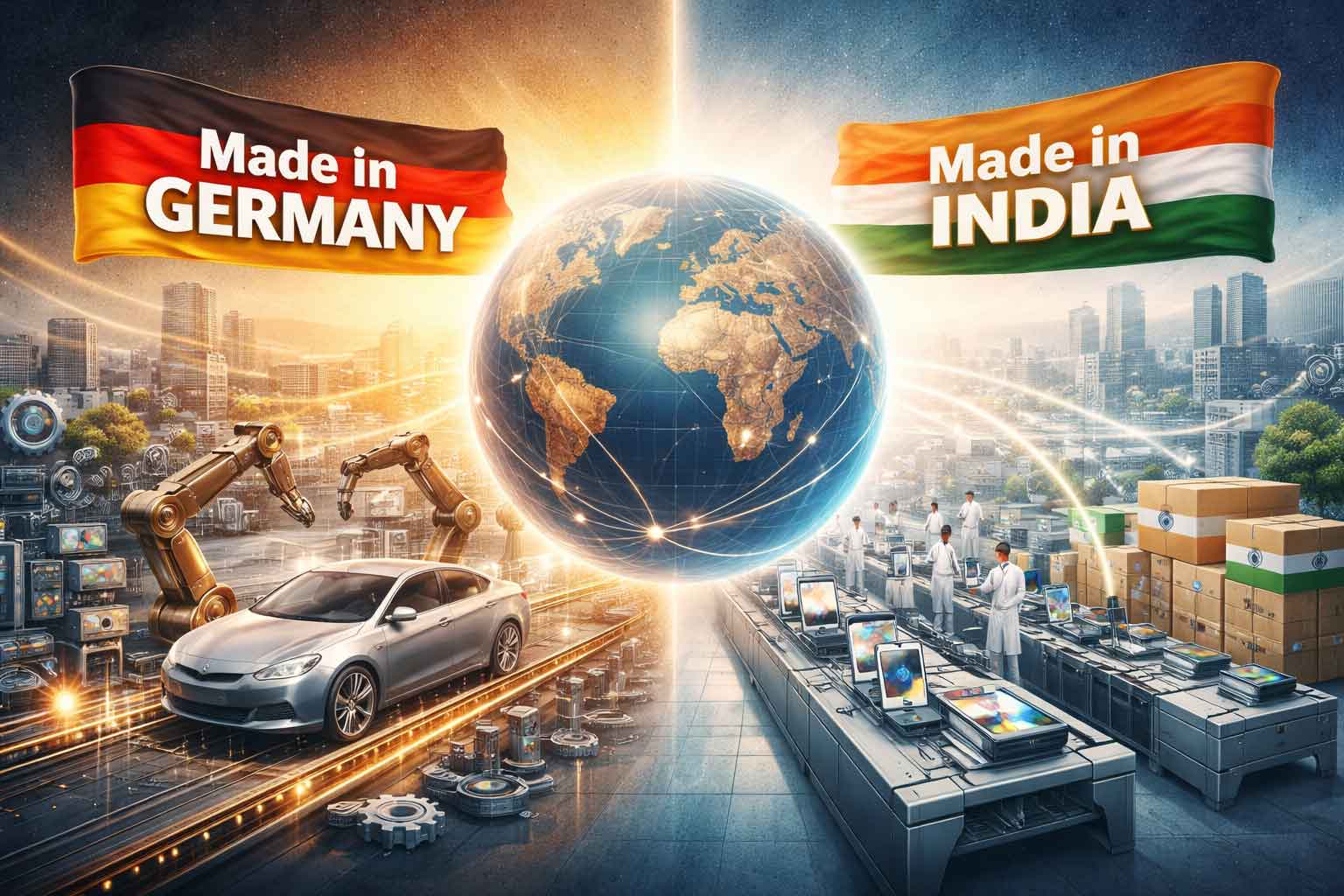
A new global study on country-of-origin labels highlights the continued dominance of Germany’s manufacturing reputation while pointing to India’s steady progress as a rising and increasingly credible global production hub.
Findings from the Nuremberg Institute for Market Decisions (NIM) suggest that while “Made in Germany” remains the gold standard in global trust, India is gradually strengthening its position amid shifting supply chains and policy-driven manufacturing growth.
Germany Retains Top Spot in Global Trust Rankings
The NIM survey ranks Germany highest, with 66% of global respondents expressing trust in “Made in Germany” products, reaffirming its long-standing reputation for quality and precision.
Switzerland (64%) and Japan (63%) follow closely, underlining the dominance of advanced industrial economies in shaping global consumer confidence.
The report attributes Germany’s leadership to its decades-long legacy of engineering excellence, innovation, and strict quality standards, particularly in sectors like automobiles and industrial manufacturing. The “Made in Germany” label continues to significantly influence purchasing decisions worldwide.
‘Made in India’ at 27%—A Market on the Rise
“Made in India” currently holds a 27% global trust score, placing it among emerging manufacturing economies that are gaining traction in international markets.
While this trails countries such as China (31%) and Taiwan (33%), the data reflects India’s ongoing transition from a cost-driven manufacturing base to a value-driven production hub.
The study indicates that around a quarter of global consumers already see “Made in India” as a positive factor in their buying decisions, signalling growing acceptance.
Perception gaps persist, with developed economies often associated with reliability and craftsmanship. However, India’s expanding role in electronics, pharmaceuticals, and advanced manufacturing is steadily reshaping these narratives.
Bridging the Gap: India’s Shift from Scale to Quality Perception
The findings underline a key challenge: aligning manufacturing capability with global perception.
India has made rapid gains in scale and supply chain integration, but the report emphasises that consistent quality and long-term reliability will be critical in building deeper global trust.
Germany’s edge stems from historical consistency, whereas India represents a fast-evolving manufacturing ecosystem, supported by policy reforms and increasing global integration.
Importantly, the study notes that price and product quality outweigh country-of-origin alone, suggesting India has a clear pathway to accelerate trust through performance and innovation.
Europe’s Collective Strength vs India’s Growth Curve
Beyond Germany, Europe continues to demonstrate strong collective credibility. France, Italy, and the United Kingdom each record trust levels of around 57%, while the European Union stands at 55%.
This reflects a shared industrial reputation across the region. In contrast, India is still in the process of building a comparable national brand identity in manufacturing.
However, India’s increasing presence in global value chains—especially in electronics and high-volume production—points to a gradual shift toward higher-value perception.
Indian Consumers More Open Than European Counterparts
One notable insight from the study is the difference in consumer attitudes. Respondents from emerging economies like India are more open to foreign labels, while consumers in industrialised nations such as Germany and Japan tend to be more critical.
This asymmetry reflects varying levels of domestic industrial confidence and exposure to global brands, highlighting how perception is shaped not just by production capability but also by consumer mindset.
Policy Push: Strengthening the ‘Made in India’ Tag
Recognising the importance of credibility, India is also tightening regulatory frameworks around the label. Authorities are working to ensure that products labelled “Made in India” genuinely meet domestic value-addition and quality standards, amid concerns about mislabelling.
Such measures are expected to enhance transparency and reinforce trust in Indian manufacturing as the country seeks to position itself as a reliable global supplier.
The Road Ahead: From Scale to Global Trust
The report underscores a broader shift: India’s manufacturing story is moving from scale to credibility.
While Germany continues to set the global benchmark through legacy and consistency, India’s trajectory reflects steady gains driven by policy support, industrial expansion, and growing global integration.
As supply chains diversify and Indo-German industrial cooperation deepens, India’s ability to translate manufacturing strength into sustained global trust will shape its next phase of economic growth.