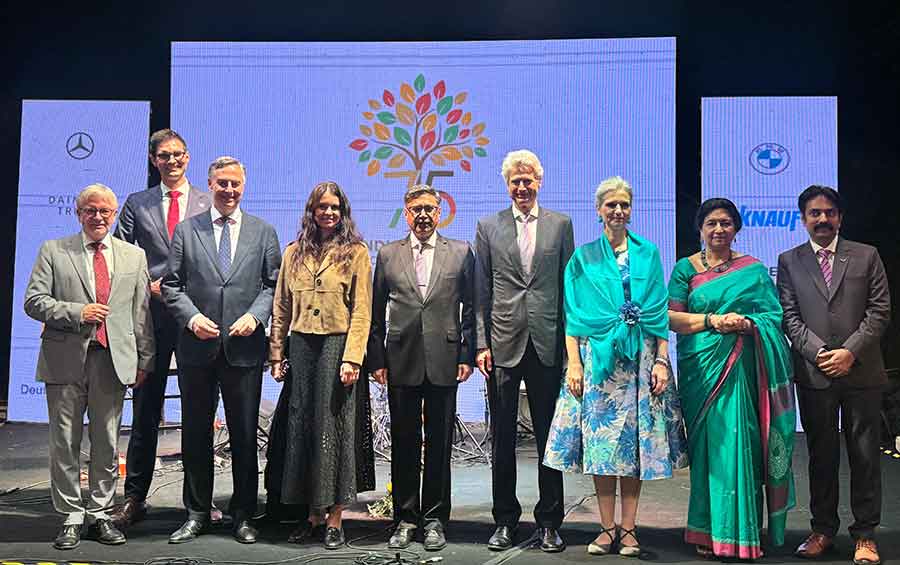
India and Germany marked 75 years of diplomatic relations at Germany’s National Day reception in New Delhi on October 27, with German Ambassador Dr Jaspar Wieck highlighting a partnership spanning trade, technology, climate action, education and security.
Held in the German Embassy garden in Chanakyapuri, the reception was attended by Foreign Secretary Vikram Misri as chief guest, alongside parliamentarians, diplomats, business leaders and representatives of civil society, academia and the Indo-German community.
 A European Parliament delegation led by David McAllister, chairman of its Foreign Affairs Committee, and two members of the German Bundestag were among the guests of honour, according to the embassy’s press note.
A shared journey of 75 years
Welcoming guests in English, German and Hindi, Ambassador Wieck recalled the reunification that Germany’s National Day commemorates.
“36 years ago Germany reunited – after 40 years of division, of barbed wire and of families torn apart,” he said.
“Each year we remember this moment of joy and happiness with deep gratitude to all those who have made this turn of history possible – in particular the people who stood up against communist dictatorship in Leipzig, Dresden, in Berlin and in many other parts of Central and Eastern Europe.”
Turning to the anniversary of bilateral relations, he added: “This year, there is even more to celebrate: 75 years ago Germany and India established diplomatic relations.”
The ambassador described how the relationship had expanded since its beginnings in 1951.
“What began in 1951, has grown into a trusted strategic partnership encompassing all central topics of our time: trade and investment, research and technology, climate protection and sustainability, artificial intelligence and space, migration and mobility, security and defense. Germany is proud to stand alongside India as a trusted partner in this journey.”
He underlined the message in Hindi: “Is safar mein Bharat aur Germany saath milkar aage badh rahe hain”—“On this journey, India and Germany are moving ahead together.”
Looking forward to the EU–India trade agreement
The anticipated signing of the EU–India free trade agreement featured prominently in Ambassador Wieck’s address.
“At the end of this year we will see, hopefully, the signing of the EU-India Free Trade Agreement, a game changer for our trade and investment partnership,” he said.
India and the European Union concluded negotiations on the agreement at their summit in New Delhi on January 27, 2026. Signing and the subsequent approval process remain separate steps from the conclusion of negotiations.
Ambassador Wieck noted that the agreement would require ratification by the European Parliament after signing, making the visiting parliamentary delegation particularly welcome.
He also emphasised the role of legislators in building a relationship that reaches beyond governments.
“In a partnership between democracies, Parliaments play a crucial role. Parliamentarians bring a partnership into their constituencies – to the citizens, to civil society, to entrepreneurs, who all are the backbone of our partnership.”
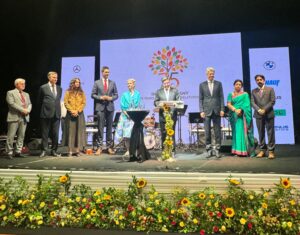
The ambassador welcomed Bundestag members Sepp Müller, deputy chairman of the CDU/CSU parliamentary group, and Vanessa Zobel to the stage. He also greeted McAllister and his European Parliament committee colleague Michael Gahler.
Why 2026 is a landmark year for India and Germany
This year’s reception carried significance beyond the annual celebration of German unity. Diplomatic relations between India and the Federal Republic of Germany were established in 1951, just two years after the latter came into being. Over three-quarters of a century, that engagement has developed into a broad partnership encompassing economic, strategic and social ties.
Elevated to a strategic partnership at the turn of the millennium, the relationship now covers trade and investment, research and technology, climate and sustainability, artificial intelligence and space, migration and mobility, and security and defence.
According to the embassy’s background note, the Inter-Governmental Consultations, held regularly since 2011, provide the highest-level framework for this engagement. The eighth round is scheduled in Germany in early 2027.
Germany is India’s largest trading partner in the European Union, the note said. More than 2,000 German companies operate in India, chiefly in automotive manufacturing, mechanical engineering, chemicals and renewable energy. Indian companies, meanwhile, invest in Germany in information technology, pharmaceuticals and engineering.
Education and migration have added a substantial human dimension to the partnership. The embassy said almost 70,000 Indian students are enrolled in Germany, while nearly a third of German student visas issued worldwide are issued in India. Germany’s 2024 “Focus on India” strategy, which also covers skilled-worker recruitment, reflects the growing importance of these connections.
The anniversary year has also seen high-level diplomatic engagement. According to the press note, Chancellor Friedrich Merz visited India on January 12–13 with a business delegation. Two weeks later, the 16th EU–India Summit in New Delhi marked the conclusion of negotiations on the free trade agreement.
These developments provided the backdrop to a reception that commemorated German reunification 36 years ago while looking ahead to the next phase of India–Germany cooperation.
History, film and music
Guests watched an embassy-produced film tracing milestones in the relationship since 1951, when India was among the first countries to establish diplomatic relations with the Federal Republic of Germany.
The evening also featured a performance by the Jazz Formation of the German Army Music Band Neubrandenburg, led by Master Sergeant Marcel Vollmann.
Thanking the musicians before handing over to Minister Misri, whom he described as “my dear friend Foreign Secretary Vikram Misri,” Ambassador Wieck closed with an invitation in English and Hindi: “Let’s celebrate together!”—“Aao, hum saath mein jashn manayein!”