
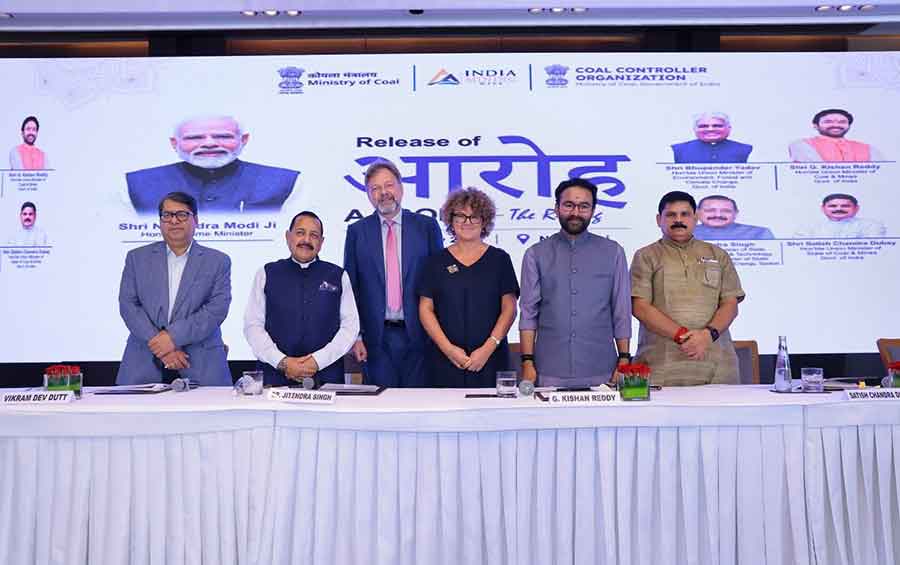
Photo Credit: German Embassy New Delhi
India and Germany have expanded their cooperation on sustainable mining through a €10-million technical cooperation project aimed at the scientific closure and repurposing of coal mines.
The implementation agreement between the Union Ministry of Coal and Deutsche Gesellschaft für Internationale Zusammenarbeit (GIZ) was signed in New Delhi on July 22, 2026, alongside the release of AAROH—the country’s first comprehensive annual report on scientific mine closure and repurposing.
Commissioned by Germany’s Federal Ministry for Economic Cooperation and Development and co-financed by the European Union, the bilateral project will operate over the next four years and run until 2030. It will bring together Indian and German expertise to develop sustainable approaches for closing mines and converting former mining areas into productive environmental, economic and community assets.
AAROH documents the closure of 42 coal mines
Prepared by the Coal Controller Organisation, AAROH—Annual Report on Mine Closure—documents the transformation of 42 coal mines that have been closed in accordance with approved scientific mine-closure plans.
The report presents mine-level accounts of land reclamation, ecological restoration, sustainable post-mining land use and community-oriented interventions. Each mine profile includes information about the closure measures undertaken, the subsequent use of the land, before-and-after visual documentation and QR code-enabled videos recording the site’s transformation.
According to the Ministry of Coal, the publication is intended to serve as a national knowledge repository, documenting successful models and providing practical insights for future mine-closure and repurposing projects.
The report was formally released at an event at The Oberoi in New Delhi attended by Union Minister of Coal and Mines G. Kishan Reddy; Union Minister of State (Independent Charge) for Science and Technology and Earth Sciences Jitendra Singh; Union Minister of State for Coal and Mines Satish Chandra Dubey; German Ambassador to India and Bhutan Dr Philipp Ackermann; and Deputy Head of the European Union Delegation to India Dr Ewa Suwara.
Coal Secretary Vikram Dev Dutt, Additional Secretary in the Ministry of Coal Sanoj Kumar Jha, Coal Controller Sajeesh Kumar N. and representatives from government agencies, coal companies, international organisations, industry and academia also participated.
Germany and EU to support four-year cooperation project
The implementation agreement signed by the Ministry of Coal and GIZ covers technical cooperation on mines approaching the end of their operational lives.
The project has a total volume of €10 million and will continue until 2030. Funding will come from the German government and the European Union under the wider Team Europe partnership with India.
The cooperation will focus on scientific mine closure, mine repurposing, technical capacity-building, knowledge exchange and the adoption of international practices. It will also support the development of new approaches through which former coal-mining areas can continue to benefit surrounding communities and the environment.
Mine closure involves more than ending production at an exhausted or commercially unviable site. It includes securing the mine, reclaiming disturbed land, managing environmental hazards, restoring ecosystems and identifying new economic uses capable of supporting communities that previously depended on mining.
The German Embassy New Delhi said the project would combine Indian and German expertise while strengthening technical capabilities, facilitating knowledge exchange and encouraging the adoption of global practices.
The Embassy described the investment as a reflection of the shared commitment of Germany, the European Union and India to sustainable economic development. It said the initiative also builds on priorities reaffirmed during the 16th India–EU Summit and the German Chancellor’s visit to India earlier in 2026.
India targets 147 additional mine closures
Minister Reddy described scientific mine closure as a national priority and an important component of India’s Viksit Bharat 2047 vision.
India has scientifically closed 42 coal mines, including 33 during the past year, according to the Ministry. The government is now targeting the scientific closure of another 147 mines over the next two to three years.
The Minister said Germany’s experience in mine closure and a just transition would be combined with India’s scale, policy framework and implementation capacity. The objective is to develop an Indian model that integrates environmental restoration, technology, community participation and economic opportunities.
Former mining areas are already being repurposed for renewable-energy projects, eco-tourism, agriculture, water conservation, community infrastructure and livelihood generation. The Ministry cited initiatives at West Bokaro, Bishrampur and the Viveknagar Solar Project as examples of this transition.
₹40,000-crore corpus created for mine closure
The government has created a dedicated corpus of more than $5 billion, equivalent to approximately ₹40,000 crore, for scientific and progressive mine closure.
It has also earmarked 25% of approved mine-closure costs for community development. The Ministry estimates that this provision could create an investment potential of nearly ₹10,000 crore over the next decade.
This approach is intended to ensure that communities living in coal-producing regions receive a greater share of the benefits generated through the closure and redevelopment process.
The Ministry’s Mine Closure Guidelines, 2025, place community participation and environmental sustainability at the centre of mine-closure planning. District Collector-led Mine Closure Advisory Committees have also been established to bring local stakeholders into the process.
German experience to support a just transition
Ambassador Ackermann said the agreement would facilitate the exchange of technical expertise and global practices relating to scientific mine closure and sustainable repurposing.
The Ambassador said the cooperation would reinforce the India–Germany partnership while supporting a just and sustainable transition in mining-dependent regions.
Deputy Head of the EU Delegation Suwara said sustainable mine closure required long-term planning, stakeholder participation, land restoration and investment in reskilling. She described the agreement as a practical step towards ensuring that the transition in former mining regions remains fair and inclusive.
The EU’s participation gives the project a wider India–Germany–EU dimension, combining European financial and technical support with India’s domestic mine-closure programme.
Frameworks developed for mine repurposing
AAROH also records the evolution of India’s regulatory and planning system for mine closure. This includes the RECLAIM Framework for community engagement and the L.I.V.E.S. Framework for sustainable mine closure and repurposing.
The SUVIKALP digital platform helps authorities and other stakeholders assess possible uses for former mine sites, while SUVIKALP Samvaad supports consultation, knowledge exchange and stakeholder participation.
The Ministry has also introduced the A.R.T.H.A. Framework and advisory committees led by District Collectors to improve coordination and ensure that local requirements are reflected in closure plans.
Together, these mechanisms seek to shift mine closure from a regulatory exercise conducted at the end of production to a planned process encompassing land restoration, economic diversification and community development.
Exhibition showcases restored mining areas
Minister Reddy also inaugurated an exhibition on mine closure and repurposing during the July 22 programme.
The exhibition presented projects undertaken by Coal India Limited and its subsidiaries, NLC India Limited, Singareni Collieries Company Limited, NTPC and private mining companies.
The initiatives covered scientific reclamation, ecological restoration, community development and the sustainable use of post-mining land. They demonstrated how former mining sites can be adapted for agriculture, renewable energy, water conservation and other productive purposes.
Coal NEER plants turn mine water into drinking water
Coal NEER plants established by Coal India subsidiaries were also inaugurated at the event. The initiative treats mine-discharge water and converts it into safe drinking water for communities in coal-bearing regions.
Coal public-sector undertakings currently supply nearly 300 lakh kilolitres of treated mine water annually, benefiting approximately three lakh people, according to the Ministry of Coal.
The Coal NEER initiative is also expected to create livelihood opportunities through the participation of local self-help groups, particularly those led by women.
Skill-development agreements signed for Jharia
Tripartite memoranda of understanding were signed under the Revised Jharia Master Plan to provide vocational training and employment-oriented skills to rehabilitated families.
The agreements involve Bharat Coking Coal Limited, the Jharia Rehabilitation and Development Authority, Hindalco Industries Limited and Rajdhani Universal Fabrics Private Limited.
The wider programme includes plans for a plug-and-play textile manufacturing facility and industry-linked training for families affected by rehabilitation in Jharia.
Minister Dubey said environmental restoration and socioeconomic development must advance together. He said the India–Germany project would help strengthen institutional capabilities and support the transformation of closed mines into assets capable of generating sustainable livelihoods and long-term regional development.
From mine closure to regional redevelopment
The release of AAROH and the launch of the four-year India–Germany project signal a broader change in how India approaches the end of a mine’s operational life.
Instead of treating closure solely as the termination of production, the emerging framework links it with ecosystem restoration, water management, renewable energy, community infrastructure, reskilling and economic diversification.
The project’s longer-term significance will depend on how effectively technical cooperation is translated into measurable restoration, new land uses and livelihood opportunities across India’s coal-producing regions. If applied at scale, the partnership could help establish mine closure as the beginning of regional redevelopment rather than simply the end of mining activity.