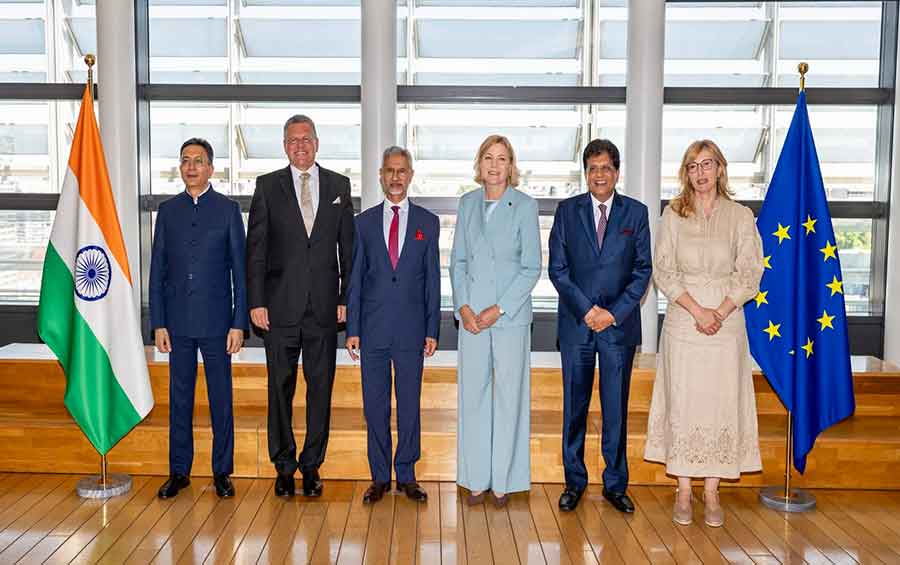
India and the European Union have moved to build on the momentum of their Free Trade Agreement by expanding cooperation in technology, research, investment and resilient supply chains following the third India-EU Trade and Technology Council meeting in Brussels on Wednesday, July 15, 2026.
The meeting resulted in plans to begin negotiations on India’s association with Horizon Europe, establish an innovation hub for electric-vehicle charging technologies and launch a deep-tech startup partnership. India and the EU also agreed to deepen cooperation in semiconductors, artificial intelligence, high-performance computing, quantum technologies, 6G and digital public infrastructure.
The Indian delegation included External Affairs Minister Dr S. Jaishankar, Commerce and Industry Minister Piyush Goyal and Minister of State for Electronics and Information Technology Jitin Prasada.
The EU was represented by European Commission Executive Vice-President for Tech Sovereignty, Security and Democracy Henna Virkkunen; Commissioner for Trade and Economic Security Maroš Šefčovič; and Commissioner for Startups, Research and Innovation Ekaterina Zaharieva.
FTA anchors expanding India-EU partnership
External Affairs Minister Dr Jaishankar said the India-EU partnership had entered a more ambitious phase, supported by progress on trade, security and mobility.
“India-EU partnership is today poised to reach greater heights. The free trade agreement, the security and defence partnership and the mobility framework have been its key achievements this year,” Minister Dr Jaishankar said.
“The potential of our ties will be realised through the implementation of the joint comprehensive strategic agenda. The TTC plays a notable role in that regard,” he added.
Commerce and Industry Minister Goyal described 2026 as a “historical year” for bilateral relations and said the FTA would benefit businesses and consumers on both sides.
“This is a historical year in the ties between the EU and India. We concluded the mother of all trade deals, as Her Excellency Von der Leyen called the EU-India free trade agreement,” Minister Goyal said.
“This free trade agreement is fair, equitable, and balanced, truly a win-win agreement for EU businesses in the EU, India businesses and the people of India,” he added.
The agreement is expected to be formally signed later in 2026.
“We look forward to witnessing the signing of the EU-India FTA later this year,” Minister Goyal said.
Trusted partnerships amid global economic pressures
External Affairs Minister Dr Jaishankar said supply-chain disruptions, market-access concerns and technology gaps had increased the importance of reliable international partnerships.
“As the international economy faces supply chain chokepoints, market access issues and technology gaps, trusted and reliable partnerships like that of India and EU show the way forward,” he said.
The External Affairs Minister identified overdependence on limited production sources and volatile market access as interlinked challenges facing the global economy.
“The solutions lie in de-risking through more diversified production and ensuring predictable markets,” Minister Dr Jaishankar said. “Strengthening the resilience of supply chains is today clearly a global priority.”
He said India and the EU had developed trust as open societies and market economies.
“The rule of law and the sanctity of contracts are central to our thinking,” he said. “India and the EU have developed this trust with each other and now strive to take that into the business and technology domains.”
Supply chains, investment and WTO reform
India and the EU agreed to strengthen supply chains in pharmaceuticals, agri-food products and clean-energy technologies while working on market access, technical regulations and food-safety standards.
“Both the EU and India are committed to de-risking our dependencies on certain critical areas. We are both committed to building reliable and diversified supply chains,” Minister Goyal said.
The two sides also completed a work programme on foreign direct investment screening and exchanged regulatory practices intended to facilitate investment flows.
“We have concluded a work program on foreign direct investment screening. We have exchanged best practices and will help further speed up the flow of investments on both sides,” the Commerce and Industry Minister said.
India and the EU reaffirmed their support for the multilateral trading system and reform of the World Trade Organisation.
“The multilateral trading system is undergoing great turbulence around the world, and therefore our shared commitment to a rules-based, open, inclusive and non-discriminatory World Trade Organisation will help us steer progress at the WTO in the future,” Minister Goyal said.
Horizon Europe negotiations to begin
India and the EU agreed to begin formal negotiations on India’s association with Horizon Europe, the EU’s €93.5-billion research and innovation programme. The negotiations are expected to conclude before the end of 2026, potentially allowing Indian researchers and innovators to participate fully from 2027.
“We will be starting negotiations for India’s association with the Horizon Europe programme. It is also worth noting that joint research calls in areas like waste-to-green hydrogen, combating marine pollution and EV battery recycling are now at a pilot-scale validation and will hopefully go beyond,” Minister Dr Jaishankar said.
The joint statement described the decision as “a historic and strategic shift towards a long-term institutional framework of cooperation between both sides, which will allow Indian researchers and innovators to fully participate in the programme as from 2027.”
European Commissioner Zaharieva said closer research and startup links could help convert shared technological ambitions into practical outcomes.
“When Europe and India innovate together, we don’t just develop new technologies — we shape the future. By bringing India closer to Horizon Europe and connecting nearly half a million startups, we are building a partnership designed to turn shared ambition into global impact,” Commissioner Zaharieva said.
Clean technology and €60-million research programme
The two sides reviewed research projects supported by a joint investment of €60 million over four years. These include producing renewable hydrogen from agricultural and industrial waste, deploying AI and advanced biosensors to monitor marine pollution, and recycling electric-vehicle batteries to recover critical raw materials.
India and the EU also agreed to continue cooperation on hydrogen safety standards, Hydrogen Valleys, electric mobility and other green technologies. Experts from both sides are expected to exchange information on hydrogen projects during the second half of 2026.
The meeting also cleared plans for the first India-EU Innovation Hub, which will focus on electric-vehicle charging technologies, testing and infrastructure standards.
Semiconductor partnership set to expand
India and the EU agreed to deepen semiconductor cooperation, with a focus on research, capacity building, investment and secure chip supply chains.
“With semiconductors, we see that India is a very important partner for the European Union,” European Commission Executive Vice-President Virkkunen said.
“We want to build up our own capacity in the European Union, but we also want to work with our trusted partners,” she added.
Executive Vice-President Virkkunen said India’s large pool of skilled professionals made it an important partner for semiconductor research and development.
“It’s important to build better resilience for these supply chains to make sure that we are not dependent on one source… That we have alternatives and we have our own capacity,” she said.
“When it comes to research and development of new chips, of course, India is a very important partner for us because it has a very large pool of highly skilled talent,” she added.
A joint semiconductor roundtable will be held during Semicon India 2026. The two sides will also examine cooperation between semiconductor design facilities under the India Semiconductor Mission and pilot lines created through the EU Chips Act.
This could include access to advanced Process Design Kits, technology platforms and shuttle programmes for more cost-effective silicon prototyping.
Minister of State Prasada said the Union Cabinet had approved the Semicon 2.0 programme with an outlay of approximately $13.25 billion. It will cover chip design, semiconductor equipment and materials, research and development, chemicals and gases required for manufacturing, and additional fabrication facilities.
“More manufacturing will come to India, further strengthening our ATMP and OSAT packaging networks. R&D in semiconductors and talent development will also be major thrust areas under the India Semiconductor Mission 2.0,” Minister of State Prasada said.
Joint AI roadmap and digital cooperation
India and the EU agreed to explore a Joint Artificial Intelligence Roadmap and exchange practices on responsible AI adoption, with healthcare identified as a potential focus area.
The two sides will also expand cooperation in high-performance computing, quantum technologies and 6G. A coordinated high-performance computing project will support research and knowledge exchange on natural hazards, climate change and bioinformatics.
They will continue technical work on making digital trust services interoperable, explore greater mobility for skilled ICT workers and examine a pilot connecting India’s DigiLocker with the EU Digital Identity Wallet.
“The EU-India partnership has led to many fruitful exchanges on AI, semiconductors, interoperability of digital trust services and startups,” Executive Vice-President Virkkunen said. “Together with India, we will continue pursuing the common objectives to promote secure, trusted and resilient technology.”
Deep-tech startup partnership planned
India and the EU agreed to establish a Deep-Tech Startup Partnership involving Start-up India and the European Innovation Council. The initiative will help Indian and European startups access new markets and commercialise technologies, particularly in deep tech and clean technology.
Minister of State Prasada said both sides had adopted an action plan for 2026-27 covering strategic and emerging technologies. “Our cooperation has increasingly moved towards an action-oriented and outcome-driven partnership, bringing together governments, industry, research institutions and innovation ecosystems from India and the European Union,” he said.
“Today, both sides have agreed on a forward-looking action plan for the year 2026-27, which will guide our cooperation across strategic and emerging technologies,” the Minister of State added.
He said the next phase would focus on implementation, digital skills, talent mobility and measurable results.
“India and the European Union can make an important contribution towards building the global technology frameworks and standards that are open, trusted, interoperable, and responsive to the needs of our societies,” Minister of State Prasada said.
Next TTC meeting in New Delhi
The India-EU Trade and Technology Council was established in April 2022 by Prime Minister Narendra Modi and European Commission President Ursula von der Leyen. Its first ministerial meeting was held in May 2023 and the second in February 2025.
At the July 15, 2026 meeting, ministers directed the TTC’s three working groups—covering strategic technologies and digital connectivity, clean and green technologies, and trade and resilient value chains—to implement the agreed plans and report regularly on progress.
India and the EU also decided to hold the India-EU Business Forum annually and organise regular industry consultations in priority sectors. The next ministerial meeting of the TTC will take place in New Delhi in 2027.