
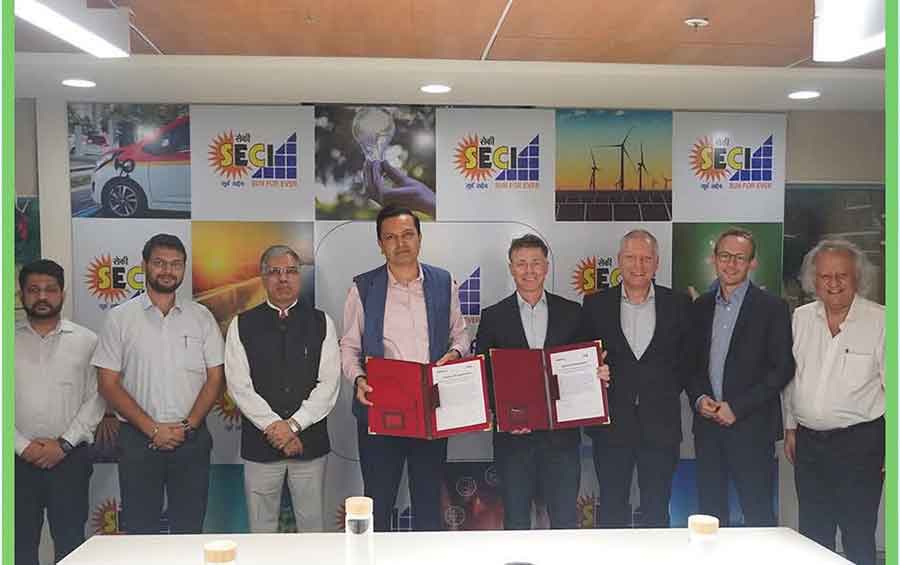
Photo Credit: Solar Energy Corporation of India Limited
India and Germany have moved forward in their cooperation on green hydrogen and renewable fuels, with Solar Energy Corporation of India Limited (SECI) and Germany’s Hintco GmbH agreeing on the key terms of a framework agreement for a potential bilateral H2Global tender.
The proposed framework covers the preparation, development and implementation of a joint tender for trading Renewable Fuels of Non-Biological Origin (RFNBOs). Detailed preparations remain subject to the necessary government approvals and will be undertaken in consultation with the respective governments. The development therefore represents progress towards a possible procurement mechanism, rather than the launch or award of a tender.
Building on the November 2024 partnership
The latest development follows the memorandum of understanding signed between SECI and H2Global Stiftung on November 19, 2024, during European Hydrogen Week in Brussels.
That partnership established a basis for sharing knowledge on market mechanisms and exploring joint tender designs to support international trade in green hydrogen and its derivatives. It also identified trade logistics and engagement with market participants as areas relevant to India’s ambition to become an export hub for these products.
Agreement on the framework’s key terms takes this cooperation towards a more specific bilateral tender proposal. SECI has described the initiative as a step towards deeper India–EU cooperation in green hydrogen and renewable fuels, supporting the development of international trading pathways.
How the H2Global mechanism supports trade
H2Global seeks to address a central challenge in emerging clean fuel markets: producers need dependable demand to justify investment, while buyers need affordable and reliable supplies.
Hintco acts as the trading intermediary within this mechanism. Through competitive auctions, it purchases eligible products from producers under long-term agreements and subsequently sells them to buyers through shorter-term sales contracts.
The difference between purchase costs and sales revenues can be covered by funding from public or philanthropic sources. This approach is designed to provide producers with greater commercial certainty while allowing demand and market prices to develop through repeated sales auctions.
For a future Indo-German tender, the detailed contractual and funding arrangements would need to be established through the preparation and approval process. The general H2Global model provides context for the proposal; it does not, by itself, confirm the final design of the bilateral tender.
What the renewable fuel category covers
RFNBOs include renewable hydrogen and synthetic fuels made from renewable hydrogen combined with captured carbon dioxide or nitrogen. The category can therefore encompass hydrogen-derived products relevant to industrial and transport applications.
The European Union has established a regulatory framework covering these fuels, including requirements governing their production and recognition as renewable. For prospective exporters, meeting the applicable requirements is an essential part of accessing this market.
The proposed SECI–Hintco initiative is framed around RFNBO trade. The announcement reviewed does not specify a final product mix, procurement volume, financial allocation, delivery schedule or bidding timetable. These details will be necessary to assess its eventual commercial scale.
Significance for India–Germany clean energy cooperation
The proposal adds an institutional dimension to India–Germany renewable fuel cooperation by bringing an Indian public sector renewable energy organisation and the H2Global trading intermediary together around a possible joint procurement process.
Its potential significance lies in developing a repeatable route for international trade. If approved and implemented, such a mechanism could help connect renewable fuel supply with buyers and provide a clearer basis for investment decisions. This is consistent with the original SECI–H2Global partnership’s focus on aligning supply and demand and developing international hydrogen trade corridors.
For now, the next steps are government approvals and detailed tender preparation. The framework’s agreed terms mark progress in bilateral cooperation, while the eventual tender documents will determine the products, participation conditions and scale of the opportunity.