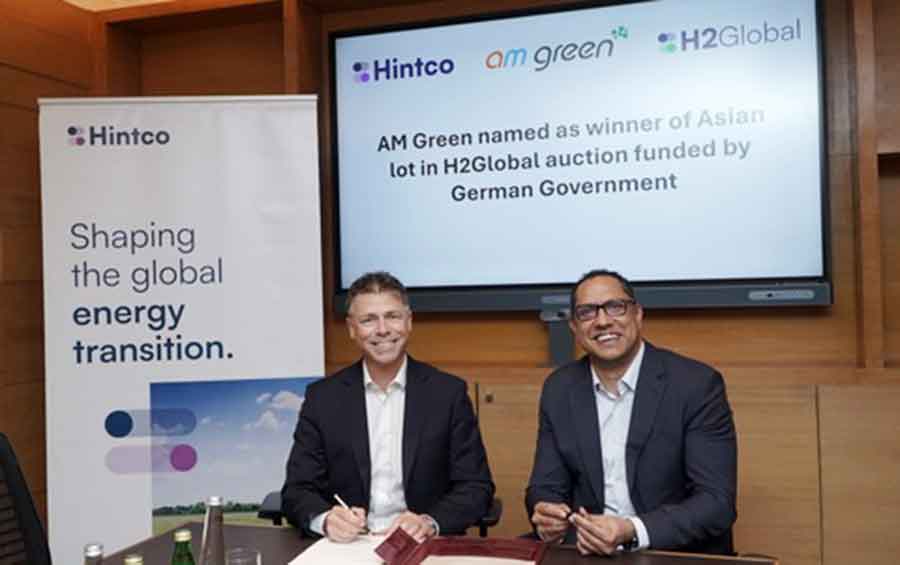
Photo Credit: AM Green
India’s AM Green Ammonia has secured a long-term agreement to supply renewable ammonia to Germany after emerging as the sole winner of the Asian lot in the German government-funded H2Global auction. Under the agreement announced on September 30, HINT.CO GmbH, known as Hintco, will purchase ammonia worth a minimum of €585 million over ten years.
The ammonia will be supplied from Phase 2 of AM Green’s Kakinada project in Andhra Pradesh, with first deliveries to Germany expected in 2029. The award followed a competitive bidding process in which the company’s offer ranked first among the submissions received.
The agreement adds a commercial development to India–Germany clean-energy cooperation, connecting an Indian renewable ammonia project with long-term demand in Germany. Its significance lies in the purchase commitment: securing a buyer over an extended period is an important part of developing a market for renewable hydrogen and its derivatives.
A long-term purchase commitment
Hintco serves as the intermediary under the H2Global mechanism, purchasing renewable products from producers and selling them to buyers. The €585 million figure represents the minimum value of ammonia purchases over the contract period.
Additional volumes may be purchased using proceeds from the resale of green ammonia in the European market. Further auction details remain pending, with Hintco expected to publish the full results before the end of 2026, alongside the outcomes of other regional tenders.
For emerging clean-energy projects, such agreements address a central commercial challenge: developers require predictable revenues to support investment, while buyers need dependable supplies at prices they can accommodate. H2Global is designed to connect these two sides of the market through competitive auctions.
Kakinada to anchor supplies to Germany
At Kakinada, AM Green is converting an existing natural gas-based ammonia and urea complex into a renewable ammonia facility using alkaline electrolysis technology. Electricity will be supplied through renewable power backed by pumped-hydro storage, in line with EU requirements.
Shipments are expected to leave through Kakinada Seaports, located alongside the plant. The combination of production, electricity supply and nearby export infrastructure brings together the principal elements required for the planned deliveries.
The company had announced its final investment decision for a million-tonne-per-year green ammonia project at Kakinada in August 2024. That earlier investment announcement established the project’s development plans; the latest award identifies a long-term purchase arrangement for supplies from its second phase.
How the H2Global mechanism works
H2Global uses a double-auction model to help establish markets for clean hydrogen and other low-carbon products. Hintco enters into long-term purchase contracts with producers, then sells the products through separate auctions to customers under shorter-term arrangements.
Public funding covers the difference between the purchase and resale prices. This allows producers to secure greater revenue certainty while helping buyers access renewable products that may initially cost more than conventional alternatives.
The model uses competition on both sides of the transaction. Producers compete to supply the product, while customers compete to purchase it. Long-term contracts support investment planning, and shorter resale contracts allow the mechanism to respond to changing demand and market prices.
H2Global describes this approach as a means of overcoming barriers that prevent producers and buyers from establishing a functioning market independently during its early stages.
Building on India–Germany hydrogen cooperation
The award comes against the backdrop of several years of bilateral work on green hydrogen.
In May 2022, India and Germany agreed to establish an Indo-German Green Hydrogen Task Force. Its scope covered cooperation in production, utilisation, storage and distribution, alongside enabling frameworks for projects, regulations, standards, trade and joint research and development.
The partnership advanced with the introduction of the Indo-German Green Hydrogen Roadmap during the seventh Inter-Governmental Consultations in New Delhi on October 25, 2024. The roadmap was intended to promote the development of the green hydrogen market and guide future cooperation between the two countries.
In their January 2026 joint statement, the two countries reiterated the importance of aligning India’s National Green Hydrogen Mission and Germany’s National Hydrogen Strategy through closer technological, commercial and regulatory cooperation. They also highlighted the need for stronger business-to-business connections.
Viewed against this framework, the H2Global award illustrates how bilateral clean-energy cooperation can develop through specific commercial commitments. It connects production planned in India with a purchasing mechanism funded by Germany.
Earlier commercial and regulatory links
The latest award also follows other developments involving Indian-produced green ammonia and German partners.
The January 2026 joint statement welcomed an offtake agreement between AM Green and Uniper Global Commodities for the supply of green ammonia. It also welcomed an agreement between India’s Petroleum and Natural Gas Regulatory Board and the German Technical and Scientific Association for Gas and Water Industries, DVGW, to advance cooperation on hydrogen regulations and standards.
These developments address different requirements of an emerging cross-border industry. Purchase agreements establish demand, while cooperation on regulations and standards supports the framework within which production, transport and trade can develop.
The Hintco arrangement adds another long-term purchasing channel to this evolving commercial relationship.
Supporting India’s green hydrogen ambitions
India’s National Green Hydrogen Mission places production, domestic use and exports within a common development framework. Approved in January 2023 with an initial outlay of ₹19,744 crore, the mission aims to establish India as a global hub for green hydrogen and its derivatives.
Its expected outcomes include developing at least five million metric tonnes of annual green hydrogen production capacity by 2030, supported by approximately 125 GW of associated renewable energy capacity. These are national targets, distinct from the capacity or supply commitments of any individual ammonia project.
The mission also provides for supply-chain development, research, standards, testing facilities and skills. Its approach recognises that expanding production requires supporting infrastructure and institutions alongside investment in individual plants.
Within this wider effort, export purchase agreements provide a commercial connection between Indian projects and overseas demand. The AM Green award offers a concrete example of that connection, although deliveries under the newly announced arrangement remain scheduled for the future.
A further step in bilateral clean-energy trade
The H2Global award strengthens the commercial dimension of India–Germany hydrogen cooperation. India brings a developing renewable production base, while the German-funded mechanism provides a route to long-term purchasing commitments.
With first shipments expected in 2029, the agreement establishes a future supply relationship between Kakinada and Germany. It gives the two countries’ clean-energy partnership a defined commercial commitment as they continue work on investment, technology and standards.