
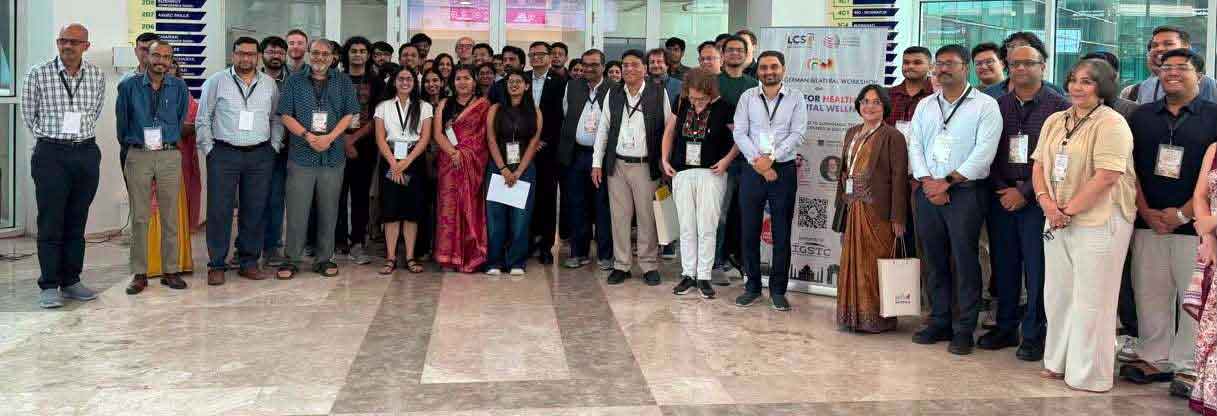
Photo Credit: IIT Delhi
India and Germany are expanding their scientific cooperation into Green Artificial Intelligence, with researchers from both countries exploring how energy-efficient and trustworthy AI models could be applied in healthcare and mental wellness.
A two-day Indo-German Bilateral Workshop on Green AI for Healthcare and Mental Wellness was held at the Indian Institute of Technology Delhi on September 3 and 4, 2026. The programme brought together more than 30 researchers and experts from India and Germany to discuss the development and responsible deployment of AI systems in different healthcare environments.
Sponsored by the Indo-German Science and Technology Centre (IGSTC), the workshop was organised by Professor Tanmoy Chakraborty of IIT Delhi and Professor Iryna Gurevych of Germany’s Technical University of Darmstadt.
IGSTC is a bilateral platform supported by India’s Department of Science and Technology and Germany’s Federal Ministry of Research, Technology and Space. It promotes applied research partnerships involving academic institutions and industry in the two countries.
Moving beyond increasingly large AI models
The discussions examined whether healthcare applications always require large, computing-intensive AI models, or whether smaller and more specialised systems could deliver reliable results while consuming fewer computational and energy resources.
Green AI refers broadly to the development and use of artificial intelligence systems that account for energy consumption, computing requirements and environmental impact. The approach seeks to improve efficiency across the AI lifecycle—from training a model to deploying and operating it in real-world settings.
Smaller language models were therefore an important part of the workshop. Unlike general-purpose large language models, these systems can be designed for specific tasks and may require less computing capacity. In some cases, they can also operate locally on a device, reducing dependence on cloud-based infrastructure.
Professor Chakraborty underlined the need for the next phase of AI development to look beyond model size and place greater emphasis on efficiency, sustainability, trustworthiness and accessibility. Healthcare and mental wellness, he indicated, offer important areas in which these principles can be translated into practical applications.
Medical imaging, mental health and multilingual care
The workshop covered possible applications of Green AI in medical imaging, clinical decision support, mental healthcare and multilingual health services.
Multilingual systems could be particularly relevant in India, where patients and healthcare professionals work across numerous languages and varying levels of digital and medical infrastructure. More compact models may also offer possibilities for healthcare facilities that do not have continuous access to advanced computing systems.
In medical imaging, energy-efficient AI could support the analysis of scans and other diagnostic material without requiring the same level of computing infrastructure as larger models. Clinical decision-support tools, meanwhile, could assist healthcare professionals in organising information and identifying relevant patterns, although their use would require clinical validation and human oversight.
Mental wellness emerged as another significant area of discussion. Researchers examined how smaller and privacy-preserving AI models could potentially support mental-health applications while keeping sensitive personal information closer to the user.
Professor Gurevych highlighted the potential of compact AI systems that can operate on devices, an approach that could reduce the transfer of sensitive health data to external servers. Such applications, however, would still need to meet standards relating to privacy, safety, transparency and clinical relevance.
Deployment challenges remain
Participants also examined the technical, infrastructural, regulatory and ethical questions surrounding the use of AI in healthcare. A model’s computational efficiency alone does not establish whether it is appropriate for clinical or mental-health settings.
Healthcare AI systems must also be assessed for accuracy, bias, data protection, patient safety and their ability to perform reliably across different populations and medical environments. The workshop therefore connected environmental sustainability with the wider objective of developing responsible and accessible healthcare technologies.
Dr. Kusumita Arora, Director of IGSTC, said the initiative brought together the complementary capabilities of India and Germany to address shared questions relating to Green AI, healthcare and mental wellness.
Roadmap for future Indo-German research
The meeting was also intended to support longer-term cooperation among researchers, healthcare professionals and industry stakeholders in India and Germany. Participants discussed the preparation of a roadmap for future joint research, innovation and capacity-building programmes.
No specific AI product or clinical deployment was announced at the workshop. Its immediate outcome lies in identifying areas for further research and establishing connections among specialists working at the intersection of sustainable computing and healthcare.
The initiative adds a new dimension to the India–Germany science and technology partnership. As both countries increase their focus on AI, the IIT Delhi workshop placed energy use, privacy, accessibility and clinical responsibility alongside technological performance—issues that will determine whether healthcare AI can be deployed sustainably and safely at scale.