
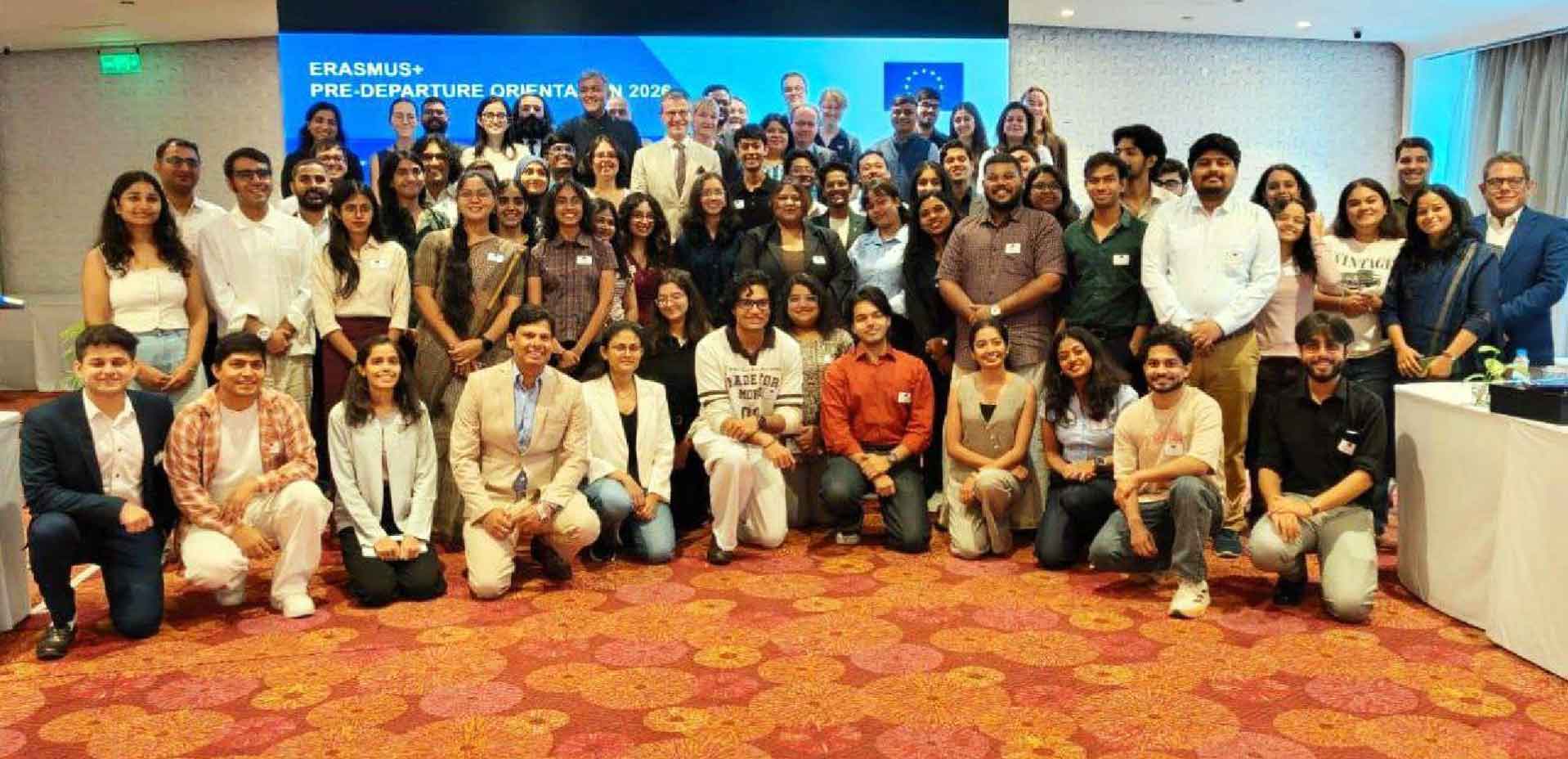
Photo Credit: LinkedIn/Delegation of the European Union to India
The European Union has launched the EU-India Student Ambassadors’ Network, a new initiative aimed at strengthening educational, cultural and people-to-people ties between India and Europe, while simultaneously announcing that 75 Indian students have been selected for the prestigious Erasmus Mundus Joint Master Degree (EMJMD) scholarships for the 2026–2028 academic cycle.
The announcements were made during a pre-departure ceremony hosted by the Delegation of the European Union to India in New Delhi, bringing together scholarship recipients, alumni, education stakeholders and representatives of EU member states.
The newly launched ambassador network will bring together 40 student representatives from 20 universities across India, tasked with promoting awareness about European higher education opportunities, research collaborations and the broader India-EU partnership.
Erasmus Students to Champion India-EU Relations
Speaking at the event, Hervé Delphin, Ambassador of the European Union to India, described Erasmus scholars as ideal representatives of the growing strategic relationship between India and Europe.
“We need ambassadors of the EU-India agenda, and I think no one else than the Erasmus students would be better placed to be this agent of positive change, drawing bridges between our two geographies. We will need this type of talent and profiles more that can be nurturing to the business, trade, economy, cultural and all sorts of relations that will exist between Europe and India, which are bound to grow.”
Announcing the ambassador initiative, Amb Delphin added: “We have selected 20 higher education institutes in India, and in each of them, we are trying to identify what we call EU ambassadors in India because we believe very much in the importance of raising awareness and creating a better understanding of Europe, and to also highlight all that connects Europe and India.”
According to the EU Delegation, the initiative aligns with the EU-India Strategic Agenda’s emphasis on knowledge-sharing, youth engagement and innovation, while creating a peer-led community to deepen academic and cultural exchanges between the two regions.
Seventy-Five Indian Students Selected for Europe’s Flagship Scholarship Programme
The latest cohort of Erasmus Mundus scholars will pursue interdisciplinary master’s programmes across universities in 15 European countries, including France, Germany, Belgium, Italy, Spain and the Netherlands. Their areas of study range from artificial intelligence and cybersecurity to renewable energy, vaccinology, smart urban development, pharmaceutical sciences, social sciences and humanities.
The Erasmus Mundus programme continues to hold strong appeal among Indian students. With nearly 100,000 Indian students currently enrolled in higher education institutions across Europe, the continent remains one of the most attractive destinations for advanced academic and research opportunities.
The Erasmus+ programme, established in 1987 as the European Region Action Scheme for the Mobility of University Students, remains the European Union’s flagship academic mobility initiative.
Declining Scholarship Numbers Reflect Growing Global Competition
Although Indian students continue to perform strongly, the number of Erasmus Mundus scholarships awarded to Indians has declined in recent years.
After reaching a peak of 174 scholarships in 2023, the number fell to 146 in 2024, 101 in 2025, and 75 in 2026, prompting questions about India’s position within the programme.
Addressing these concerns, Ambassador Delphin argued that the decline should be viewed in the context of the programme’s expanding global popularity.
“India, since it signed the strategic partnership in 2004, has by far been the largest cohort in the history of the Erasmus Mundus programme, cumulatively offering over 6,000 students so far. Even with 75 students, India remains among the top source countries. This is a reflection of the success of the programme and its attraction around the world.”
He noted that Erasmus Mundus now attracts applicants from more than 140 countries, intensifying competition for a scholarship pool that has not expanded proportionately.
Migration Debate Unlikely to Impact India-EU Mobility
The Ambassador also addressed concerns around Europe’s evolving migration policies.
In November 2025, the Council of the European Union adopted revised visa suspension rules that lowered the threshold for triggering restrictions in response to irregular migration indicators, such as asylum applications and visa overstays.
Amb Delphin, however, stressed that India occupies a distinct position within Europe’s migration landscape.
“Migration is first and foremost a national-level competence. There are debates across Europe, but the hard economic truth is that Europe needs a labour force that its own demography cannot sustain.”
Drawing a distinction between broader political debates and India’s role as a source of skilled talent, he added: “India is a very minor source of illegal migration. That is simply not the problem when it comes to India. What India represents, on the positive side, is a supply of skilled profiles in ICT, hospitality, and healthcare, that are increasingly in demand across Europe. So, there may be politics around migration broadly, but I do not think that will affect EU-India mobility.”
The Ambassador also highlighted the Schengen Visa Cascade agreement introduced two years ago, which is intended to facilitate longer-term visas and smoother mobility for students, researchers and business travellers. He noted that visa approval rates for Indian applicants currently exceed 85 per cent.
Optimism Grows Around India-EU Free Trade Agreement
Beyond education, Amb Delphin expressed confidence that negotiations on the long-awaited India-European Union Free Trade Agreement (FTA) are moving towards conclusion.
“If we can bring the FTA into force within roughly a year of concluding negotiations, that would be a record, and it would speak highly of the political energy on both sides.”
He suggested that experience from previous EU trade agreements indicates that bilateral trade volumes often double within a few years of an FTA coming into effect.
Addressing concerns among Indian industry regarding the European Union’s Carbon Border Adjustment Mechanism (CBAM), Delphin said any simplification measures adopted by Brussels would apply equally to India. He also indicated that a future FTA could accelerate European support for India’s decarbonisation efforts, including renewable energy, green hydrogen and smart grid infrastructure.
‘European Universities Are Schools of Tolerance’
Reflecting on the educational experience awaiting the scholarship recipients, Amb Delphin emphasised Europe’s tradition of intellectual openness and interdisciplinary learning.
“European universities are schools of tolerance, places where dissent is as valued as the mainstream, because the history of science is the history of someone contradicting what came before.”
He also pointed to the growing importance of interdisciplinary education, saying universities are increasingly building “bridges between bodies of knowledge” rather than maintaining rigid academic silos.
On career prospects for Erasmus scholars, Amb Delphin said: “These students will be very well positioned, whether for Indian companies or for European companies that increasingly want employees with cross-continental experience.”
Expanding Academic Partnership
The newly launched EU-India Student Ambassadors’ Network includes students from leading institutions such as the Indian Institute of Technology Madras, Indian Institute of Technology Bombay, Indian Institute of Science, Jawaharlal Nehru University, University of Delhi and University of Mumbai, alongside universities from across India.
India has emerged as one of the strongest participants in the Erasmus programme since formal engagement began in 2004. According to EU figures, more than 7,500 scholarships have been awarded to Indian nationals, while over 2,500 students have completed joint master’s degrees under the initiative. Since 2021, Indian universities have also participated in 16 higher education capacity-building projects, while 17 Indian academics have been recognised through Jean Monnet Actions in European Studies.
The latest scholarship cohort and the launch of the ambassador network underscore the European Union’s growing focus on youth engagement, educational cooperation and people-to-people ties as central pillars of the broader India-EU strategic partnership.