Photo Credit: National Capital Region Transport Corporation (NCRTC)
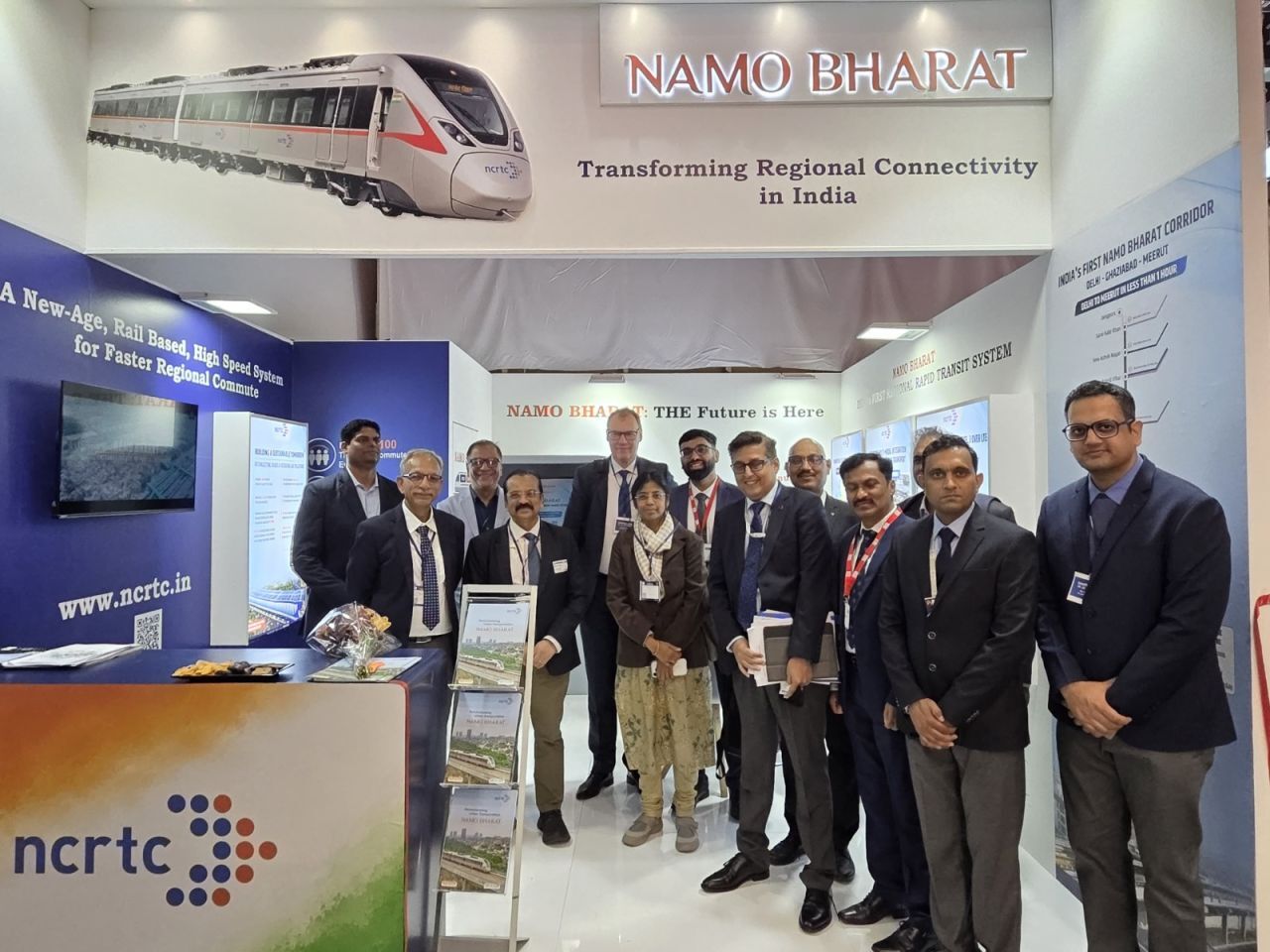
The National Capital Region Transport Corporation (NCRTC) showcased India’s first Regional Rapid Transit System, Namo Bharat, at InnoTrans 2026 in Berlin, presenting the Delhi–Ghaziabad–Meerut corridor and India’s growing capabilities in regional mobility. The international transport technology fair took place from September 22 to 25.
The project also has an established India–Germany connection through its operations and maintenance partnership with Deutsche Bahn.
Regional connectivity takes centre stage
NCRTC’s presentation focused on the 82-kilometre corridor connecting Sarai Kale Khan in Delhi with Modipuram in Meerut. Its exhibition stall was inaugurated by NCRTC Chairperson D. Thara, Secretary, Department of Capital Development, Ministry of Housing and Urban Affairs, in the presence of Managing Director Shalabh Goel.
The entire corridor became operational in February 2026. Designed to strengthen connectivity across the National Capital Region, the system aims to ease road congestion and pollution while improving access to employment and economic centres.
Connecting cities and economic opportunities
At the event, Chairperson Thara highlighted how affordable and efficient regional rail connectivity can support population distribution beyond major cities. Managing Director Goel described Namo Bharat as an example of India’s ability to develop advanced regional transport solutions using modern technologies.
At the time of the showcase, the corridor had recorded more than 4.5 crore passenger journeys and a peak daily ridership exceeding 1.68 lakh commuters, illustrating its growing use for travel across the NCR.
Deutsche Bahn’s role in Namo Bharat
Namo Bharat’s German connection extends to the delivery of passenger services. On July 1, 2022, NCRTC signed an agreement with DB India, a subsidiary of Germany’s national railway company Deutsche Bahn, for the comprehensive operation and maintenance of the Delhi–Ghaziabad–Meerut corridor for 12 years.
DB RRTS Operations India manages the corridor’s operations and maintenance, bringing German railway expertise to the Indian regional transport project. Deutsche Bahn’s 2026 interim report also records the opening of the corridor’s final section in February and confirms its responsibility for operations and maintenance under the contract.
The Berlin showcase thus presented an Indian infrastructure project whose daily operations already involve an established partnership with a German railway group.
Cooperation extends to rail manufacturing
India–Germany railway cooperation also encompasses freight transport and manufacturing. Indian Railways awarded Siemens India a project to manufacture 1,200 electric freight locomotives of 9,000 horsepower over an eleven-year period, alongside 35 years of maintenance support. The locomotives are being manufactured at the railway factory in Dahod, Gujarat.
Prime Minister Narendra Modi flagged off the first locomotive in May 2025. In May 2026, Siemens announced the handover of the first set for commercial operations, marking a further step in the programme’s implementation.
The project connects German rail technology with manufacturing in India and long-term maintenance, adding another dimension to cooperation alongside Namo Bharat’s regional passenger services.
India’s mobility experience on an international stage
InnoTrans 2026 provided a platform for developments in transport technology, infrastructure and public mobility. Its programme included a focus on the connections between vehicles, infrastructure and digital services, alongside the Mobility+ and AI Mobility Lab areas.
NCRTC’s participation brought India’s experience in connecting a major metropolitan centre with surrounding cities to this international forum. With Deutsche Bahn involved in Namo Bharat’s operations and Siemens supporting freight locomotive manufacturing in Dahod, the Berlin presentation took place against a backdrop of practical India–Germany cooperation across passenger mobility, railway technology and industrial production.