Photos’ Credit: German Embassy New Delhi
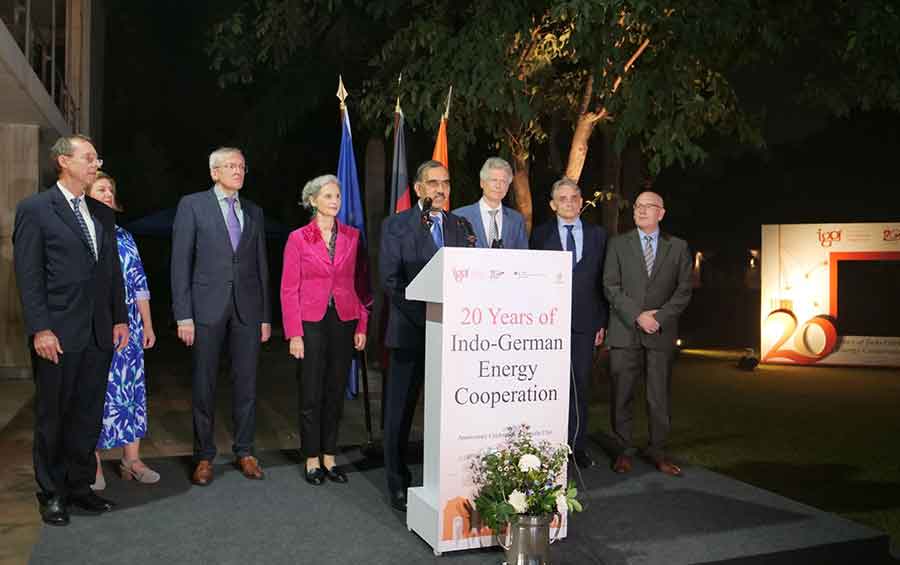
The Indo-German Energy Forum (IGEF) marked 20 years of energy cooperation between India and Germany with an anniversary evening at the German Embassy in New Delhi on 3 November 2026.
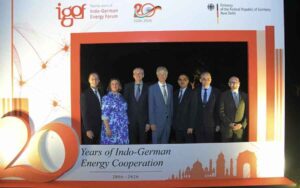 Held under the theme “Indo-German Energy Forum – Navigating from Past to Present, with Optimism for the Future”, the gathering brought together senior government officials from both countries, industry leaders, long-standing partners and friends of IGEF, including former co-chairs.
The event reviewed milestones in bilateral energy cooperation and priorities for the next phase of the partnership, including green hydrogen, according to the anniversary press release.
Two decades of energy cooperation
German Ambassador to India Dr Jasper Wieck recalled that IGEF was established by then German Chancellor Angela Merkel and then Prime Minister Dr Manmohan Singh at the Hannover Trade Fair in 2006.
Established in April that year by the two governments, the forum was intended to give structure and continuity to their cooperation on energy policy. It serves as a central platform for energy dialogue, bringing together ministries, industry, financial institutions, business associations, research organisations and think tanks from both countries.
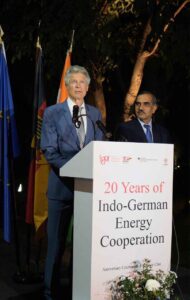 “The Indo-German Energy Forum has become a true success story: from helping India’s power plants integrate more renewable energy, to advancing energy efficiency, battery storage and green hydrogen. But above all, the Indo-German Energy Forum has built something that cannot be measured in megawatts or euros alone: mutual trust, strong networks and the ability to get things done together,” Ambassador Dr Wieck said.
Looking ahead, he added: “I believe the most exciting chapters of our energy partnership are still ahead of us. Our ambition is to work with our Indian partners not only to expand renewable energy, but also to build the industries and value chains of the future.”
Green hydrogen and future energy trade
The evening opened with “20 Years of IGEF – A Walk Down Memory Lane”, a visual timeline of milestones in Indo-German energy cooperation, followed by an anniversary film about the forum.
Alexandre Callegaro, Minister Counsellor and Head of the Department for Economic and Global Affairs at the German Embassy, welcomed the guests.
Dr Gunther Grathwohl, Head of Division for International Hydrogen Ramp-up and Bilateral Cooperation on Hydrogen Infrastructure at Germany’s Federal Ministry for Economic Affairs and Energy (BMWE), delivered the special address.
“Green hydrogen is the natural next frontier for the Indo-German Energy Forum. By aligning regulatory standards, connecting industrial clusters and de-risking investments, Germany and India are building the framework for large-scale, sustainable energy trade,” Dr Grathwohl said.
The two governments developed the Indo-German Green Hydrogen Roadmap with inputs from the Indo-German Green Hydrogen Task Force, which was supported by IGEF. Both governments launched the roadmap at the seventh India–Germany Inter-Governmental Consultations on 25 October 2024.
From software pilots to energy policy
A fireside chat titled “20 Years. 20 Minutes. Our Journey with IGEF.” brought together three industry representatives who have worked with the forum.
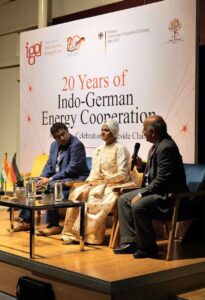 Moderated by Hari Natrajan, the discussion featured Dr J. T. Verghese, former Chairman of STEAG Energy Services India; Vivek Saraf, Founder and Chief Executive Officer of SunSeed APV; and Dr Rashi Gupta, Director of Vision Mechatronics Private Limited.
The panellists shared their experiences of IGEF. According to the release, the discussion traced how its engagement over two decades had progressed from foundational software pilots to helping shape national policies on thermal power plant flexibilisation and agrivoltaics, or Agri-PV.
Thermal plant flexibilisation involves adapting plant operations to accommodate changes in electricity demand and renewable generation. Agrivoltaics combines solar power generation with agricultural use of land.
The panellists emphasised that the next phase should prioritise institutional frameworks for sharing intellectual property, domestic testing infrastructure and scalable commercial business models to support mutual energy independence.
Exhibition and reception
Guests also explored “IGEF in Action”, an exhibition of photographs, facts and achievements showcasing the forum’s work.
The celebration continued with a reception at the Ambassador’s Residence, hosted by Ambassador Dr Wieck. All four Consuls General of Germany in India attended, alongside representatives of the energy sector.
How the forum operates
IGEF is anchored by Germany’s Federal Ministry for Economic Affairs and Energy and India’s Ministry of Power (MoP).
Strategic discussions take place at the IGEF Forum, its annual high-level steering body and highest-level decision-making forum, co-chaired at Secretary level by the two ministries.
Five subgroups shape its agenda:
- Flexibilisation of Existing Thermal Power Plants.
- Renewable Energies.
- Energy Efficiency.
- Green Energy Financing and Grid Integration.
- Green Hydrogen.
The subgroups bring together government representatives and stakeholders from industry, finance, research and other organisations to support dialogue and cooperation on shared energy priorities.
The Support Office’s role
The IGEF Support Office (IGEF-SO) serves as the forum’s secretariat. It is funded by BMWE and jointly managed by GIZ and KfW, together with India’s Bureau of Energy Efficiency (BEE).
The Support Office connects government, industry and finance; commissions studies; organises delegations, training programmes and workshops; and coordinates German Pavilions at key energy events in India.
The anniversary discussions placed hydrogen standards, industrial connections, investment conditions and technology deployment alongside the forum’s established work on power systems and energy efficiency.