
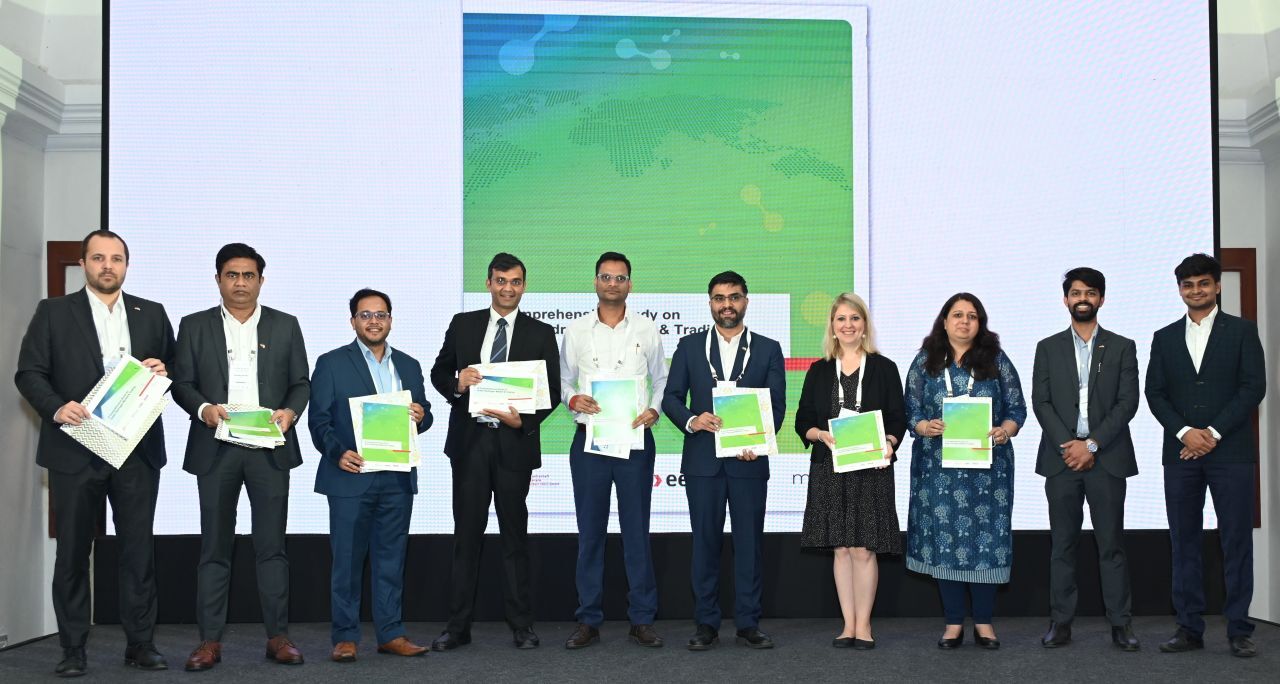
Photo Credit: Indo-German Energy Forum Support Office (IGEF-SO)
A new Indo-German study has proposed the creation of a government-backed price index and a phased trading platform for green hydrogen and its derivatives in India, estimating that the country’s short-term market could be worth as much as $450 million annually by 2035.
The report, titled A Comprehensive Study on Green Hydrogen Market & Trading, was published in New Delhi in July 2026 by Deutsche Gesellschaft für Internationale Zusammenarbeit (GIZ) on behalf of the German Federal Ministry for Economic Affairs and Energy. It was prepared under the International Hydrogen Ramp-up Programme, or H2Uppp.
The study forms part of an H2Uppp public-private cooperation project involving Germany’s European Energy Exchange (EEX) and the Indian Gas Exchange (IGX), focused on researching a price index and trading platform for green hydrogen in India. H2Uppp supports German and European companies working with local partners to develop hydrogen markets in emerging economies..
Prepared by the MEC+ team, the report was reviewed by representatives of IGX, EEX and GIZ. Its findings draw on consultations with more than 30 organisations, including project developers, industrial buyers, logistics companies, international stakeholders and commodity exchanges.
Short-term trade could reach $464 million by 2035
India’s National Green Hydrogen Mission has set a target of producing at least 5 million metric tonnes of green hydrogen annually by 2030. The new study examines how a short-term market could emerge alongside the long-term supply agreements expected to underpin most large hydrogen projects.
It estimates that production variability and the need for flexibility among domestic and export-oriented buyers could push between 4% and 7% of total demand into short-term trading between 2030 and 2035.
Under the report’s base-case projection, the combined short-term trade in green hydrogen, ammonia and methanol could reach 255,000 tonnes per annum by 2035, valued at approximately $284 million.
In the optimistic scenario, tradable volumes could rise to 494,000 tonnes and generate an annual market worth about $464 million.
The projected 2035 market comprises:
- Between 138,000 and 205,000 tonnes of green hydrogen
- Between 60,000 and 184,000 tonnes of green ammonia, including domestic and export demand
- Between 57,000 and 105,000 tonnes of green methanol, including domestic and export demand
For 2030, the report estimates combined tradable volumes of between 92,000 and 196,000 tonnes, representing a market valued at approximately $165 million to $280 million.
Demand expected to rise across refining and fertilisers
The assessment identifies refineries and fertiliser plants as India’s principal anchor consumers. These sectors currently use an estimated 7 million tonnes of grey hydrogen annually, largely produced from imported natural gas under long-term arrangements.
Chemical, explosives and other industrial consumers also account for demand of around 3 million tonnes of ammonia and 3.1 million tonnes of methanol, supplied through imports and surplus domestic production.
According to the study, India’s anchor-sector hydrogen demand could increase to approximately 12.5 million tonnes by 2035. Ammonia demand could reach 7.6 million tonnes, while methanol consumption could rise to 6.6 million tonnes.
The report projects green hydrogen demand of approximately 400,000 tonnes by 2030 under its base-case scenario, increasing to around 1 million tonnes by 2035. Compliance requirements for hard-to-abate industries and government-supported pilot programmes are expected to drive the transition from fossil-based hydrogen.
The study also points to export opportunities as demand grows in Europe, Japan and South Korea. It estimates that India could export between 1.2 million and 2.4 million tonnes of green hydrogen derivatives over the coming decade.
Announced capacity yet to reach investment stage
Despite the substantial pipeline, the report finds that only a small share of India’s planned production capacity has reached the final investment stage.
Around 12.2 million tonnes of green hydrogen and green ammonia capacity has been announced, but only approximately 5% has secured a Final Investment Decision. Much of the capacity expected after the National Green Hydrogen Mission is also likely to be tied to long-term contracts.
Consequently, the study estimates that only around 5% of production may be available for short-term transactions. This would provide a tradable supply pool of approximately 270,000 tonnes in 2030, rising to 496,000 tonnes by 2035.
Five regional clusters identified
Transportation remains a major constraint on short-term green hydrogen trading. The report finds that moving hydrogen through tube trailers is generally commercially viable only within a radius of approximately 250 kilometres.
It therefore recommends organising the initial market around five regional supply clusters:
- Gujarat
- Andhra Pradesh
- Odisha
- Tamil Nadu
- Karnataka
Gujarat is projected to provide the largest short-term supply, increasing from 81,000 tonnes in 2030 to 159,000 tonnes in 2035. Andhra Pradesh could supply 76,000 tonnes in 2030 and 141,000 tonnes in 2035.
Odisha’s available supply could rise from 33,000 to 54,000 tonnes, while Tamil Nadu’s could increase from 25,000 to 48,000 tonnes. Karnataka is projected to contribute 15,000 tonnes in 2030 and 30,000 tonnes in 2035.
Other states could collectively provide another 40,000 tonnes in 2030 and 63,000 tonnes by 2035.
Hybrid price index proposed within six months
The report recommends a two-stage institutional framework, beginning with the introduction of a green hydrogen and green ammonia price index within six months.
The proposed hybrid index would combine a calculated cost-based benchmark with price information obtained from over-the-counter transactions and market participants. It would initially reflect production costs, including renewable electricity, electrolyser investment, water, operating expenses and ammonia conversion costs.
As trading activity increases, actual market quotations and completed transactions would be given greater weight. The index could be published in rupees and euros per kilogram at both regional-cluster and national levels.
The report recommends institutional support from the Ministry of New and Renewable Energy to ensure that the data used in calculating the index is verifiable and protected against manipulation.
It also calls for a regularly updated hydrogen project database and quarterly surveys of project developers and buyers across the five proposed clusters.
Trading platform envisaged over 36 months
The second stage would involve developing a pilot trading platform over a 36-month period, with the first phase expected to become operational between months 18 and 24.
The platform would initially offer monthly pay-as-bid products for green hydrogen and green ammonia. Under this model, successful sellers would receive the prices quoted in their respective bids rather than a single uniform market price.
Trading would initially be confined to regional clusters to keep transport distances commercially manageable. The proposed first-phase delivery hubs are:
- Deendayal Port at Kandla
- Hazira
- Paradip Port
- V.O. Chidambaranar Port at Tuticorin
The first 12 months would be used to secure regulatory approvals, appoint verification agencies, develop certification protocols and enrol suppliers, distributors and industrial buyers.
Technology development and testing would follow between months 12 and 18. The initial domestic market would then go live between months 18 and 24, publishing weekly trading information for qualifying green hydrogen and ammonia products.
Between months 24 and 36, the platform could be expanded to include additional product categories, certification tiers and cross-border registry links with the European Union, Japan and South Korea.
Green methanol, sustainable aviation fuel and environmental attributes linked to green steel could subsequently be added to the system.
Nodal agency and regulatory mandate needed
The study identifies the absence of a designated nodal authority as a key gap in India’s emerging hydrogen market.
It recommends appointing an agency empowered to issue a No Objection Certificate for the proposed over-the-counter matching platform and clarify its legal and regulatory status.
A regulator would also have to establish standards for short-term trading in green hydrogen and ammonia, determine compliance requirements and oversee traded volumes.
Other recommendations include creating a consolidated repository of central and state hydrogen regulations and establishing a public observatory that publishes production data, project costs, electrolyser manufacturing capacity and infrastructure readiness.
If implemented, the proposed framework could move India’s green hydrogen sector beyond opaque bilateral agreements towards transparent price discovery and exchange-enabled transactions. The study argues that this could help India capture its emerging domestic market while positioning the country as a reference point for trading green molecules across the Asia-Pacific region.
Read the full study >>here<<.