
Photos’ Credit: Press Information Bureau, Government of India
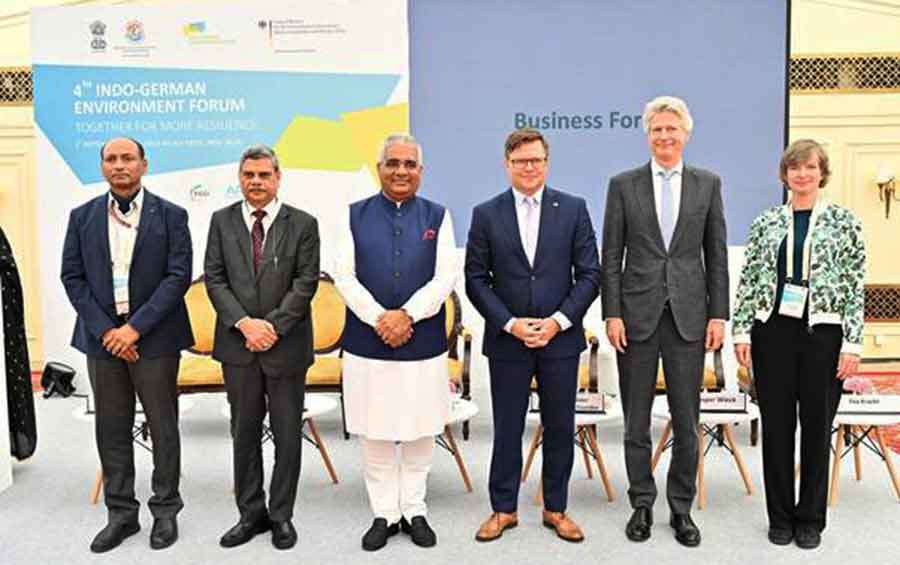
India and Germany have agreed to deepen cooperation on wetland conservation, climate resilience and the transition towards a resource-efficient economy, as ministers and other stakeholders from the two countries met for the fourth Indo-German Environment Forum in New Delhi on September 1, 2026.
Union Minister for Environment, Forest and Climate Change Bhupender Yadav and German Federal Minister for the Environment, Climate Action, Nature Conservation and Nuclear Safety Carsten Schneider co-chaired the forum, which was held under the theme “Together For More Resilience”.
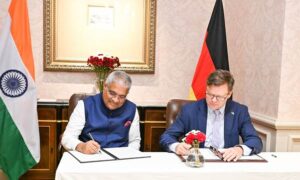 A key outcome was the signing of a Joint Declaration of Intent on the Conservation and Wise Use of Wetlands of International Importance. The agreement is expected to establish a framework through which India and Germany can strengthen scientific cooperation, exchange practices in wetland management, develop restoration methods and promote greater participation by local communities.
The declaration adds wetlands to an expanding India–Germany environmental agenda that already covers climate policy, biodiversity, renewable energy, circular economy and resource efficiency.
Wetlands cooperation takes centre stage
Wetlands play an important role in controlling floods, replenishing groundwater, storing carbon and supporting biodiversity and local livelihoods. At the same time, many wetland ecosystems face pressure from pollution, land-use change, encroachment, infrastructure development and the effects of climate change.
Under the new declaration, the two countries intend to combine scientific knowledge with practical conservation and restoration measures. The focus on community participation is also significant because the long-term management of wetlands frequently depends on the involvement of people living around these ecosystems.
Minister Yadav said the arrangement would create a platform for improving scientific understanding, sharing effective management practices and developing approaches to wetland restoration. It would also support efforts to involve communities more closely in conservation.
The declaration was signed following a bilateral meeting between the two ministers on the sidelines of the forum. During their discussion, they reaffirmed their intention to advance cooperation on environmental sustainability and climate action.
German Minister Schneider welcomed the expansion of bilateral work on wetland protection and climate adaptation. He indicated that the next phase would involve joint projects and a wider exchange of knowledge and experience between India and Germany.
Environmental cooperation linked to economic transition
The Indo-German Environment Forum, established in 2008, is the highest-level bilateral platform devoted to environmental policy cooperation between India and Germany.
The fourth edition was jointly organised by India’s Ministry of Environment, Forest and Climate Change and Germany’s Federal Ministry for the Environment, Climate Action, Nature Conservation and Nuclear Safety. The Federation of Indian Chambers of Commerce and Industry and the Asia-Pacific Committee of German Business were also associated with the programme.
Addressing the opening session, Minister Yadav said climate change, biodiversity loss, pollution and resource depletion could not be addressed separately. According to the Minister, the interconnected nature of these challenges requires coordinated policies and collaborative solutions.
He also argued that environmental targets and economic development should not be viewed as competing priorities. Citing India’s progress towards its Nationally Determined Contribution targets, the Minister said the country’s experience showed that environmental action could be pursued alongside development.
The discussions therefore extended beyond conservation to the economic and industrial dimensions of the green transition. Particular attention was given to the need to reduce emissions from energy-intensive industries such as steel, cement and chemicals.
Decarbonising these sectors is considerably more complex than expanding renewable electricity capacity because it requires changes in energy sources, industrial processes, material use, technology and investment patterns. Minister Yadav said the transition would require cleaner energy, innovation, resource efficiency, supportive policy frameworks and new production methods.
He called on the forum to concentrate on three broad areas: strengthening the evidence available for environmental policymaking, advancing solutions that can be implemented at scale, and improving the capacity of institutions responsible for implementation.
Circular economy could emerge as a major area of cooperation
Resource efficiency and the circular economy were prominent themes at the forum. Minister Yadav said India’s circular economy could generate more than $2 trillion in market value and nearly 10 million jobs by 2050.
A circular economy seeks to reduce waste by extending the life of products and materials through reuse, repair, recycling and more efficient production. For India and Germany, cooperation in this area could involve industrial technology, waste management, recycling systems, material recovery, product design and the development of common approaches to resource efficiency.
Minister Yadav also referred to the Resource Efficiency and Circular Economy Industry Coalition established during India’s G20 presidency. The initiative was intended to bring governments and industries together around more efficient use of resources and the reduction of waste across global value chains.
Three bilateral joint working groups dealing with climate change, biodiversity and the circular economy met ahead of this year’s forum. Their discussions reviewed progress under existing cooperation and examined new areas of mutual interest.
Business Forum explores green investment opportunities
An Indo-German Business Forum was also held alongside the main environmental meeting. Addressing the business gathering, Minister Yadav identified renewable energy, energy storage, green hydrogen, energy efficiency and sustainable manufacturing as areas with considerable potential for bilateral collaboration.
These sectors connect the two countries’ environmental objectives with their industrial and commercial relationship. Germany brings experience in engineering, manufacturing, energy efficiency and environmental technology, while India offers a large and rapidly expanding market for low-carbon infrastructure and industrial solutions.
The business discussions also reflected the growing emphasis on economic resilience. India and Germany are exploring how investment, technology partnerships and industrial cooperation can support lower-carbon production without weakening competitiveness or supply-chain security.
The wider forum examined four principal themes: low-carbon industries; biodiversity in wetlands, mountains and forests; resource efficiency and the circular economy as a business model; and sustainable finance, green skills and investment mobilisation.
Government representatives were joined by businesses, think tanks, expert organisations and civil-society groups, giving the forum a broader role than a conventional ministerial dialogue.
Germany describes India as renewable energy role model
German Minister Schneider said India’s expansion of solar and wind energy offered an example for other parts of the world. He also highlighted the country’s young population and innovation ecosystem as important sources of momentum for its future development.
The German Minister said both countries shared the objective of combining sustainable development with economic growth. His remarks placed environmental cooperation within the broader India–Germany relationship as the two countries mark 75 years of diplomatic ties in 2026.
The anniversary comes at a time when climate action and green development have become central components of the bilateral partnership. Cooperation now stretches from renewable energy and green hydrogen to sustainable urban development, biodiversity, climate adaptation and industrial resource efficiency.
The fourth Indo-German Environment Forum indicated that the relationship is increasingly moving towards implementation-oriented cooperation. The wetlands declaration provides a new institutional basis for work in a specific area, while the discussions on industrial decarbonisation, circularity, skills and finance point to a wider agenda involving governments, research institutions, communities and businesses.
The next measure of progress will be how the agreements and policy discussions translate into joint projects, investment and restoration work. For India and Germany, the forum has nevertheless expanded the environmental partnership by linking ecosystem conservation with industrial transition, economic resilience and climate adaptation.