Photo Credit: Press Information Bureau / Ministry of Power, Government of India
India and Germany have agreed to deepen cooperation across energy security, electrification, low-carbon development, carbon markets and the diversification of supply chains.
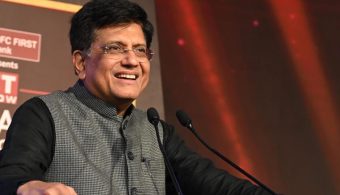
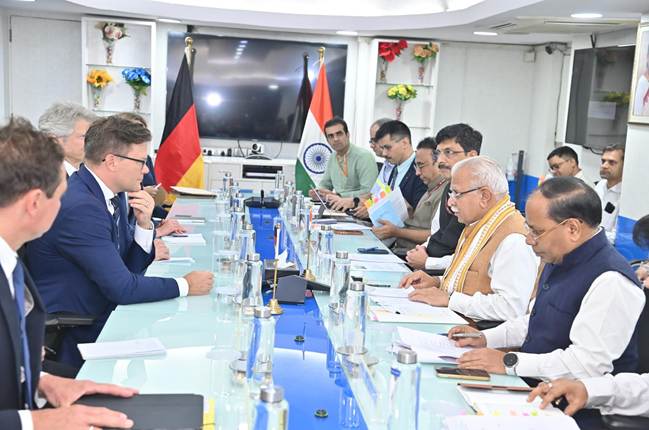
The areas were discussed during a bilateral meeting between Union Minister for Power and Housing and Urban Affairs Manohar Lal and German Federal Minister for the Environment, Climate Action, Nature Conservation and Nuclear Safety Carsten Schneider in New Delhi on September 2.
The meeting reviewed existing bilateral engagement in the energy sector and explored areas in which cooperation could be expanded. According to India’s Ministry of Power, the Ministers viewed energy security, low-carbon development and carbon markets as closely connected areas in which coordinated action could deliver mutual benefits.
The discussions reflected a widening energy agenda between the two countries—one that extends beyond renewable-energy generation to include the reliability of energy systems, industrial decarbonisation, market-based climate instruments and access to critical technologies and components.
Energy Security and Electrification in Focus
Energy security has gained greater prominence as countries attempt to expand clean-energy capacity while maintaining affordable and reliable power supplies. For India, this transition is unfolding alongside increasing electricity demand, industrial expansion and the need to extend modern energy services across different regions and sectors.
Germany, meanwhile, has been restructuring its energy system around renewable power, efficiency and lower-carbon industrial processes. These different but complementary experiences provide scope for cooperation in areas such as renewable-energy integration, transmission networks, storage, industrial electrification and energy efficiency.
The diversification of supply chains also featured in the talks. This assumes importance as both countries seek resilient access to the technologies and components required for their respective energy transitions.
While no new project, funding commitment or implementation timeline was announced following the meeting, the inclusion of supply-chain diversification indicates that bilateral energy engagement is increasingly being viewed through both climate and economic-security considerations.
Carbon Markets Enter the Bilateral Agenda
Carbon markets were another central part of the discussions. Such markets seek to attach an economic value to reductions in greenhouse-gas emissions, allowing verified emission reductions or removals to be traded.
India is in the process of developing its domestic carbon market framework, while Germany operates within the European Union’s established emissions-trading and climate-policy architecture. Cooperation could therefore involve technical exchanges on monitoring, reporting and verification systems, emissions accounting, market governance and the integrity of carbon credits.
The Ministers agreed that carbon markets should not be considered separately from energy security and low-carbon development. The effectiveness of these mechanisms ultimately depends on their ability to support credible emission reductions without undermining energy affordability, industrial competitiveness or development priorities.
The meeting, however, did not announce a bilateral carbon-trading arrangement or provide details of any new joint mechanism.
Building on Established Cooperation
The latest talks build upon a longer institutional relationship in the energy sector. The Indo-German Energy Forum, established in 2006, provides a platform for government and industry engagement on renewable energy, energy efficiency, energy security, investment and collaborative research.
More recently, the Green and Sustainable Development Partnership, signed by Prime Minister Narendra Modi and then-German Chancellor Olaf Scholz in May 2022, brought several strands of bilateral climate and development cooperation under a broader framework aligned with the Paris Agreement and the United Nations Sustainable Development Goals.
Germany has indicated that it intends to make available at least €10 billion by 2030 under the partnership to support transformative approaches in areas including renewable energy, modern electricity grids, storage, sustainable mobility, climate-resilient development and environmental protection. Much of Germany’s development financing for India is provided through reduced-interest loans rather than grants.
The current discussions also took place as India and Germany mark 75 years of diplomatic relations and 25 years of their Strategic Partnership.
From Policy Dialogue to Implementation
The meeting underscores the increasingly broad scope of India–Germany energy cooperation. Renewable energy and efficiency remain important pillars, but the agenda now also covers the resilience of power systems, low-carbon industrial growth, carbon-market architecture and secure technology supply chains.
The next stage will depend on how these discussions translate into specific projects, financing arrangements, technology partnerships and measurable outcomes. Both Ministers indicated that engagement would continue in the coming months, keeping energy and sustainable development at the centre of the expanding India–Germany partnership.