A new report has argued that India and Germany could build a distinctive partnership in applied artificial intelligence by combining India’s technology talent and capacity for large-scale deployment with Germany’s industrial expertise, specialised data and strong regulatory institutions.
The Observer Research Foundation’s September 2026 report, The Anchor and the Scale: Germany, India, and Applied AI, places the partnership within the wider global competition over artificial intelligence. It notes that the United States and China continue to dominate the development of frontier AI models, computing infrastructure and large-scale data ecosystems.
However, the report contends that much of AI’s economic value may eventually emerge not only from building increasingly powerful foundation models, but from applying existing technologies across manufacturing, healthcare, mobility, energy, financial services and public systems.
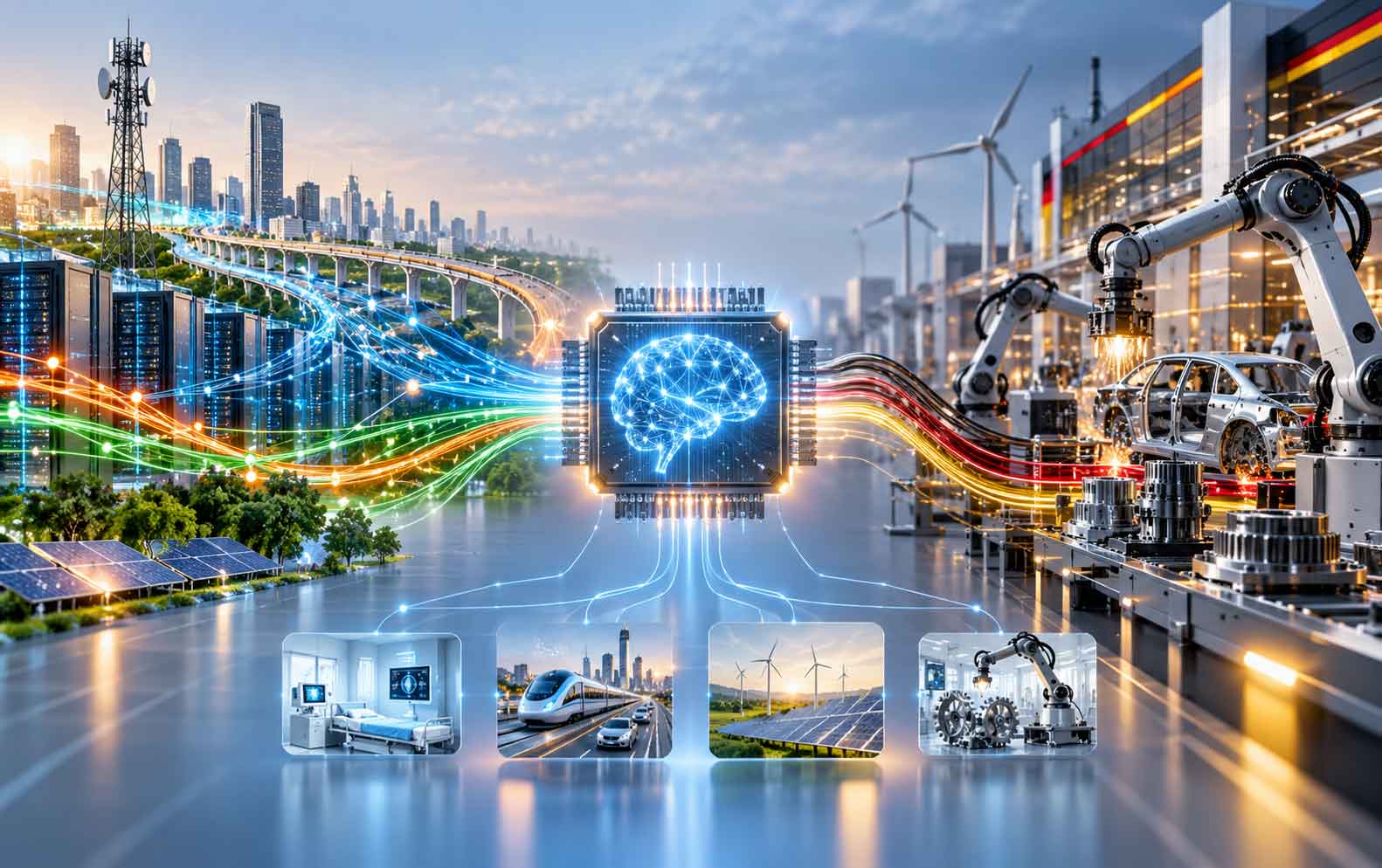
In this emerging landscape, Germany could provide what the report describes as the “anchor”: industrial knowledge, proprietary data, engineering standards and clearly defined operational problems. India, meanwhile, could provide the “scale” through its large technology workforce, expanding digital infrastructure and experience in deploying services across a vast and diverse population.
From AI ambition to practical deployment
The report’s argument reflects a wider shift in the global AI debate. As open and commercially available models become more capable and affordable, competitive advantage may increasingly depend on how effectively companies and governments adapt them to real-world requirements.
Germany has established strengths in automotive engineering, advanced manufacturing, industrial automation, chemicals, healthcare and energy systems. India offers a large pool of software engineers, AI professionals and technology service companies, alongside a growing network of Global Capability Centres.
According to the report, more than 150 German corporate capability centres currently operate in India and employ over 130,000 people. The report identifies these centres as potential locations for developing, testing and scaling AI applications for German companies.
This model is already emerging in the corporate sector. German software company SAP has a substantial research and development presence in India. In September 2025, it launched SAP Sovereign Cloud in India to support government bodies and regulated industries seeking to use cloud and AI services while retaining control over sensitive data and operations.
In June 2026, SAP Labs India also announced a Startup Studio cohort focused on enterprise AI and deep-tech innovation. This followed an agreement signed by SAP Labs India and Germany’s SRH University in March 2026 to expand digital and enterprise-technology education and AI-ready skills in India.
In November 2025, Tech Mahindra announced a collaboration with the German Research Center for Artificial Intelligence, or DFKI, to develop AI-powered smart-factory solutions for German enterprises. The partnership covers generative AI, robotics, human-machine interaction, digital twins, semantic data models, autonomous production and agentic AI.
Such initiatives illustrate the report’s central proposition: Germany can contribute sector-specific problems, industrial data and engineering expertise, while Indian teams provide software capabilities and the capacity to develop and deploy solutions at scale.
AI moves higher on the bilateral agenda
Artificial intelligence has also become more prominent within official India–Germany cooperation.
During German Chancellor Friedrich Merz’s visit to India on January 12–13, 2026, Prime Minister Narendra Modi and Chancellor Merz welcomed the finalisation of the Indo-German Digital Dialogue Work Plan for 2026–27.
In his official press statement on January 12, Chancellor Merz said the two countries had agreed to intensify cooperation in artificial intelligence, digitalisation and critical minerals.
At the India–Germany CEOs Forum in Ahmedabad, Prime Minister Modi said India’s inclusive vision for AI could connect with Germany’s AI ecosystem to support a human-centric digital future. He also called for German precision and innovation to be combined with India’s scale and speed.
The India–Germany Joint Statement issued during the visit identified artificial intelligence, internet and data governance, semiconductors, Industry 4.0 and emerging technologies as areas for cooperation. The two sides also acknowledged the signing of a Joint Declaration of Intent on telecommunications cooperation.
The joint statement further noted the extension of the Indo-German Science and Technology Centre’s tenure. The centre supports industry-academia research in areas including advanced manufacturing, medical technologies, sustainable production, bioeconomy and artificial intelligence for sustainability.
India and Germany are also working towards Indo-German Centres of Excellence on Innovation in Digital Convergence, Battery Technology, Green Transportation and Affordable Healthcare. While these are not dedicated AI centres, they form part of the wider bilateral technology and innovation framework.
These initiatives sit within the broader India–Germany Innovation and Technology Partnership Roadmap, which seeks to connect government agencies, universities, research institutions, startups and industries in both countries.
Germany participates in India AI Impact Summit
Germany also participated in the India AI Impact Summit held in New Delhi in February 2026.
The German delegation was headed by Prof. Dr Kristina Sinemus, Hessian Minister for Digitalisation and Innovation. It included representatives from Fraunhofer FOKUS, the Global GovTech Centre Berlin, the TUM Think Tank and the German AI industry.
Federal Minister for Digital Transformation and Government Modernisation Karsten Wildberger was also present. German participants contributed to discussions on AI policy, safety, governance and the relationship between technological development and legal safeguards.
The summit provided another platform for engagement between Indian and German policymakers, researchers and industry representatives. No separate bilateral AI agreement was announced during the event.
Green AI for healthcare and mental wellness
One of the most recent examples of sector-specific cooperation came from the Indo-German Bilateral Workshop on Green AI for Healthcare and Mental Wellness, held at IIT Delhi on September 3–4, 2026.
Supported by the Indo-German Science and Technology Centre, the workshop brought together experts and early-career researchers from India and Germany.
Discussions focused on developing energy-efficient and sustainable AI systems for healthcare, with attention to medical imaging, clinical decision support, mental wellness and multilingual health applications. Participants also examined the responsible deployment of generative AI and the environmental costs associated with training and operating large models.
The workshop was intended to support a longer-term research and innovation roadmap. Its emphasis on efficient models designed for specific healthcare settings closely reflects the applied-AI approach outlined in the new report.
This followed an Indo-German medical partnership workshop held at TU Dresden from July 16–18, 2025, which examined artificial intelligence, extended reality in healthcare and opportunities in robotic surgery.
Research cooperation broadens
Artificial intelligence has also entered wider bilateral discussions on scientific cooperation.
On June 2, 2026, Minister of State for Science and Technology Dr Jitendra Singh met Thuringia Minister-President Mario Voigt and a German delegation in New Delhi.
The two sides identified artificial intelligence, quantum technologies and photonics among the areas offering scope for deeper scientific and technological cooperation. The discussions also covered research, standards development and talent exchange.
More recently, on the sidelines of the G20 Innovation Ministers’ Meeting held in Chapel Hill in the United States on September 1–2, 2026, Minister of State for Electronics and Information Technology Jitin Prasada met German Parliamentary State Secretaries Thomas Jarzombek and Dr Silke Launert.
The meeting explored opportunities to deepen India–Germany cooperation in technology, innovation and research. Separately, the wider G20 discussions covered AI standards, intellectual-property policies for artificial intelligence, workforce development and trusted technology adoption. No new bilateral AI agreement was announced during the India–Germany meeting.
The European regulatory dimension
Any deeper India–Germany AI partnership will also operate within the European Union’s regulatory environment, particularly the EU Artificial Intelligence Act.
Germany’s industrial experience and its role in implementing European rules could help Indian companies understand requirements relating to risk classification, transparency, data governance and responsible AI deployment. India, in turn, offers Germany a large and diverse environment for developing applications across different languages, markets and operational conditions.
The EU–India Trade and Technology Council has expanded this wider framework. In July 2026, India and the European Union launched an EU–India Startup Partnership covering clean technologies, artificial intelligence and semiconductors. The two sides also moved towards negotiations on India’s possible association with Horizon Europe.
These India–EU initiatives provide an additional European framework within which future India–Germany technology cooperation could develop.
Significant obstacles remain
The report cautions that the apparent complementarity between India and Germany will not automatically result in a successful AI partnership.
It identifies differences between the two countries’ industrial structures, questions over where economic value and intellectual property will be retained, differences in regulatory approaches, and a mismatch between the speed of technological change and the slower pace of diplomatic processes.
Access to high-quality industrial data will be particularly sensitive. German companies may be reluctant to share proprietary information, while Indian technology partners will seek a larger role in product development and intellectual-property creation rather than remaining limited to outsourced implementation.
AI systems developed for German industrial environments may also require considerable adaptation before they can be deployed in India. Questions involving language, affordability, digital infrastructure, cybersecurity and data protection will need to be addressed at the design stage.
Building the partnership through use cases
Recent initiatives indicate that India–Germany AI engagement is beginning to extend beyond policy statements into research programmes, institutional partnerships and company-led projects.
Healthcare, smart manufacturing, enterprise technology, mobility, energy efficiency and industrial automation are emerging as practical areas for collaboration.
The new report brings these developments into a wider strategic framework. Its central proposition is that India and Germany do not need to replicate the frontier-model strategies of the United States or China. Instead, they could build influence by demonstrating how AI can be deployed responsibly and commercially across industries and public-facing systems.
Whether that potential is realised will depend on the ability of both countries to convert existing dialogues and pilot projects into joint platforms, investable solutions and clearly defined arrangements for sharing data, intellectual property and economic value.
Read the full ORF report here.