German automotive group Volkswagen and Indian industrial conglomerate JSW Group are reportedly moving closer to a partnership aimed at strengthening Volkswagen’s operations and electric-vehicle plans in India.
The discussions centre on a possible investment by JSW in Škoda Auto Volkswagen India Private Limited (SAVWIPL), the entity that manages Volkswagen Group’s passenger-vehicle operations in the country. However, as of August 11, 2026, the companies had not confirmed a transaction, its proposed ownership structure or a timetable for completing an agreement.
The development adds a fresh India–Germany dimension to the country’s expanding electric-mobility and automotive-manufacturing sector.
Talks focus on Volkswagen’s India business
On July 21, 2026, Reuters, citing an earlier Bloomberg report, said Volkswagen was in advanced discussions to sell a stake in its Indian operations to JSW Group. The report said an investment in SAVWIPL was being considered as Volkswagen evaluated ways to bring additional capital into its India business.
Responding at the time, a Škoda spokesperson declined to comment on the reported transaction. The company nevertheless said it continued to examine different business opportunities to realise India’s growth potential and implement its strategy in the country’s rapidly changing automotive market. JSW did not issue a comment on the reported discussions.
Subsequent publicly available reports have linked the possible partnership more closely with local electric-vehicle production. These details remain unconfirmed, and no binding agreement has been disclosed by either side.
Local EV development could form part of alliance
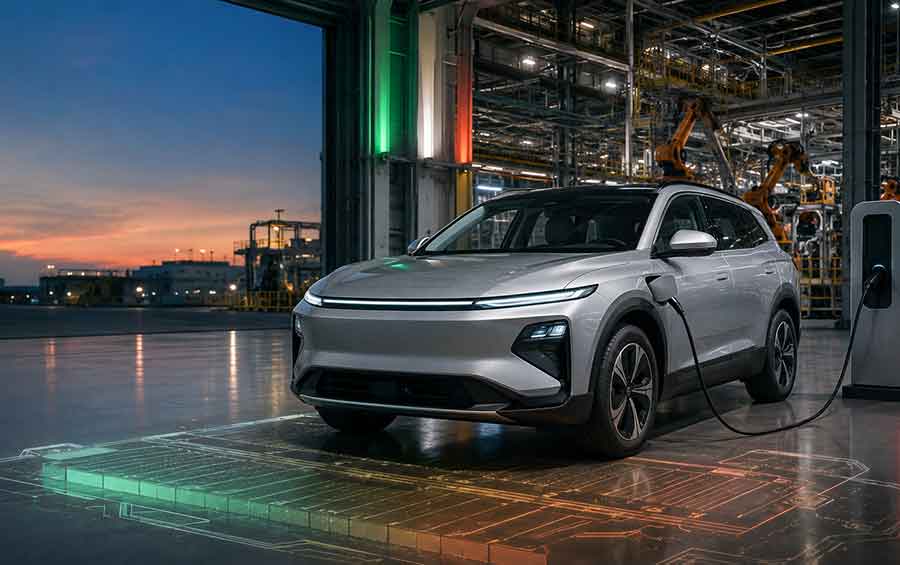
A partnership with JSW could help Volkswagen pursue greater localisation of electric vehicles and their underlying technology in India. Reports have suggested that the companies are examining a locally adapted EV architecture and production arrangements for future models.
Volkswagen has not officially confirmed the platform, proposed investment or vehicle-launch plans associated with the talks. Consequently, the reported partnership remains under discussion rather than a concluded joint venture.
The possible alliance comes as Volkswagen seeks to regionalise more of its product development. In its current global strategy, the German group identifies battery-electric and hybrid vehicles as an expanding part of the automotive market and emphasises partnerships with companies that offer strong local capabilities.
Volkswagen expands its India manufacturing base
SAVWIPL is responsible for the Indian operations of six Volkswagen Group brands: Škoda, Volkswagen, Audi, Porsche, Lamborghini and Bentley.
The company operates manufacturing facilities at Chakan near Pune and Shendra in Chhatrapati Sambhajinagar. According to SAVWIPL, the Pune facility can produce more than 225,000 vehicles annually, while the Chhatrapati Sambhajinagar plant has an annual capacity of 60,000 units. Škoda Auto Volkswagen India
On January 13, 2026, SAVWIPL reported record domestic sales of approximately 117,000 vehicles during 2025. Volkswagen Group has also described India as an important part of Škoda’s international expansion strategy and a future export hub outside Europe. SAVWIPL
In March 2026, Škoda Auto CEO Klaus Zellmer described India as a strong second pillar in the Czech automaker’s international business. Škoda leads Volkswagen Group’s operations in the Indian market.
JSW broadens its automotive presence
JSW already has a substantial presence in India’s automotive and electric-mobility sector through JSW MG Motor India, its joint venture with China’s SAIC Motor.
In January 2025, JSW Group also signed an investment memorandum with the Maharashtra government covering several sectors, including electric vehicles and battery manufacturing. JSW Group
A separate partnership with Volkswagen would extend JSW’s automotive portfolio while giving the German group access to an Indian partner with experience across steel, energy, manufacturing and vehicle production.
For now, the proposed Volkswagen–JSW alliance remains subject to negotiations and any necessary corporate and regulatory approvals. If concluded, it would mark a significant new industrial partnership between India and Germany, with localisation and electric mobility expected to form key areas of cooperation.