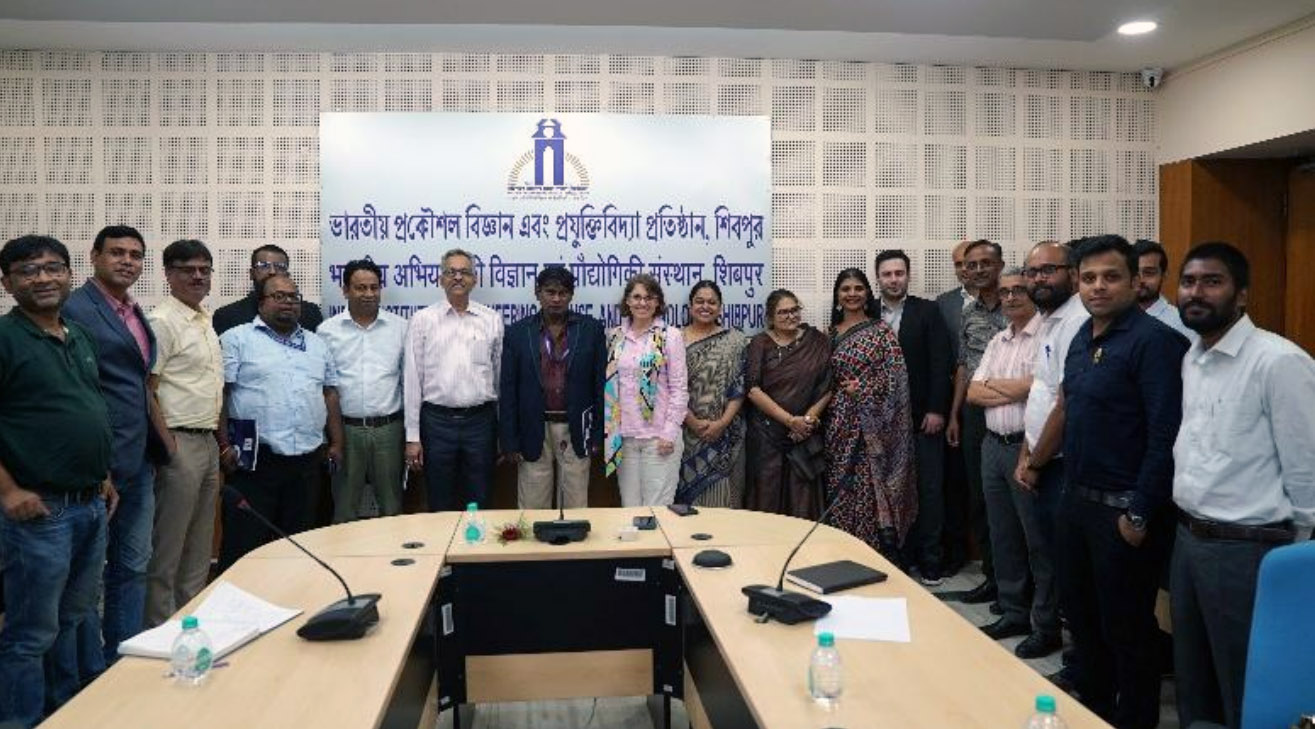
Indian Institute of Engineering Science and Technology, Shibpur, in collaboration with GIZ Germany, hosted the “Indo-German Living Lab Initiative” on May 7, bringing together policymakers, researchers, industry leaders and MSME stakeholders to strengthen AI-driven industrial collaboration between India and Germany.
Held at the institute’s Shibpur campus in West Bengal, the international programme focused on building innovation partnerships connecting Indian MSMEs, German SMEs, research institutions and industrial ecosystems through Artificial Intelligence, smart manufacturing and Industry 4.0 technologies.
Organised by the Industry-Institute Partnership Cell (IIPC), the initiative emerged as a major platform for promoting cross-border technological cooperation, applied research and sustainable industrial development between the two countries.
According to an institute statement, the programme “brought together eminent academicians, policymakers, industry leaders, MSME representatives, innovation experts, entrepreneurs, alumni and international delegates to deliberate on the transformative role of Artificial Intelligence (AI), smart manufacturing, Industry 4.0 technologies, and sustainable industrial growth.”
The Ministry of Education also collaborated in the initiative along with two National Institutes of Technology (NITs) apart from IIEST Shibpur.
Focus on AI, MSMEs and industrial innovation
Discussions during the programme centred on how AI-enabled industrial ecosystems can help modernise manufacturing, improve industrial sustainability and create globally competitive industries. The initiative also highlighted the growing importance of academia–industry collaboration in supporting MSMEs through research, consultancy and innovation-driven technological solutions.
Welcoming the delegates, Professor Konika Das Bhattacharya emphasised the role educational institutions can play in strengthening MSMEs through innovation-led research and AI-enabled industrial support systems. She noted that deeper collaboration between academia and industry could help create future-ready technological talent while boosting India’s manufacturing ecosystem.
IIEST Director highlights Indo-German cooperation
Addressing the gathering, IIEST Shibpur Director V. M. S. R. Murthy underlined the importance of expanding Indo-German cooperation in industrial research and innovation.
“The integration of Germany’s industrial expertise with India’s rapidly expanding research and manufacturing strengths could open new avenues for innovation, entrepreneurship, and economic growth,” Murthy said.
The German delegation from GIZ included Sabrina Garcia, Preyansi Mani and Chani Raj, while international participants also included Dr. Alireza and Nitij Singh.
Representatives from GIZ stressed the need to integrate students and researchers into real-world industrial problem-solving environments, particularly those linked to challenges faced by MSMEs. The initiative aims to encourage experiential learning, entrepreneurship and industry-oriented innovation among engineering students and young researchers.
Faculty exchange and collaboration roadmap
As part of the proposed collaboration roadmap, two faculty members from IIEST Shibpur are expected to visit Germany for first-hand exposure to German SMEs, industrial automation systems, innovation ecosystems and applied research practices.
“The Indo-German Living Lab Initiative programme is expected to formally commence in early 2027 following bilateral visits, formal MoUs, and the completion of collaborative institutional agreements between the participating stakeholders,” the institute statement said.
Industry leaders discuss Eastern India’s MSME potential
Several industry experts and government representatives also participated in the discussions during the event.
Shaswata Mukherjee highlighted the industrial and entrepreneurial potential of Eastern India’s MSME sector, while M K Anjanaiah spoke about government initiatives aimed at strengthening MSME quality standards and industrial growth.
Corporate leader and alumnus Gautam Ray also emphasised the importance of stronger industry-academia partnerships in supporting MSMEs in West Bengal.
International delegates visit advanced research facilities
A key highlight of the programme was the international delegates’ visit to several advanced research and innovation facilities at IIEST Shibpur. These included the Solar PV Hub, Healthcare Laboratory, SOMR Facility, VLSI Laboratory and the Wind Tunnel & Drones Laboratory under the Department of Aerospace Engineering and Applied Mechanics.
The visits showcased the institute’s growing capabilities in advanced technology research, engineering innovation and applied industrial development.
The programme concluded with an extensive discussion between institute leadership and international delegates, laying the foundation for future collaboration in research, industrial innovation, AI applications and sustainable development.
The Indo-German Living Lab Initiative ultimately reinforced the shared commitment of India and Germany towards building technology-driven innovation ecosystems powered by research excellence, industrial cooperation and inclusive economic growth.