
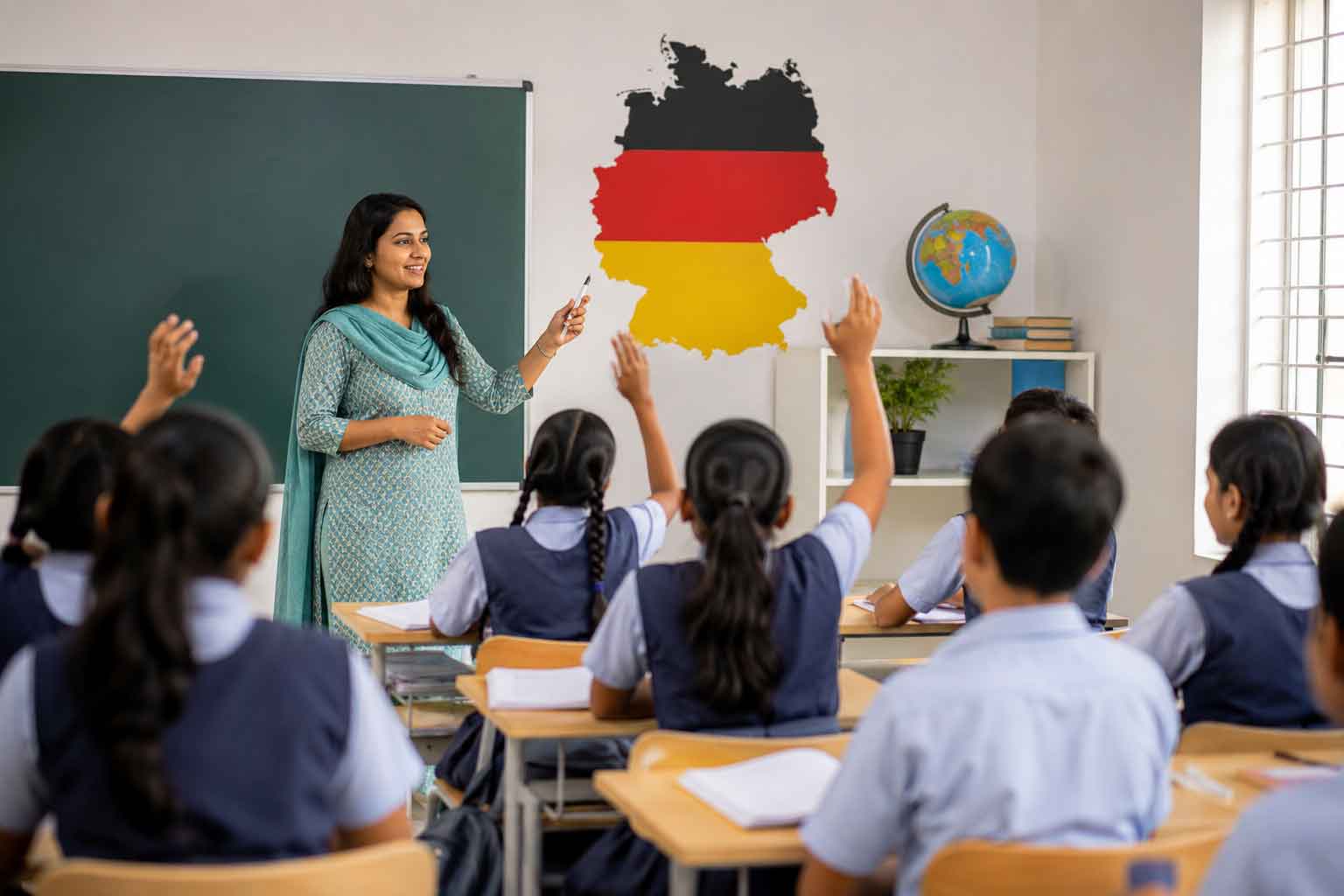
In a significant move aligned with the National Education Policy (NEP) 2020 and India’s growing focus on global education and employability, the Haryana Department of School Education has partnered with the German Embassy to introduce German as an optional language subject in government schools across the state.
The initiative aims to equip students with international language skills and improve future academic and employment opportunities in an increasingly interconnected global economy.
Haryana Begins Teacher Selection Process for German Language Programme
As part of the rollout strategy, the Haryana government has started identifying and training teachers from within its existing education cadre to build the instructional ecosystem for the programme.
Teachers interested in teaching German have been asked to submit applications through the state’s Management Information System (MIS) portal by May 20. Eligible candidates include Post Graduate Teachers (PGTs) in English, Trained Graduate Teachers (TGTs) in English, and TGTs in Social Studies.
According to official communication issued by the Directorate of Secondary Education, applicants have also been asked to specify whether they possess any certification or prior coursework related to German or other foreign languages.
The notification clarified that submitting an Expression of Interest (EOI) would not automatically guarantee selection for the programme.
“The initiative aims to create a pool of interested teachers for training and future implementation of German language programme at government schools in Haryana,” stated a communique issued by the office of the Director General, Secondary Education, Haryana.
German Embassy to Support Teacher Upskilling
Officials said the shortlisted teachers would undergo specialised upskilling and language training programmes in collaboration with the German Embassy to develop proficiency in German language instruction.
The initiative reflects a broader push under NEP 2020 to expand multilingual learning, international exposure and skill-based education in Indian schools. The policy encourages the inclusion of foreign languages and aims to prepare students for global mobility and international careers.
Education experts note that proficiency in languages such as German can open pathways in higher education, research collaborations, vocational training and employment opportunities in countries like Germany, which has increasingly emerged as a preferred destination for Indian students and skilled professionals.
Inspired by Goethe-Institut’s “German in 1,000 Schools” Initiative
The Haryana government’s move also mirrors the earlier “German in 1,000 Schools” initiative launched in 2012 by the Goethe-Institut/Max Mueller Bhavan. The programme aimed to introduce German as an additional or third foreign language within India’s state-run school education system.
That initiative had sought to promote cultural exchange and strengthen Indo-German educational ties by expanding access to German language learning among Indian students.
Growing Focus on Foreign Language Education in Government Schools
The introduction of German follows Haryana’s recent efforts to diversify language education in public schools. Earlier, the State Council of Educational Research and Training (SCERT) had also launched a training programme aimed at introducing French language instruction in government schools.
The back-to-back initiatives indicate a broader shift within state education systems toward integrating international languages into public education, particularly in line with NEP’s vision of creating globally competent learners.
With foreign language skills increasingly linked to global employability, international education and cross-border collaboration, Haryana’s latest initiative could mark a significant step in expanding educational opportunities for students studying in government schools.