Image Credit: PM Modi/X
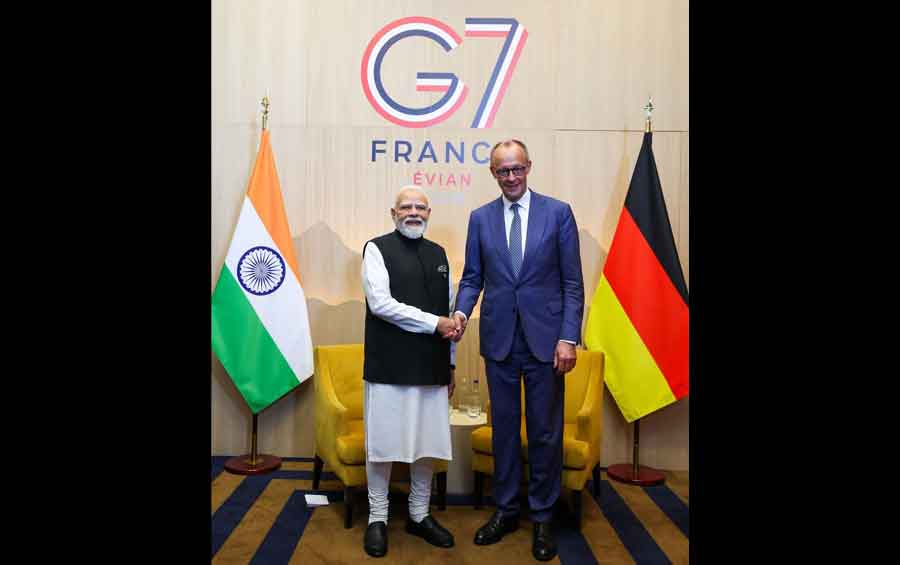
Prime Minister Narendra Modi and German Chancellor Friedrich Merz held bilateral talks on the sidelines of the G7 Summit, reaffirming their commitment to further strengthening the India-Germany Strategic Partnership across trade, investment, defence, technology, sustainability and people-to-people ties.
The meeting, held in Evian, France, marked the second interaction between the two leaders this year and comes as India and Germany prepare to celebrate 75 years of diplomatic relations in 2026. The discussions reflected the growing strategic importance of bilateral ties amid evolving geopolitical and economic realities.
Leaders Review Progress Across Key Areas of Cooperation
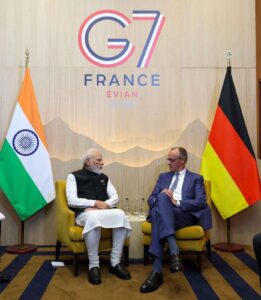 According to the Ministry of External Affairs (MEA), the two leaders reviewed progress in bilateral cooperation and expressed satisfaction over the renewed momentum in the India-Germany Strategic Partnership.
The discussions covered a broad range of sectors, including trade and investment, defence and security, green and sustainable development, technology and innovation, education, mobility and cultural exchanges.
Sharing details of the meeting on X, Prime Minister Modi described the talks as “very fruitful”.
“The talks with Chancellor Merz were very fruitful. We discussed ways to further cement bilateral cooperation by working together in trade, investments, circular economy, defence, IT and more.”
The Prime Minister added: “We also talked about boosting cultural linkages between our nations.”
The meeting followed PM Modi’s participation in the G7 Outreach Summit, where he called for stronger global support mechanisms to help developing countries navigate economic and social challenges.
Focus on Trade, Investment and India-EU FTA
Trade and economic cooperation featured prominently during the discussions, with both leaders reviewing developments following the conclusion of negotiations on the India-European Union Free Trade Agreement earlier this year.
MEA spokesperson Randhir Jaiswal said the leaders agreed that the early implementation of the India-EU FTA would further strengthen economic ties between India and Germany.
“The leaders agreed that early implementation of India-EU FTA will further deepen India-Germany ties. They also discussed key global and regional challenges,” Jaiswal said.
Germany is India’s largest trading partner within the European Union and one of the leading sources of foreign investment and technology collaboration in the country. The proposed FTA is expected to provide additional momentum to trade, investment and industrial cooperation between India and Europe.
Defence Cooperation and Mobility Initiatives Highlighted
The leaders also reviewed progress in defence cooperation, including the recently signed Defence Industrial Cooperation Roadmap, which is expected to encourage closer collaboration between defence industries in both countries and support joint development and manufacturing initiatives.
Another important development discussed during the meeting was the operationalisation of Germany’s transit visa waiver for Indian nationals travelling through German airports. The measure is expected to simplify travel procedures and further strengthen people-to-people connectivity between the two countries.
Discussions on Regional and Global Issues
Beyond bilateral cooperation, PM Modi and Chancellor Merz exchanged views on major regional and international developments, including the situation in West Asia and the ongoing Russia-Ukraine conflict.
Both leaders welcomed diplomatic efforts aimed at reducing tensions and ending hostilities in West Asia, underscoring their shared interest in promoting stability, dialogue and peaceful conflict resolution.
The discussions also reflected the increasing convergence between India and Germany on key global issues, including resilient supply chains, sustainable development, technological cooperation and international security.
India-Germany Inter-Governmental Consultations Later This Year
Looking ahead, Chancellor Merz invited Prime Minister Modi to attend the eighth India-Germany Inter-Governmental Consultations (IGC), scheduled to take place in Germany later in 2026.
Launched in 2011, the IGC mechanism serves as the highest institutional platform for bilateral cooperation, bringing together ministers and senior officials from both governments to advance strategic priorities and deepen sectoral collaboration.
The upcoming consultations are expected to provide a significant boost to the rapidly expanding partnership as both countries seek to broaden cooperation in manufacturing, clean energy, innovation, skills development and emerging technologies.
With diplomatic ties entering their 75th year in 2026, the latest PM Modi-Chancellor Merz meeting signals continued momentum in one of India’s most important partnerships in Europe, with both sides seeking to translate strong political engagement into deeper economic, technological and strategic cooperation.