
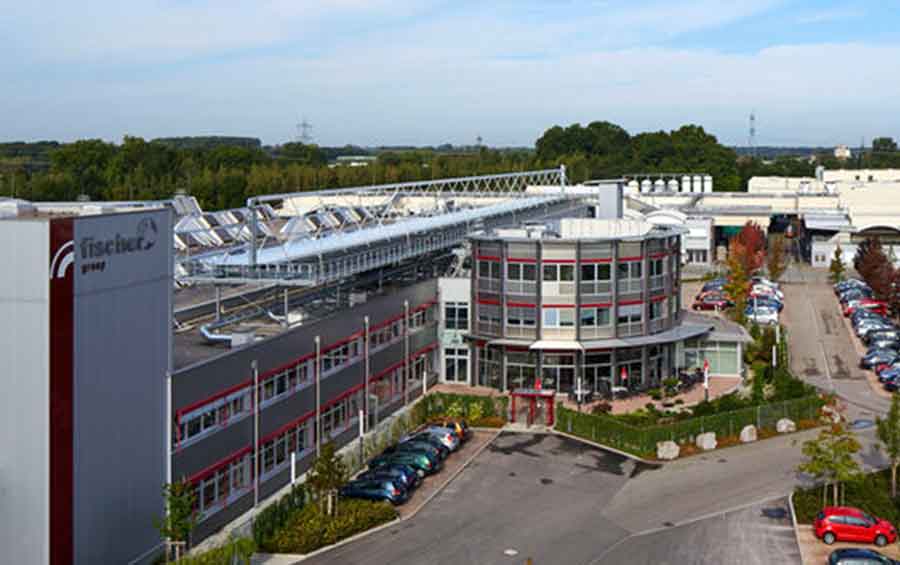
Photo Credit: fischer Group
German fastening systems manufacturer fischer Group has expanded its India footprint with the launch of a new installation solution—the FUS-C Channel—alongside the inauguration of a manufacturing facility in Bengaluru, signalling a sharper shift toward localisation in one of its fastest-growing markets.
The move reflects a broader trend among German industrial firms to align global engineering standards with India’s scale-driven infrastructure demand under the ‘Make in India’ framework.
Localisation push anchors India–Germany industrial ties
With the new plant, fischer India aims to reduce lead times and strengthen supply chain responsiveness for domestic projects. The company said the facility would enable it to better serve India’s rapidly expanding construction and infrastructure sectors.
Mayank Kalra, Managing Director of fischer India, said: “This new facility is a significant step forward in our journey towards building a stronger, more agile fischer India.”
He added: “By enhancing our local manufacturing capabilities, we are not only improving speed and efficiency but also reinforcing our commitment to ‘Make in India’ for India with German quality standards.”
Kalra further noted: “This investment reflects our long-term vision of being closer to our customers, supporting their evolving needs, and driving sustainable growth.”
While such localisation strategies are increasingly common, they also reflect a structural shift in India–Germany industrial cooperation—where German firms are moving beyond exports to embed manufacturing within India.
Product upgrade targets evolving construction needs
The newly launched FUS-C Channel is positioned as an upgrade to traditional U-channel systems used in installation frameworks across industrial and commercial projects.
According to the company, the system features:
- Standardised geometry aligned with international specifications
- Enhanced angular design for improved structural performance
- Higher load-bearing capacity through deeper serrations
- Multiple size variants for broader application
It also incorporates Zinc-Magnesium coating technology, which the company says offers improved corrosion resistance and durability compared to conventional galvanisation, while supporting longer lifecycle performance.
Infrastructure growth driving demand for advanced systems
The launch comes amid sustained momentum in India’s infrastructure build-out—spanning urban development, energy, transport, and industrial corridors—where demand for durable, modular installation systems is rising.
Industry trends suggest that global manufacturers are increasingly tailoring products for India’s cost-sensitive yet scale-intensive market, balancing performance with localisation.
In this context, fischer’s dual approach—introducing globally standardised products while expanding domestic manufacturing—illustrates how German engineering firms are recalibrating their India strategies.
Beyond exports: German firms deepen manufacturing presence
Germany’s Mittelstand companies, known for specialised engineering, have historically relied on exports. However, India’s policy push for local value addition and supply chain resilience is prompting a shift toward in-country production.
fischer’s latest investment aligns with this trajectory, positioning India not just as a market, but as a manufacturing base integrated into global operations.
The larger India–Germany play
As India scales up its infrastructure ambitions, partnerships with German engineering firms are expected to play a growing role in bringing advanced technologies into local ecosystems.
For companies like fischer, the challenge will be to maintain global quality benchmarks while adapting to India’s price sensitivities and project timelines—an equation that increasingly defines the next phase of India–Germany industrial collaboration.